Basic
Loss and Damage
This section explains loss and damage in the context of climate change and introduces global efforts to avert, minimize, and address related impacts.
In scientific assessments, losses and damages generally refer to the adverse impacts of climate change. In the UNFCCC negotiation context, Loss and Damage often refers to the policy agenda, institutional arrangements, and support mechanisms for addressing such impacts. This site distinguishes between these terms according to context.
What is Loss and Damage?
The Intergovernmental Panel on Climate Change (IPCC) Sixth Assessment Report (AR6) states that human-induced climate change has caused “widespread adverse impacts and related losses and damages to nature and people.”
Loss and damage refers to the impacts of climate change that occur despite mitigation and adaptation efforts. While mitigation addresses the causes of climate change, such as reducing greenhouse gas emissions, adaptation addresses its impacts, such as building levees to reduce flood risks. Loss and damage includes residual and unavoidable impacts, and in some cases irreversible losses. (See Greenhouse Gas Emissions and Mitigation Measures and Perspectives on Climate Change Adaptation.)
Source: About Loss and damage, UNEP
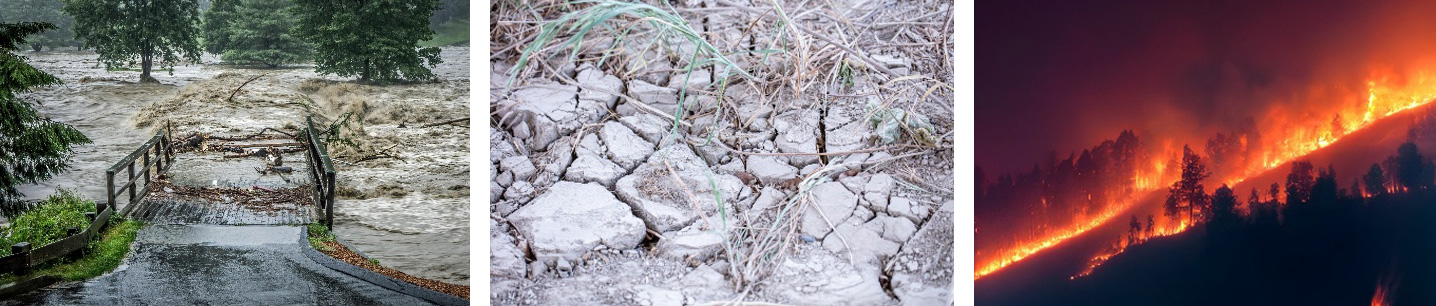
Under the United Nations Framework Convention on Climate Change (UNFCCC), addressing Loss and Damage is a critical pillar of global climate action. Losses and damages arise from both extreme weather events, such as floods, droughts, heatwaves, and tropical cyclones, and slow onset events, which develop gradually over time. Slow onset events include increasing temperatures, desertification, biodiversity loss, land and forest degradation, glacial retreat, sea level rise, ocean acidification, and salinization.
These adverse climate impacts are broadly categorized into two dimensions:
- Economic losses refer to quantifiable losses of property, assets, infrastructure, agricultural production, and revenue resulting from the adverse effects of climate change.
- Non-economic losses (NELs) refer to impacts that are difficult to quantify in monetary terms, including loss of life, health, mobility, territory, cultural heritage, indigenous knowledge, biodiversity, and ecosystem services.
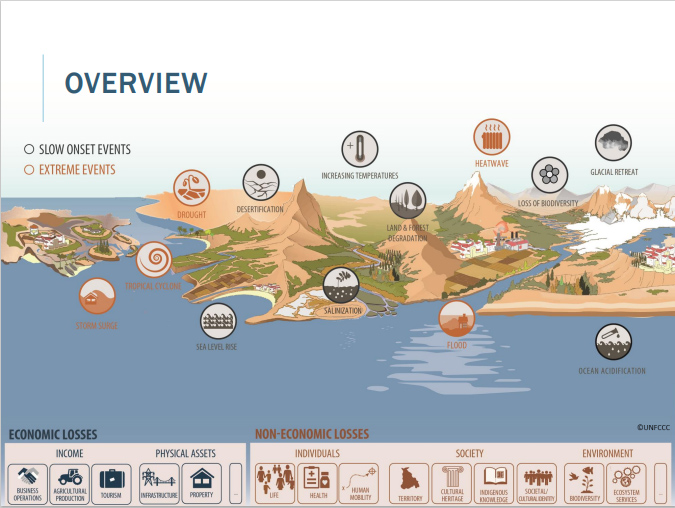
Source: LOSS AND DAMAGE ONLINE GUIDE – UNFCCC (PDF)
Overview of the International Framework
Under the UNFCCC, the framework for addressing Loss and Damage has evolved significantly over time.
A major step forward came in 2013 (COP19) with the establishment of the Warsaw International Mechanism for Loss and Damage (WIM). As the main vehicle under the UNFCCC process, WIM promotes approaches to address climate change impacts in particularly vulnerable developing countries in a comprehensive, integrated and coherent manner, by enhancing knowledge, strengthening stakeholder dialogue, and scaling up action and support.
This momentum was reinforced in 2015 (COP21), when Article 8 of the Paris Agreement formally anchored Loss and Damage, strengthening global cooperation, action, and support.
Further progress was made in 2019 (COP25) with the establishment of the Santiago Network for Loss and Damage, which aims to catalyze technical assistance from relevant organizations, bodies, and experts for vulnerable developing countries.
At COP27 in 2022, Parties agreed to establish a dedicated Fund for responding to Loss and Damage. At COP28 in 2023, the Fund was operationalized under the UNFCCC and the Paris Agreement. More recently, the Fund has developed initial funding arrangements, including the Barbados Implementation Modalities (BIM), to support country-led responses in vulnerable developing countries. BIM provides grants for country-led approaches, aiming to test and refine operations while long-term policies are developed. (See Global frameworks.)
Challenges in Addressing Loss and Damage
Addressing Loss and Damage remains a key priority under the UNFCCC. Major challenges include mobilizing finance, enhancing technical assistance through the Santiago Network, addressing slow onset events, and responding to non-economic losses.
Another challenge is improving data, risk assessment, and early warning systems to better understand and manage climate-related losses and damages.
Building long-term resilience will require comprehensive risk management approaches, including risk reduction, preparedness, recovery, and adaptation planning.
Source: Approaches to address Loss and Damage associated with Climate Change impacts in developing countries, UNFCCC
LOSS AND DAMAGE ONLINE GUIDE – UNFCCC (PDF)
Japan’s Initiatives on Loss and Damage
In 2022, aligning with the goals of the UNFCCC and the Sendai Framework for Disaster Risk Reduction, the Government of Japan announced the Assistance Package by the Government of Japan for Averting, Minimizing and Addressing Loss and Damage. Japan provides a wide range of support, from disaster preparedness to post-disaster recovery, guided by the “Build Back Better” principle. Key initiatives include:
- Knowledge Sharing: Japan supports climate risk-informed decision-making by providing scientific tools, adaptation planning information, and capacity-building resources through the Asia-Pacific Climate Change Adaptation Information Platform (AP-PLAT). Japan also shares Earth observation and climate projection data through the Data Integration and Analysis System (DIAS), supporting human resource development for disaster risk assessment using satellite and climate data.
- Development of Early Warning Systems (EWS): In support of the UN “Early Warnings for All” initiative, Japan promotes the development of EWS through public–private partnerships. For example, Japanese companies are installing high-frequency observation radars and delivering climate information services across the Asia-Pacific region.
- Capacity Building for Disaster Risk Reduction: Japan contributes to human resource development through the Asian Disaster Reduction Center (ADRC) and provides technical assistance to National Meteorological and Hydrological Services.
- Disaster Risk Insurance and Relief: Recognizing the need for rapid financial liquidity, Japan contributes to sovereign disaster risk insurance facilities, including the Southeast Asia Disaster Risk Insurance Facility (SEADRIF) and the Pacific Catastrophe Risk Assessment and Financing Initiative (PCRAFI). In addition, Japan provides Post-Disaster Stand-by Loans to highly vulnerable developing countries, enabling the rapid disbursement of funds following catastrophic events.
Source: Assistance Package by the Government of Japan for Averting, Minimizing and Addressing Loss and Damage, MOE, Japan (PDF)
WMO and the Early Warnings for All Initiative (PDF)