Causes of climate change
This section explains the mechanisms by which greenhouse gases drive climate change and explores topics such as irreversible climate change.
How Greenhouse Gases Cause Climate Change
All molecules are able to absorb and emit electromagnetic radiation of specific wavelengths depending on their type. Greenhouse gas molecules absorb some of the heat (infrared radiation) emitted from the Earth’s surface, trapping warmth in the atmosphere.
The strength of this greenhouse effect varies depending on the type of greenhouse gas and is expressed as Global Warming Potential (GWP). Because carbon dioxide (CO2) is the most common greenhouse gas, its GWP has been set as the baseline value of 1. In other words, GWP indicates how many times more or less potent a gas is than CO2 at warming the atmosphere.
Focusing just on the GWPs listed in the table, the greenhouse effect of CO2 seems small, but the consumption of fossil fuels results in vast amounts of CO2 emissions.
Methane (CH4) is also a significant greenhouse gas, accounting for almost one-fifth of global emissions in terms of greenhouse effect. CH4 is released from various sources, including the belching of livestock like cattle and sheep, rice paddies, waste disposal landfills, wastewater treatment plants, and natural gas production. Measures are being pursued to reduce CH4 emissions in many of these fields, including improvements in livestock farming and waste disposal technologies.
Water vapor is also a greenhouse gas that influences average global temperature, but because its concentration is not significantly increased by human activity, it is not a target for reduction in global climate change mitigation initiatives.
Water vapor (H2O), carbon dioxide (CO2), nitrous oxide (N2O), methane (CH4), and ozone (O3) are the primary greenhouse gases (GHGs) occurring in the Earth’s atmosphere.
Moreover, multiple GHGs, such as halocarbons and other chlorine- and bromine-containing substances, which originate only from anthropogenic sources, are addressed under the Montreal Protocol. In addition to CO2, N2O, and CH4, the Kyoto Protocol addresses the occurrence of sulfur hexafluoride (SF6), hydrofluorocarbons (HFCs), and perfluorocarbons (PFCs).
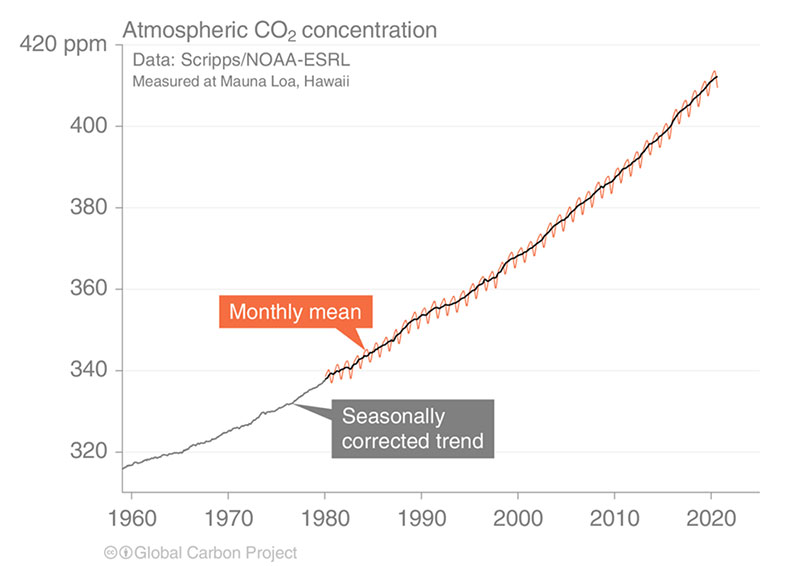
Data from: NOAA-ESRL after 1980; the Scripps Institution of Oceanography before 1980 (harmonised to recent data by adding 0.542ppm)
Source: NOAA-ESRL; Scripps Institution of Oceanography; Friedlingstein et al 2020; Global Carbon Budget 2020
(You can check the satellite-based global observation data from the following website: https://data2.gosat.nies.go.jp/gallery/L4B/concmov/concmov.html)
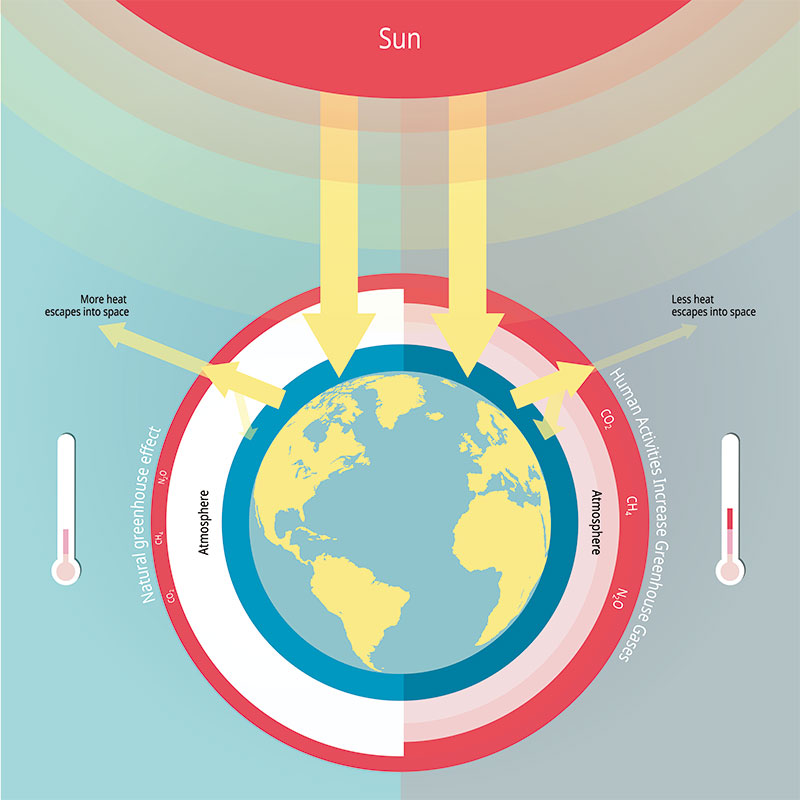
The solar energy absorbed by the Earth’s surface is emitted as thermal radiation from the land and ocean. Later, most thermal radiation is absorbed by the atmosphere, including clouds, and radiated back to the Earth. This is called the greenhouse effect. Without the natural greenhouse effect, the average temperature at the Earth’s surface would be below the freezing point of water. Thus, this effect facilitates the survival of organisms. However, anthropogenic activities, primarily the burning of fossil fuels and clearing of forests, have considerably intensified the natural greenhouse effect, consequently, causing global warming (IPCC, 2007).
We have focused up to now on how greenhouse gas emissions drive climate change, but throughout Earth’s history, cyclical changes in the planet’s axial tilt and orbit around the sun (known as Milankovitch cycles) have also caused repeated climate changes due to variations in solar radiation. However, compared to the most recent temperature increase from this natural mechanism (about 21,000 years ago), present-day anthropogenic global warming is occurring ten times faster. In addition to the rise in temperature itself, the problem is that its rapid pace exceeds the capacity of our essential infrastructure and natural ecosystems to adapt.
Why Climate Change Cannot Be Stopped Immediately
Even if greenhouse gas emissions could be instantly reduced to zero, temperatures would not stop rising from that moment. Some of the CO2 and other greenhouse gases released into the atmosphere are subsequently removed through chemical reactions in the atmosphere or absorption by vegetation, soils and oceans, but some also remain in the atmosphere for a long time. Today’s climate change is being driven by the greenhouse gases that are not removed and have accumulated in the atmosphere. As such, even if we could instantly end all greenhouse gas emissions, accumulated past emissions lingering in the atmosphere would prevent the rapid halt of climate change.
Other Causes of Global Warming
Any increase in the concentration of greenhouse gases in the atmosphere will drive up average temperatures, but various other factors can also influence climate change, either accelerating or reversing it.
For example, sea ice and glaciers reflect much of the sun’s radiation, so when they melt in the Arctic, the Antarctic, and elsewhere due to rising temperatures, they expose darker land or ocean surfaces that absorb more solar radiation, leading to further warming. This in turn causes more ice to melt, exposing more dark surfaces, and leading to even higher temperatures in a cyclical process that reinforces warming. The mechanism is called a “positive feedback loop” because it works in the direction of rising temperatures. This particular loop is called the “ice-albedo feedback loop,” with “albedo” being the term used to describe the ability of a surface to reflect sunlight.
Similarly, as mentioned earlier, water vapor is a greenhouse gas, and when the average temperature rises, evaporation from oceans and land increases, raising the amount of water vapor in the atmosphere. Since water vapor traps heat, this leads to further temperature increases and even more evaporation, creating another positive feedback loop.
There are, however, also negative feedback loops that work to counteract warming. For example, increased water vapor from higher temperatures can lead to more cloud formation. Clouds have two opposing effects: they reflect solar energy back into space, thereby cooling the Earth, but they also absorb and re-radiate heat from the Earth’s surface, thereby raising temperatures. Overall, clouds can sometimes have a net cooling effect. Also, when temperatures drop, heat radiation from the Earth’s surface decreases. This too is a negative feedback loop that can help to lower temperatures.
As you can see, various mechanisms are at work that can either speed up or, conversely, slow down global warming.
Irreversible Climate Change
Climate change impacts such as the rise in average temperatures tend to unfold gradually, but experts warn that we could reach “tipping points” beyond which large-scale, irreversible changes occur. Events that could bring about major changes on a global scale when tipping points are reached are known as “tipping elements.” The following are some examples of tipping elements thought to be approaching tipping points.
- Destabilization of the Greenland ice sheet
- The Greenland ice sheet has been clearly losing mass in recent years. Because ice sheets reflect solar radiation, it is predicted that beyond a certain point, the ice-albedo feedback loop will come into play, increasingly accelerating melting.
- Slowdown of ocean thermohaline circulation
- Deep ocean circulation (global ocean conveyor belt) is driven by density differences caused by variations in seawater temperature and salinity, and it takes about 1,000 years to complete a global cycle. Experts have predicted that climate change will cause this cycle to slow down, resulting in disruption of warm currents and concomitant colder temperatures in some parts of the world.
- Thawing of permafrost
- Permafrost is composed largely of frozen organic matter. When rising temperatures cause the permafrost to thaw, this organic matter starts to decompose, releasing large amounts of greenhouse gases (CH4 and CO2) into the atmosphere and further exacerbating climate change as a result.
These changes do not occur in isolation; rather, they are intricately interconnected and will impact our lives and ecosystems in various ways.
While we do not yet have a clear idea of the temperatures at which these tipping elements will be triggered, it is crucial that we minimize the risk of crossing temperature tipping points by doing our utmost to reduce greenhouse gas emissions (mitigation) while also preparing for likely impacts (adaptation).