Industrial and economic activities
Climate change is expected to impact various industrial and economic sectors. What specific effects will it produce?
This section outlines the impacts that have already occurred on Japan's industrial and economic activities and those that may arise in the future.
Impact on Industrial and Economic Activities due to Reduced Snowfall and Increased Natural Disasters
Significant effects of climate change on tourist activities that rely on natural resources
Tourism that depends on natural resources such as forests, snow-covered mountains, and beaches is likely to face major effects from climate change. For instance, reports indicate that warmer winters are causing insufficient snowfall at ski resorts.
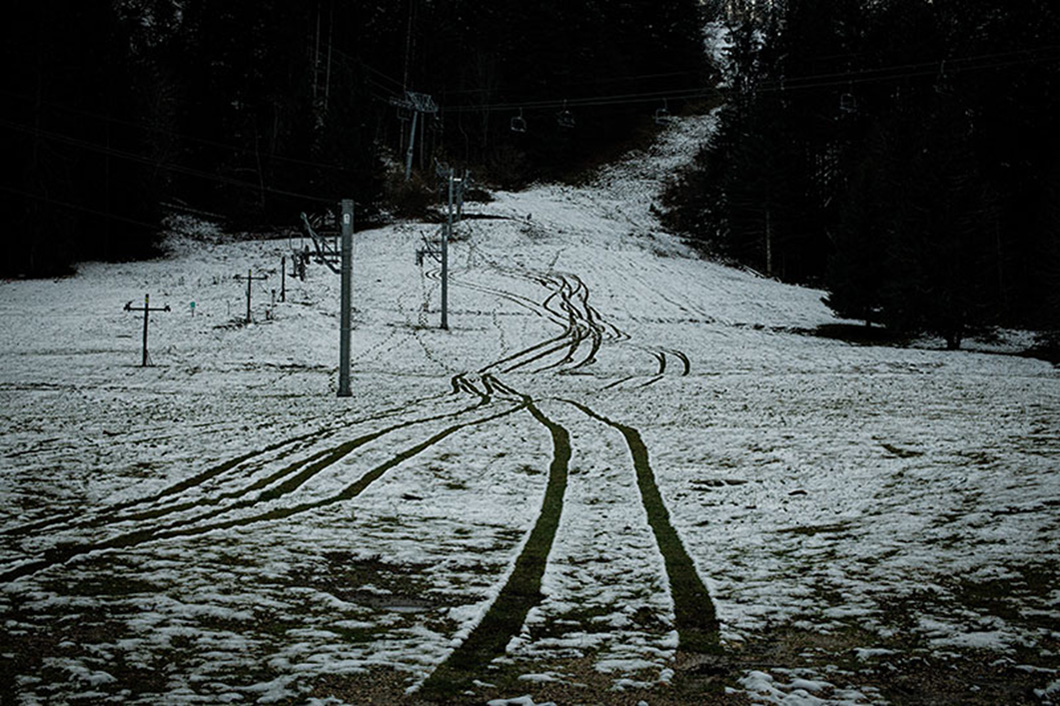
Ski Resorts with Insufficient Snow
Snowfall has declined in recent years across the country, and ski resorts in Toyama Prefecture have observed a correlation between lower snowfall and reduced holiday visitor numbers.
In the future, most ski resorts are expected to experience decreased snow depth, which will likely reduce visitor numbers and operating profits.
Significant effects of climate change-induced natural disasters on the financial and insurance industries
In Japan and globally, insurance losses (excluding liability and life insurance claims) from natural disasters are on the rise. From 1992 to 2018, insurance losses increased by 4.7%. For example, the November 2018 California wildfires caused the largest insurance loss globally that year, totaling US$12 billion. In the same year, Typhoon Jebi in Japan generated the second-largest insurance loss at US$10 billion, marking the highest amount of insurance payouts for wind and flood damage in Japan to date.
Typhoon Jebi remains vivid in memory because of the extensive damage caused in the Kansai region, with fierce winds, record storm surges, a tanker collision with the Kansai International Airport connecting bridge, and flooded runways.
In the future, more frequent natural disasters are predicted, along with rising insurance losses and reinsurance premiums (payments made by insurance companies to other insurers to cover part or all their obligations). Furthermore, total economic losses, including insured and uninsured damages, are also expected to increase.
Climate change impacts extend beyond the tourism and finance/insurance sectors
In manufacturing, floods in 2017 caused JPY 13.1 billion in damages, highlighting the growing risk of floods caused by increases in heavy rainfall.
In the commercial sector, rapid temperature shifts and heavy rainfall are increasing the difficulty of predicting the supply and demand for seasonal products. Additionally, heavy rains and typhoons have caused sales fluctuations and temporary closures in department stores and supermarkets.
Small- and medium-sized enterprises have suffered a wide range of impacts from recent large-scale natural disasters, including damage to factories and offices, difficulties in commuting for employees, operational shutdowns due to infrastructure disruptions, decreased sales from affected customers and suppliers, and disruptions to the raw material supply from damaged trading partners. Some businesses have reported economic losses so severe that they were forced to cease operations.
In the future, the impacts of climate change are expected to increase in manufacturing and commerce, with concerns over greater physical damage from floods and more extensive economic losses from temporary closures.
This section describes the mechanisms by which climate change affects Japan's industrial and economic activities, the impacts observed to date, and potential future impacts.
Mechanisms Underlying the Impact of Climate Change on the Industrial and Economic Activities Sector
The mechanisms through which climate change influences the industrial and economic activities sector are illustrated in the figure below.
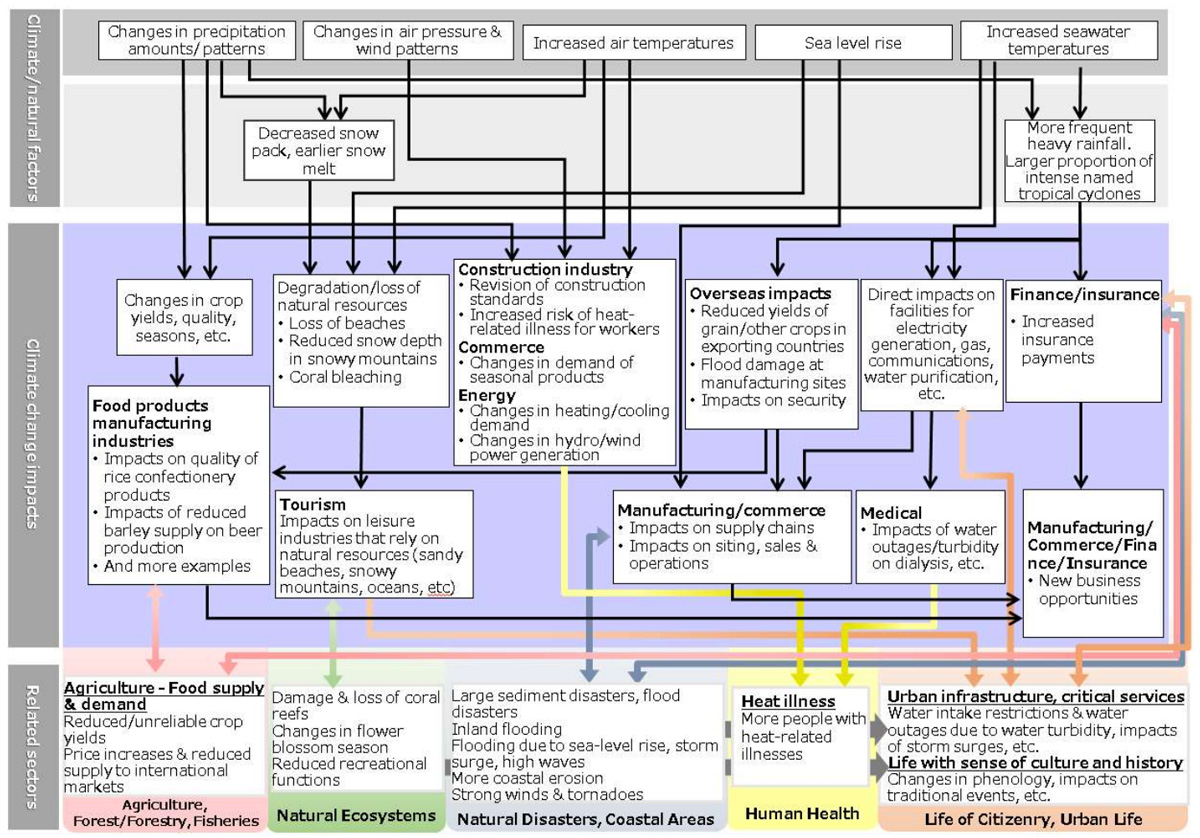
Schematic of projected impacts of climate change
Assessment Report on Climate Change Impacts in Japan, Figure 3-10., December 2020, Ministry of the Environment, Japan
Climate change can alter temperatures, change the frequency and severity of natural disasters, and potentially affect corporate operations, including overseas supply chains. However, industrial and economic activities are diverse, and the mechanisms by which climate change affects manufacturing, commerce, healthcare, and international relations are not fully understood. Furthermore, studies in Europe and the United States suggest that climate change may affect national security; however, research on this topic in Japan remains limited.
Current Impacts and Future Projections of Industrial and Economic Activities
Significant effects of climate change on tourist activities that rely on natural resources
Climate change can strongly impact tourist activities that rely on natural resources (forests, snow-covered mountains, beaches, tidal flats, etc.) because of the associated increases in temperature, alterations in rainfall and snowfall patterns, and rises in sea level, with these changes potentially reducing or limiting the usable areas and changing the periods suitable for tourism activities.
For instance, reports have highlighted the effects of insufficient snowfall caused by mild winters on ski resorts. A study analyzing meteorological and social factors affecting visitor numbers at ski resorts in Nagano Prefecture from 2007 to 2016 suggested that although social factors were the primary cause of the decline in visitors during that period, continued warming resulting in higher temperatures and reduced snow depth would further decrease visitor numbers.
In the future, the impact on the tourism sector is expected to become even more pronounced. For skiing, snow depth is predicted to decline significantly at most resorts, which is likely to cause a substantial drop in visitor numbers and operating profits. Ski resorts in Hokkaido are also expected to experience reduced snow depth, and climate projections indicate that periods with snow cover exceeding 30 cm may be shortened by approximately one month.
Significant effects of climate change-induced natural disasters on the financial and insurance industries
The growing frequency and intensity of natural disasters caused by extreme weather events linked to climate change can strongly affect the financial and insurance industries by increasing insurance losses and subsequent insurance payouts.
Recent wind and flood events have increased insurance losses, which reached JPY 1 trillion in the case of Typhoon Jebi in 2018. Moreover, a review of major wind and flood disasters revealed that seven of the top ten insurance loss events have occurred since 2014.
In the future, further increases in natural disasters are expected, along with higher insurance losses, payouts, and reinsurance premiums. The higher temperatures, rising sea levels, stronger typhoons, and heavier rainfall caused by climate change all contribute to greater weather-related disaster risks. According to "Climate Change in Japan 2025," if the global average temperature rises by 4 °C, sea levels along Japan's coast could increase by approximately 0.68 m, annual maximum daily rainfall could rise by approximately 27%, rainfall exceeding 50 mm per hour may occur approximately three times as often, and typhoons near Japan will likely intensify.
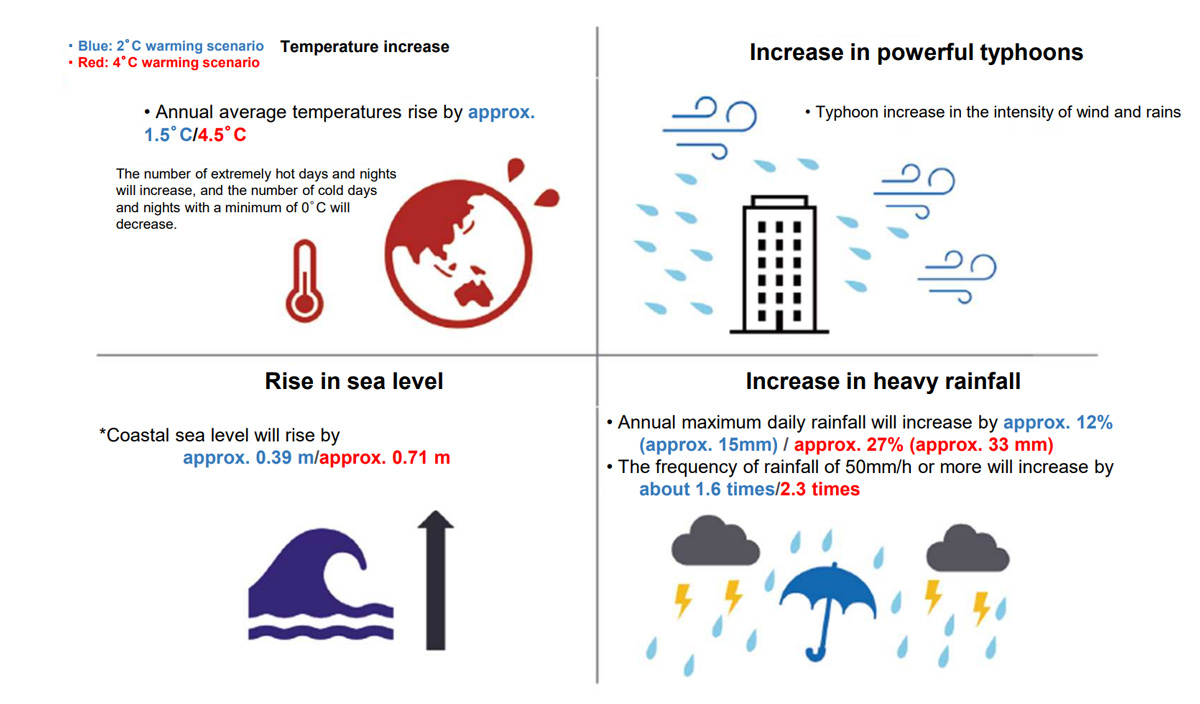
Prediction of the impact of climate change
Summary of the White Paper on Land, Infrastructure, Transport and Tourism in Japan, 2022, Ministry of Land, Infrastructure, Transport and Tourism, Japan, based on materials from MEXT and JMA
Significant effects of climate change-induced natural disasters on the construction industry
Higher temperatures are expected to affect building materials and structural integrity. For example, the period for hot weather concreting (construction that occurs when average daily temperatures exceed 25 °C, with materials, mix design, and pouring measures designed to prevent the deterioration of concrete quality) is becoming longer, particularly in southwestern Japan, due to rising summer temperatures.
In addition, the increased frequency and intensity of extreme weather events due to climate change may influence building design and performance standards. The Architectural Institute of Japan and other organizations are considering reviews of design conditions, standards, and guidelines for wind and snow loads, air conditioning loads, and flood countermeasures. The Ministry of Land, Infrastructure, Transport, and Tourism has established committees such as the "Study Group on Measures against Strong Winds for Buildings Based on the Reiwa 1 (2019) Chiba Prefecture Typhoon" and the "Study Group on the Ideal Approach to Flood Countermeasures for Electrical Equipment in Buildings" to investigate the best methods of preparing for future weather-related disasters.
Direct damage to construction sites and related locations is also anticipated. From 2015 to 2019, the construction industry reported the highest numbers of workplace heatstroke deaths and injuries, surpassing the manufacturing and transportation sectors.
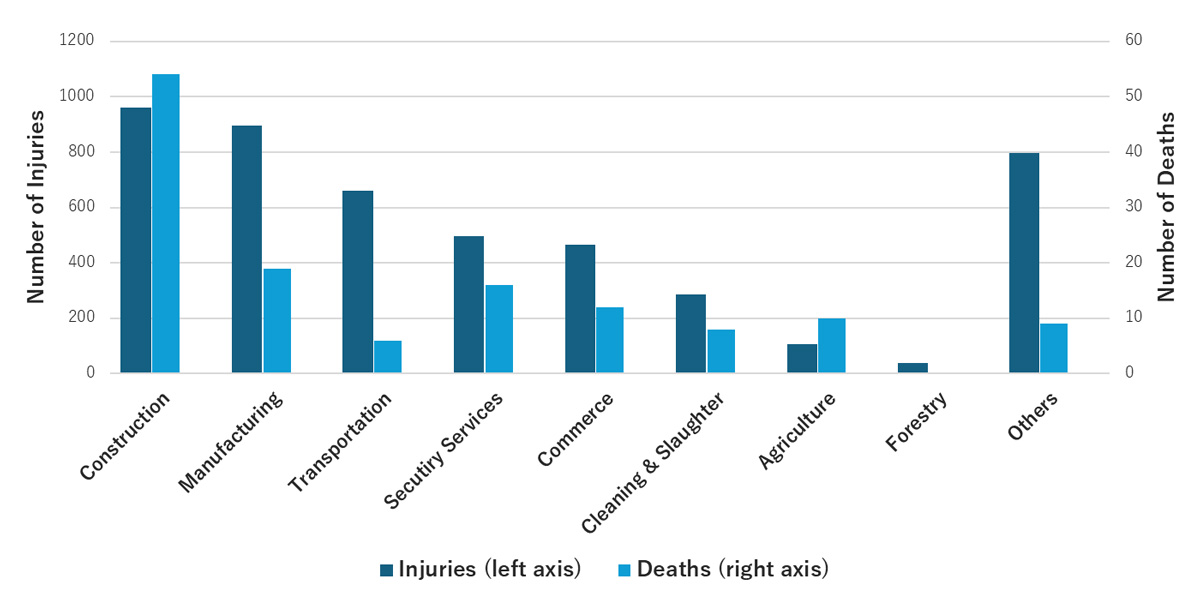
Number of Heatstroke Deaths and Injuries by Industry (Total 2020-2024)
Source: Created by CCCA based on data from the Ministry of Health, Labour and Welfare, Japan
A study examining the effects of future climate change on the delamination strength of particleboard (using the RCP2.5, RCP4.6, and RCP8.5 scenarios based on MIROC5 predictions for 2031-2050) indicates that the outdoor use of particleboard under rising temperatures may increase adhesive bond failures and biological degradation, thereby reducing delamination strength. Such changes are expected to limit the outdoor use of particleboard and impact the construction industry.
Climate change also affects the manufacturing and commerce sectors
Climate change is causing diverse impacts across manufacturing and commerce. In manufacturing, concerns exist over natural disaster-induced damage to production facilities, particularly in small- and medium-sized enterprises. These impacts include factory and office damage, commuting difficulties, operational shutdowns from infrastructure disruptions, decreased sales due to affected customers and outlets, and disruptions to raw material supply chains from damaged suppliers. Some businesses have been forced to close due to these economic losses.
Further increases in flood-related physical damage and economic losses from temporary closures are expected in the future. For instance, simulations of future climate change scenarios indicate that a typhoon equal in strength to Typhoon Jebi (2018), which caused substantial damage to businesses, could approach Japan with even greater force and lower central pressure. This implies that future damages could exceed those experienced during Typhoon Jebi.
In commerce, the relationship between temperature and product sales has been analyzed. Rising average temperatures are expected to boost cold beverage sales, although trends vary by the beverage type. Sales of sports drinks increase sharply when average temperatures exceed 22 °C, while sales of mineral water show a similar trend, with a sharp rise around 25 °C. On the other hand, sales of hot coffee increase when the temperature falls below 22 °C, but once the temperature exceeds this level, sales drop to almost zero.
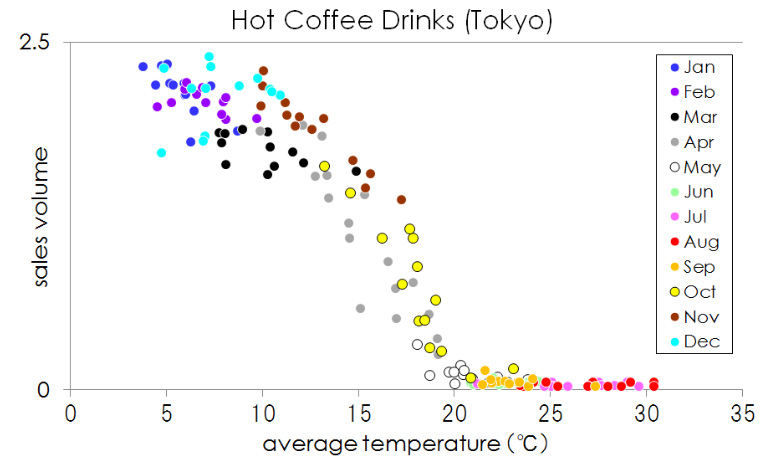
Average temperatures (April 2014-March 2017) (horizontal axis) and outdoor vending machine hot-coffee sales (vertical axis) in Tokyo. Months are represented in different colors.
Survey on climate risk management for vending machine drink sales, Japan Meteorological Agency, Japan
Sales of air conditioners have also been examined. In Tokyo, sales peak after June, when the average temperature exceeds 20 °C. A strong correlation is observed in July, where sales rise approximately 1.5 times when the average temperature is 2 °C above the monthly average. This is likely because consumers' willingness to purchase increases in July when temperatures are warmer than usual but before extreme heat conditions set in. In August, the correlation remains strong, but the peak in sales is less pronounced. This is thought to be because much of the demand had already been met in July, reducing the need for additional purchases in August.
In commerce, rapid temperature changes and increased heavy rainfall are increasing the difficulty of predicting the demand for seasonal products, while heavy rain and typhoons are causing sales fluctuations and temporary closures of department stores and supermarkets. These effects are expected to expand as climate change progresses. Seasonal products experience concentrated demand during specific periods, meaning that they do not sell well in the off-season, and unsold items at the end of the season result in losses. As weather variability increases, efforts are being made to predict short-term weather changes and forecast product demand. Improving prediction accuracy, particularly toward the end of the season, is considered essential.