What Is Climate Change?
Climate Change Impacts and Adaptation
CLIMATE CHANGE ADAPTATION: CONCEPTS and IMPORTANCE
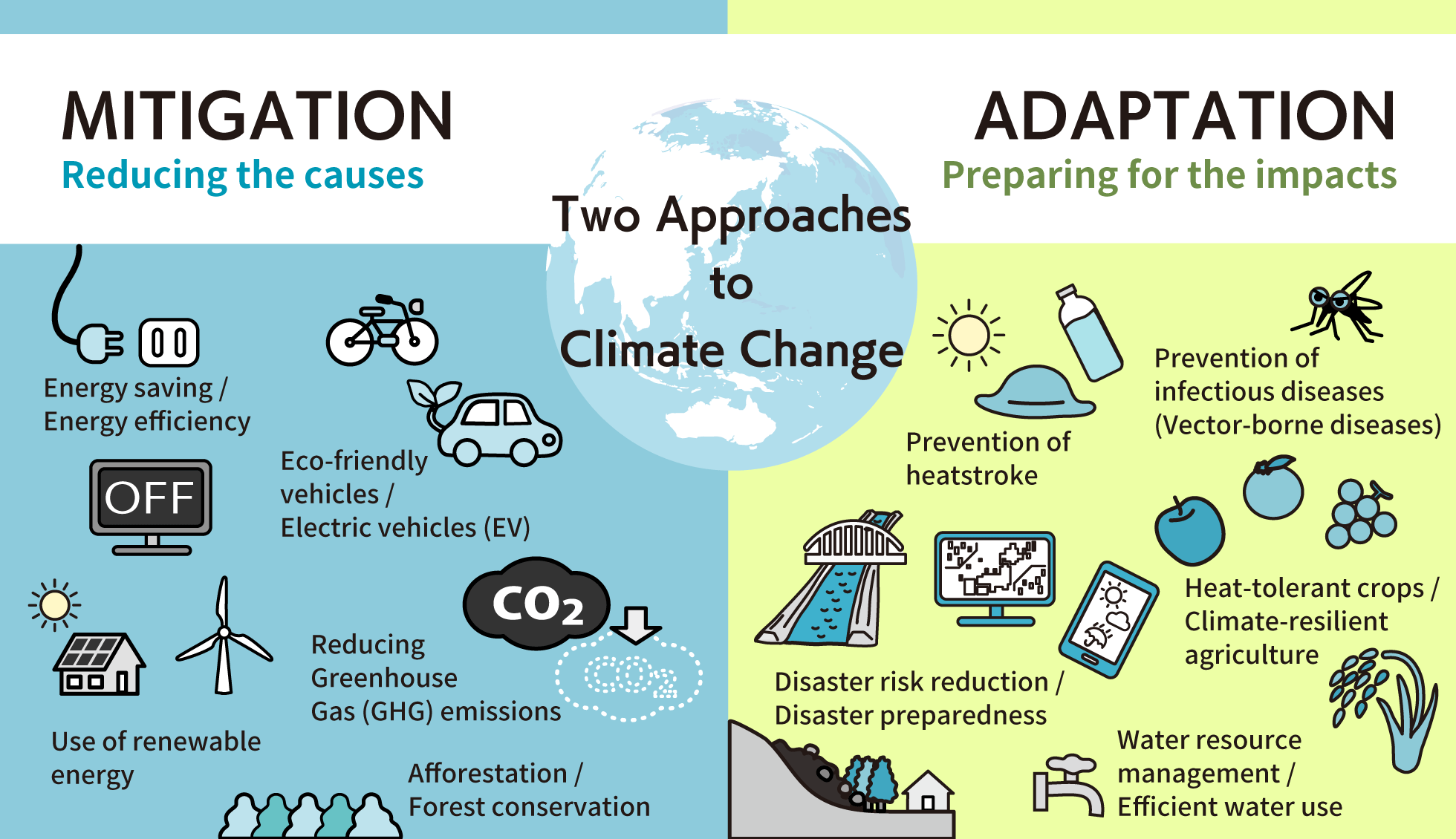
Climate change responses are commonly framed around two complementary pillars: mitigation and adaptation.
Mitigation refers to efforts to reduce greenhouse gas emissions—the main drivers of global warming—or to enhance their removal from the atmosphere through measures such as afforestation and other carbon sinks.
Adaptation, on the other hand, involves adjusting natural ecosystems and socio-economic systems in response to actual or expected climate change in order to reduce harmful impacts, while also taking advantage of potential beneficial effects.
According to the IPCC, adaptation is defined as:
“In human systems, the process of adjustment to actual or expected climate and its effects, in order to moderate harm or exploit beneficial opportunities. In natural systems, the process of adjustment to actual climate and its effects; human intervention may facilitate adjustment to expected climate and its effects.”
Source: IPCC AR6 WG1 Glossary (2021), Adaptation.
Thus, adaptation includes not only actions to reduce the adverse impacts of climate change, but also approaches that make effective use of opportunities that may arise under changing climatic conditions.
WHY IS ADAPTATION NEEDED?
Mitigation is the most essential and important measure for limiting climate change.
According to the IPCC Sixth Assessment Report (AR6) Working Group I, global mean temperature is projected to continue rising at least until the middle of this century. Unless carbon dioxide and other greenhouse gas emissions are substantially reduced in the coming decades, global warming is expected to exceed 1.5 °C and 2 °C above pre-industrial levels during the 21st century.
Because mitigation measures take time to produce noticeable effects, efforts toward deep emission reductions must begin immediately and be strengthened and sustained over the long term. However, even with the maximum possible mitigation efforts, some degree of climate change is unavoidable due to the accumulation of greenhouse gases already emitted into the atmosphere.
Extreme weather events that break observational records are already having major impacts on our lives. In recent years, heavy rainfall has caused severe flooding, and extreme heat has led to fatalities in some cases. Climate change is expected to increase the frequency and severity of such extreme events in the future. For this reason, adaptation, which aims to minimize adverse impacts under a changing climate, is indispensable.
At the same time, adaptation can also involve taking advantage of potential beneficial opportunities associated with climate change. For example, in agriculture, rising temperatures may make it possible to grow crops in regions where cultivation was previously difficult, or to shift toward higher-value crop varieties. Recognizing and making use of such positive effects is also an important perspective in adaptation efforts.
EFFORTS TOWARD ADAPTATION
In response to the increasing severity of climate change impacts, the international community has strengthened its efforts on adaptation. Under the Paris Agreement adopted in 2015, countries agreed to a shared long-term goal of holding the increase in global average temperature to well below 2 °C above pre-industrial levels, while pursuing efforts to limit warming to 1.5 °C.
In September of the same year, the United Nations adopted the declaration “Transforming our world: the 2030 Agenda for Sustainable Development,” which aims to build a society in which no one is left behind. Within this framework, Sustainable Development Goal (SDG) 13 calls for urgent action to combat climate change and its impacts. SDG 13 also includes more specific targets, such as Target 13.1, which seeks to strengthen resilience and adaptive capacity to climate-related hazards and natural disasters.
Unlike mitigation, which has a clear global objective of limiting warming to 1.5 °C through the reduction of greenhouse gas emissions, adaptation does not have a single universal target shared by all countries. This is because the impacts of climate change manifest in diverse ways depending on regional geographic, economic, and social conditions, and therefore the measures required for adaptation differ across countries and contexts.
REFERENCE (Japan)
In Japan, the Climate Change Adaptation Act was enacted in 2018 with the aim of avoiding and reducing climate change impacts nationwide. The Act incorporates provisions that encourage each region to implement adaptation measures tailored to its local natural and socio-economic conditions.
