Perspectives on Climate Change Adaptation
Adaptation can be understood from several perspectives, including "Limits to Adaptation", "Maladaptation", "Adaptation that Uses Climate Change Impacts", "Ecosystem-based Adaptation" and "Nature-based Solutions", and the relationship between the "Adaptation and SDGs."
Limits to adaptation
Climate change is already underway, and its impacts are being observed, making adaptation necessary.
Adaptation measures can reduce climate change impacts, but if we fail to curb greenhouse gas emissions (mitigation) and climate change progresses further, reducing impacts sufficiently may become technically or economically unfeasible. This is called “limits to adaptation.”
The IPCC, the global body of climate scientists, has reported that if average temperature rise exceeds 1.5 °C above 1850-1900 levels, impacts will increase in severity to a point where many human and natural systems will reach their limits to adaptation.
As such, adaptation needs to be pursued alongside mitigation.
Maladaptation
Many adaptation measures are already being implemented around the world, but unfortunately, cases of maladaptation (i.e., unsuitable adaptation, also known as “adaptation failure”) are on the rise. Maladaptation refers to measures that inadvertently increase the risk of adverse climate change impacts, raise vulnerability, or have a detrimental effect on welfare. Such measures may lack flexibility in the face of change, be excessively costly, lead to increased greenhouse gas emissions, or exacerbate existing inequalities. Avoiding maladaptation requires careful consideration of measures from a long-term perspective, and selection and implementation of measures that are suited to local circumstances and, where possible, have co-benefits for multiple sectors. Measures that can be quickly implemented may not be the wisest choice; cost-effectiveness and lead times are among the other factors that should be considered when selecting the most appropriate measures.
Harnessing Beneficial Opportunities from Climate Change
In addition to adaptation measures to reduce the adverse impacts of climate change, measures that make use of beneficial climate change impacts can also count as adaptation.
For example, initiatives are underway to cultivate tropical fruits such as mangoes and blood oranges in regions where they were not previously grown due to cooler climates, as well as to expand the range of grape varieties suitable for wine production and increase their cultivation.
Ecosystem-based adaptation and nature-based solutions
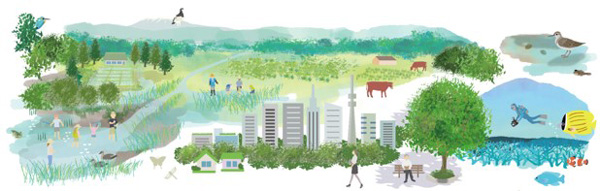
Adaptation measures that make use of ecosystems are attracting increasing attention. Known as ecosystem-based adaptation (EbA), ecosystem-based disaster risk reduction (Eco-DRR), or nature-based solutions (NbS), such initiatives make use of nature and ecosystems (green infrastructure) or provide co-benefits.
One such example is flood control that utilizes farmland or green spaces instead of relying solely on concrete levees, reservoirs, and other such “grey” infrastructure, the idea being to create spaces where plants and soil can temporarily store rainwater, preventing it from flowing all at once into rivers. Such initiatives help to conserve ecosystems as well as contributing to flood control.
Advanced
-
Climate Change and Biodiversity Synergy –Bridging Science and Policy for a Resilient Asia-Pacific
-
Nature-based Solutions (NbS) Good Practices for Coastal Area in the Asia-Pacific
SDGs and adaptation
The United Nations Sustainable Development Goals (SDGs), adopted in the same year as the Paris Agreement, include Goal 13: “Take urgent action to combat climate change and its impacts,” which calls for countries to strengthen their adaptation capacity alongside mitigation. Climate action can have both synergies and trade-offs with many other SDGs, and the appropriate implementation of climate change mitigation and adaptation is indispensable for tackling issues such as poverty, inequality, and ecosystem degradation and for achieving the SDGs’ vision to “leave no one behind.”
Adaptation Alternatives
Although several adaptation measures have been introduced above, a wide variety of adaptation actions have been identified over time. These adaptation options include many different types of measures and can generally be classified into three broad categories: "Structural/Physical," "Social," and "Institutional."
| Category | Examples | |
|---|---|---|
| 1. Structural/physical | Engineered and built environment | Sea walls and coastal protection structures; flood levees and culverts; water storage and pump storage; sewage works; improved drainage; beach nourishment; flood and cyclone shelters; building codes; storm and waste water management; transport and road infrastructure adaptation; floating houses; adjusting power plants and electricity grids |
| Technological | New crop and animal varieties; genetic techniques; traditional technologies and methods; efficient irrigation; water saving technologies including rainwater harvesting; conservation agriculture; food storage and preservation facilities; hazard mapping and monitoring technology; early warning systems; building insulation; mechanical and passive cooling ; renewable energy technologies; second-generation biofuels | |
| Ecosystem-based | Cross Chapter Box CC-EA, Ecological restoration including wetland and floodplain conservation and restoration; increasing biological diversity; afforestation and reforestation; conservation and replanting mangrove forest; bushfire reduction and prescribed fire; green infrastructure (e.g., shade trees, green roofs); controlling overfishing; fisheries co-management; assisted migration or managed translocation; ecological corridors; ex situ conservation and seed banks; community-based natural resource management (CBNRM); adaptive land use management | |
| Services | Social safety nets and social protection; food banks and distribution of food surplus; municipal services including water and sanitation; vaccination programs, essential public health services including reproductive health services and enhanced emergency medical services; international trade | |
| 2. Social | Educational | Awareness raising and integrating into education; gender equity in education; extension services; sharing local and traditional knowledge including integrating into adaptation planning; participatory action research and social learning ; community surveys; knowledge-sharing and learning platforms; international conferences and research networks; communication through media |
| Informational | Hazard and vulnerability mapping; early warning and response systems including health early warning systems; systematic monitoring and remote sensing ; climate services including improved forecasts; downscaling climate scenarios; longitudinal data sets; integrating indigenous climate observations ; community-based adaptation plans including community-driven slum upgrading and participatory scenario development | |
| Behavioral | Accommodation; household preparation and evacuation planning; retreat and migration, which has its own implications for human health and human security; soil and water conservation; livelihood diversification; changing livestock and aquaculture practices; crop-switching; changing cropping practices, patterns, and planting dates; silvicultural options; reliance on social networks | |
| 3. Institutional | Economic | Financial incentives including taxes and subsidies; insurance including index-based weather insurance schemes; catastrophe bonds; revolving funds; payments for ecosystem services; water tariffs; savings groups; microfinance; disaster contingency funds; cash transfers |
| Laws and regulations | Land zoning laws; building standards; easements; water regulations and agreements; laws to support disaster risk reduction; laws to encourage insurance purchasing; defining property rights and land tenure security; protected areas; marine protected areas; fishing quotas; patent pools and technology transfer | |
| Government policies and programs | National and regional adaptation plans including mainstreaming climate change; sub-national and local adaptation plans; urban upgrading programs; municipal water management programs; disaster planning and preparedness; city-level plans, district-level plans, sector plans, which may include integrated water resource management, landscape and watershed management, integrated coastal zone management, adaptive management, ecosystem-based management, sustainable forest management, fisheries management, and community-based adaptation | |