Human Health
Climate change also has implications for human health. Of note is the increased risk of heatstroke due to rising temperatures; however, the effects of climate have much greater health implications.
This section outlines the health impacts already observed in Japan and the potential impacts that may occur in Japan in the future.
Health Risks Exacerbated by Climate Change
Climate change is considered a contributing factor to the rising risk of heatstroke and infectious diseases. This section presents current conditions related to these risks and potential contributing factors.
Increased heatstroke associated with summer heatwaves
Although heatstroke has historically been observed primarily among individuals working in high-temperature environments or engaging in intense physical activity, climate change has increased the frequency of heatstroke in everyday indoor settings. Factors such as rising summer temperatures and a growing elderly population vulnerable to heatstroke have led to an increase in the number of heatstroke-related deaths in Japan, which has exceeded 1,000 annually and occasionally surpassed the number of deaths caused by natural disasters. In particular, the share of heatstroke deaths among people aged 65 and older has risen, with this age group accounting for 87% of total fatalities in 2020. This increase among older adults is attributed to age-related declines in thermoregulation and heat dissipation and insufficient implementation of preventive measures, such as appropriate air conditioning use and adequate hydration.
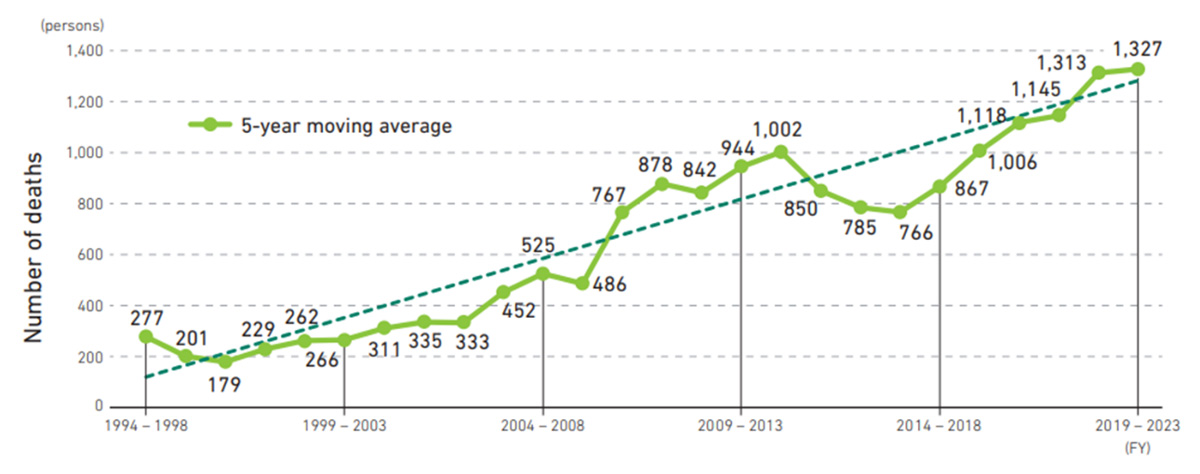
Heat illness fatalities (5-year moving average)
Annual Report on the environment in Japan 2024, Ministry of the Environment, Japan
Increases in infectious diseases transmitted via water, food, and mosquitoes
Climate change is expected to raise the risk of certain infectious diseases, which include diseases spread through media such as water and food and transmitted by arthropods such as mosquitoes and ticks. For instance, higher seawater temperatures have increased the counts of the bacterium Vibrio parahaemolyticus attached to seafood across various regions of Japan during summer. Vibrio parahaemolyticus is a causative agent of infectious gastroenteritis, with most food poisoning cases from this bacterium linked to seafood. Rising temperatures may also cause bacteria to multiply in food during processing and cooking.
In addition, reports indicate that the habitat of Aedes albopictus, a mosquito vector for dengue fever, is shifting northward. Dengue fever transmitted by mosquito bites is characterized by sudden fever, followed by symptoms such as rash, headache, joint pain, nausea, and vomiting.
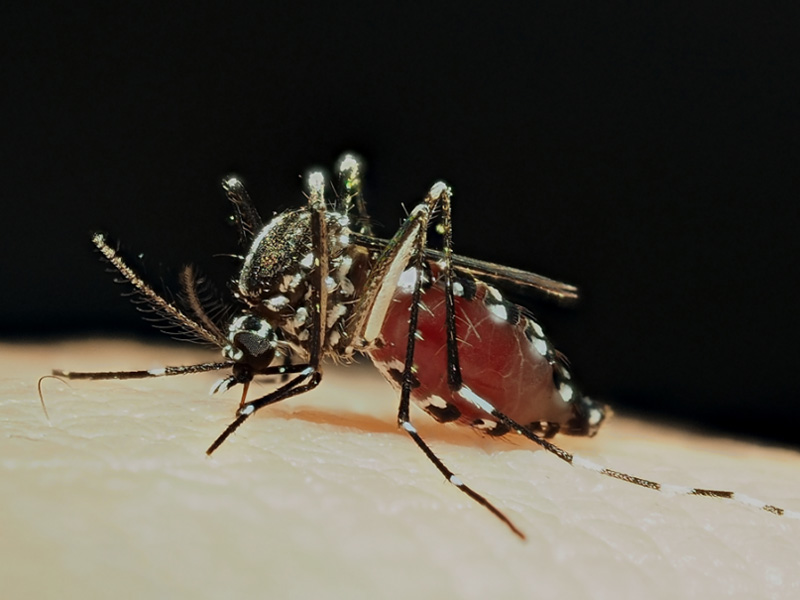
Adult Aedes albopictus
Source: Department of Medical Entomology, Japan Institute for Health Secutiry, Japan. Translated from Japanese by CCCA
Potential for greater damage in the future
Although cases of heatstroke and infectious diseases are already increasing, the damage is expected to worsen over time. For example, projections suggest that further temperature rises will increase emergency transports for heatstroke and the number of heat-related cardiovascular deaths, particularly among the elderly. Moreover, the range of the mosquito Aedes albopictus is likely to extend into parts of Hokkaido, raising the risk of dengue fever. Climate change, including shifts in temperature and humidity, may also alter the seasonality and incidence of infectious diseases such as influenza; hand, foot, and mouth disease; chickenpox; and tuberculosis.
This section describes the health impacts of climate change in Japan, including the mechanisms, observed effects to date in Japan, and potential future consequences in Japan.
Mechanisms Underlying the Impact of Climate Change on the Health Sector
The mechanisms by which climate change affects health are illustrated in the figure below.
Rising temperatures caused by climate change increase heat stress1, elevating the risk of heatstroke, heat-related deaths, and various other diseases, including respiratory illnesses. The elderly are particularly vulnerable, making the impact more severe for this population. Rising temperatures can also alter the distribution, population density, and activity of arthropods that transmit infectious diseases, potentially affecting the spread and incidence of vector-borne diseases, such as dengue fever carried by the mosquito Aedes albopictus. Temperature changes may further influence epidemic patterns of waterborne and foodborne diseases, as well as other infectious diseases like influenza.
1 Here, "heat stress" broadly refers to the health effects from high temperatures and encompasses not only extreme stress conditions that threaten life and health but also those that impact individuals at the psychological, physiological, and lifestyle levels.
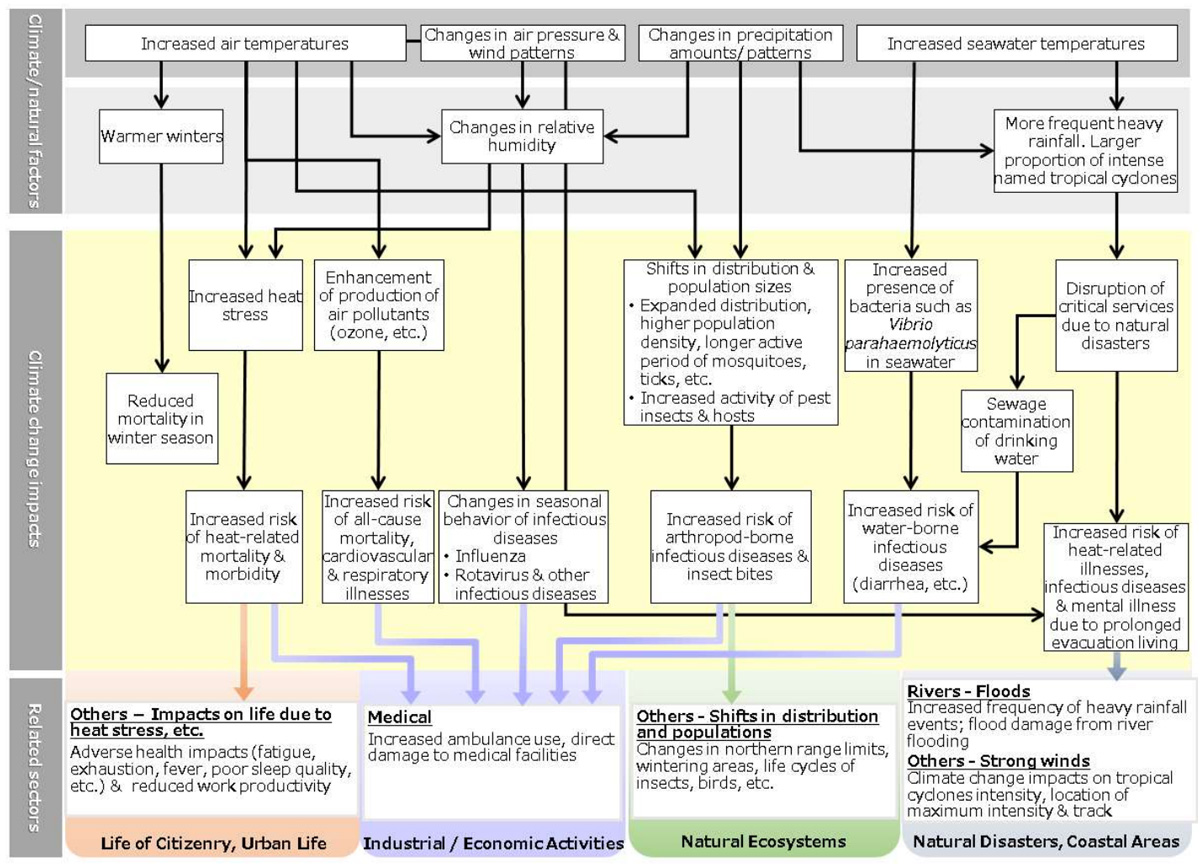
Schematic of projected impacts of climate change
Assessment Report on Climate Change Impacts in Japan, Figure 3-9., December 2020, Ministry of the Environment, Japan
Current Impacts and Future Projections in the Health Sector
Increased heatstroke associated with summer heatwaves
Factors such as rising summer temperatures and a growing elderly population at high risk of heatstroke have led to an increase in heatstroke deaths. Prior to 1993, the annual average was 67 deaths; however, since 1994, this value has risen to an average of 663 deaths per year. Moreover, in recent years, it has exceeded 1,000, consistently surpassing the fatalities caused by natural disasters.
Heatstroke incidence is closely linked to weather conditions. On hot days, the body's ability to dissipate heat to the outside air decreases, which increases the likelihood of heatstroke. In addition to high temperatures, elevated humidity and strong sunlight further increase the risk of heatstroke.
The figure below displays the number of heatstroke emergency transports (rate per 100,000 people per day) in the Tokyo 23 wards, Yokohama City, Nagoya City, Osaka City, and Fukuoka City, categorized by the daily maximum heat index (wet-bulb globe temperature, WBGT). A clear correlation is observed, with the transport count (rate) rising sharply when the daily maximum heat index (WBGT) exceeds approximately 28 °C.
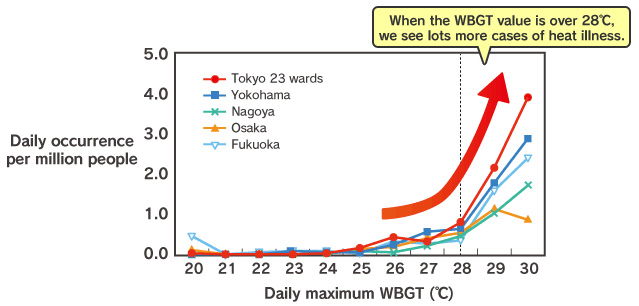
Number (Rate) of Heatstroke Ambulance Transports by Daily Maximum WBGT
Heat Illness Prevention Information, Ministry of the Environment, Japan
The heat index (WBGT), which indicates heatstroke risk more accurately than air temperature alone, measures the thermal environment by combining four factors: air temperature, airflow, humidity, and radiant heat. This index is calculated as follows: 0.7 × wet-bulb temperature + 0.2 × black globe temperature + 0.1 × dry-bulb temperature. This indicator considers the dry-bulb temperature, which is the so-called air temperature; the wet-bulb temperature, which considers the humidity of air; and the black globe temperature, which includes the intensity of radiant heat from sunlight and heated road surfaces. When the daily maximum index is forecasted at 33 °C or higher, the Ministry of the Environment and Japan Meteorological Agency issue a "Heatstroke Alert" to advise people to stay indoors and postpone or cancel outdoor activities.
Future temperature increases will likely raise the heat index (WBGT) levels across Japan. By the 2090s, available daytime hours for outdoor work in Tokyo and Osaka may decrease by 30-40% and days requiring extreme caution for strenuous outdoor exercise will increase. An increase in elderly deaths is also expected.
Increases in infectious diseases transmitted via water, food, and mosquitoes
Insect- and tick-borne infectious diseases are considered highly sensitive to climate change effects. Since 1950, the northern limit of the mosquito Aedes albopictus, the dengue fever vector, has been moving northward and reached Aomori Prefecture in 2016. The number of imported mosquito-borne infections is also rising in Japan, raising concerns about domestic transmission from diseases brought from abroad.
Rising seawater temperatures have led to an increase in the bacterium Vibrio parahaemolyticus attached to marine fish and shellfish during summer in Japan. Higher temperatures are also expected to increase the risk of foodborne infections through bacterial contamination and proliferation during food processing, distribution, storage, and cooking. A correlation exists between ambient temperature and infectious gastroenteritis risk, with higher temperatures prolonging the rotavirus epidemic season in various regions of Japan.
Waterborne infectious diseases are expected to increase in the future. International studies suggest that heavy rainfall can cause drinking water to become contaminated with sewage, thereby causing gastrointestinal illness, and similar effects may occur in Japan.
The range of the mosquito Aedes albopictus is likely to expand into parts of Hokkaido by the end of the 21st century. Rising temperatures may also lead to earlier blood-feeding and longer activity periods. The potential range of exotic mosquitoes transmitting Japanese encephalitis may also extend in the Amami and Okinawa regions. Therefore, the risk of various infectious diseases is expected to rise in the future.