Climate change adaptation at the national level
As stipulated in Japan’s Climate Change Adaptation Act, the Japanese government is addressing climate change adaptation at the national level.
This section provides an overview of the following three key initiatives, which are part of the government’s comprehensive and systematic efforts to promote climate change adaptation:
- Climate Change Adaptation Act
- Assessment Report on Climate Change Impacts
- Climate Change Adaptation Plan
In addition, we conclude by introducing the roles of Japan’s central government ministries and agencies in the field of climate change adaptation.
-
Climate Change Adaptation Act
The Paris Agreement, adopted at the 21st Conference of the Parties (COP21) to the United Nations Framework Convention on Climate Change in December 2015, called on all parties (countries) to promote adaptation and formulate adaptation plans aimed at strengthening their adaptive capacity and resilience to the impacts of climate change.
In response, Japan promulgated the Climate Change Adaptation Act in June 2018, with the act coming into effect on December 1 of the same year.
The Adaptation Act is comprised of four pillars:
- comprehensive promotion of adaptation
- development of information infrastructure
- strengthening of adaptation at the local level
- international expansion of adaptation efforts
Based on these pillars, Japan is implementing various measures, including formulating its Climate Change Adaptation Plan, conducting climate change impact assessments, designating the National Institute for Environmental Studies (NIES) as the core of its information infrastructure, and providing technical support to regional authorities.
Japan is said to be the first country to enact a standalone law on adaptation. In contrast, the United Kingdom and France, for example, address adaptation within laws concerning climate change measures or environmental policy, while Germany addresses it in plans without drawing up a dedicated law.
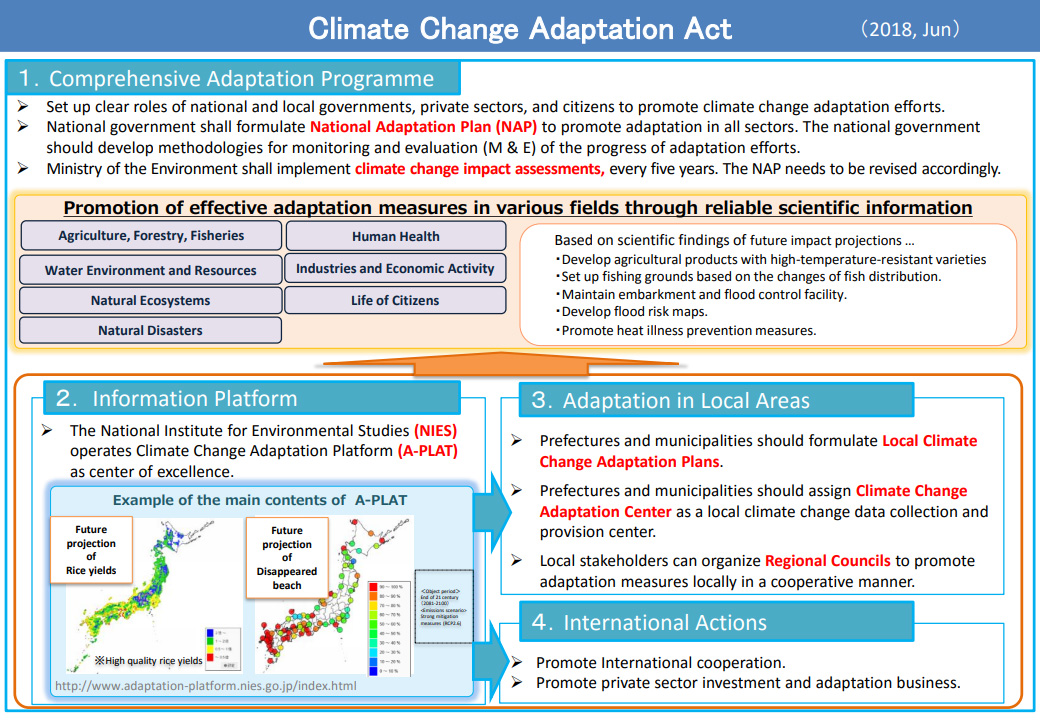
Outline of the Climate Change Adaptation Act
Outline of the Climate Change Adaptation Act, June 2018, Ministry of the Environment, Japan -
Assessment Report on Climate Change Impacts
Based on the Climate Change Adaptation Act, the Japanese government prepares and publishes an Assessment Report on Climate Change Impacts (Synthesis Report) that provides a comprehensive assessment of climate change impacts based on the latest scientific knowledge concerning the observation, monitoring, projection, and assessment of climate change and its impacts across various sectors.
In addition to outlining climate change impacts in each sector, the report presents observed results and projections for factors like temperature and precipitation, and summarizes future challenges related to impact assessment as well as current national initiatives.
This report is used to formulate the Japanese government’s Climate Change Adaptation Plan and by local governments, businesses, and other stakeholders to formulate climate change adaptation plans at the local level.
In addition to this Synthesis Report, the government also publishes an Assessment Report on Climate Change Impacts (Details) that provides more detailed information for each sector as reference material. These reports are revised approximately every five years.References:
- Assessment Report on Climate Change Impacts in Japan, February 2026, (in Japanese: 第3次気候変動影響評価報告書 (総説)), Ministry of the Environment, Japan (in Japanese)
- Assessment Report on Climate Change Impacts in Japan, December 2020, Ministry of the Environment, Japan (in English)
- Report on Assessment of Impacts of Climate Change in Japan and Future Challenges (Comment Submission), March 2015, Central Environment Council, Japan (in English)
-
Climate Change Adaptation Plan
In accordance with the Adaptation Act, the Japanese government has formulated a Climate Change Adaptation Plan to comprehensively and systematically implement measures related to climate change adaptation.
This plan is divided broadly into three chapters.
Chapter 1 outlines the basic direction for climate change adaptation measures. Chapter 2 details anticipated climate change impacts and corresponding measures by sector.
Chapter 3 lays out fundamental measures.The plan also sets key performance indicators (KPIs) for measures and stipulates progress management under a PDCA1 cycle.
- 1 PDCA, which stands for Plan, Do, Check, Act, is a management method for continuous improvement through repeating these processes.
-
Initiatives by government ministries and agencies
Addressing climate change requires action both at the national level and at the local level. Central government ministries and agencies, in particular, are responsible for policies and projects that need to be carried out on a nationwide scale. They work together to promote adaptation measures across the country.
The impacts of climate change can spread across ecosystems and society, affecting multiple sectors. This means that no single ministry can respond on its own. Some measures also create co-benefits, while others may involve trade-offs between different goals, making coordination and information sharing among ministries essential.
To support this collaboration, the Government of Japan has established the Climate Change Adaptation Promotion Council, chaired by the Minister of the Environment. The council meets about twice a year to share information, review progress, and ensure that the government promotes adaptation policies as a unified effort.