Climate Change Adaptation Plan
To promote climate change adaptation policies, Japan has formulated a national Climate Change Adaptation Plan. This section outlines the background of the plan's formulation; its core concept of "mainstreaming adaptation"; its structure, basic directions, sector-specific and cross-sectoral measures; and mechanisms for follow-up.
Background to plan formulation
The government's Climate Change Adaptation Plan is formulated in accordance with Article 7 of the Climate Change Adaptation Act to promote climate change adaptation measures in a comprehensive and systematic manner. Its predecessor, the National Plan for Adaptation to the Impacts of Climate Change, was approved by the Cabinet in November 2015, followed by the first Climate Change Adaptation Plan approved by the Cabinet in November 2018. The plan was subsequently revised to incorporate the latest scientific findings presented in the Assessment Report on Climate Change Impacts published in 2020, and following inter-ministerial coordination, further reporting from the Subcommittee on Climate Change Impact Assessment under the Central Environment Council's Global Environment Committee, and a public comment process, the revised plan was published in October 2021.
The plan's core concept: Mainstreaming adaptation
Adopted also as one of the basic strategies of the current plan, the concept of mainstreaming adaptation - integrating climate change adaptation into all relevant policy areas - is critically important today.
Promoting measures related to climate change adaptation requires action not only in policies under the jurisdiction of the Ministry of the Environment but also across a wide range of policies including disaster prevention; agriculture, forestry and fisheries; and biodiversity conservation. Adaptation measures are also expected to generate co-benefits across multiple policy goals. For example, planting trees in urban areas contributes to heat island mitigation through transpiration and shading while also helping to sequester carbon. From this perspective, relevant government ministries and agencies in Japan should work together to ensure that the concept of adaptation is integrated into a broad spectrum of related policies.
Local governments are similarly expected to promote horizontal cooperation among relevant departments through the formulation of their local climate change adaptation plans. There are cases, for example, of departments charged with reviewing internal programs to identify existing policies that can be reframed as adaptation measures, or conducting surveys and interviews with farmers and fishermen in cooperation with agriculture, forestry, and fisheries departments to assess climate change impacts.
Structure of the plan
The current Climate Change Adaptation Plan is broadly divided into the following three chapters:
- Chapter 1. Basic Directions of Measures for Climate Change Adaptation
- Chapter 2. Sectoral Measures for Climate Change Adaptation
- Chapter 3. Fundamental Measures for Climate Change Adaptation
Chapter 1 outlines the plan's goals, time frame, basic roles of stakeholders, basic strategies, and mechanisms for managing and assessing progress made on implementation of the plan. Chapter 2 details measures by sector, and Chapter 3 lays out fundamental measures spanning multiple sectors.
The revised plan also incorporates the latest scientific findings from the Assessment Report on Climate Change Impacts in a "Basic approach to adaptation" based on assessments of impacts in terms of significance, urgency, and confidence. The plan also outlines methods for monitoring and managing progress of implementation, including running PDCA cycles by setting KPIs for measures and indicators for driving awareness and uptake of adaptation at national, local, and individual levels.
Basic directions of measures
Plan goals and time frame
The plan is aimed at comprehensively and systematically implementing measures related to climate change adaptation based on scientific findings so as to achieve the following goals and create a society that ensures safety, security, and sustainability.
- Prevent or mitigate damage from climate change impacts.
- Maintain stability of people's lives.
- Promote the sound development of society and the economy.
- Preserve the natural environment and build the nation's resilience.
The plan has a time frame of approximately five years.
Basic roles of stakeholders
In the implementation of climate change adaptation, diverse stakeholders, including local governments, business operators, and members of the general public as well as central government, are expected to play their respective roles as described below and work together closely, thereby generating synergies.
While each stakeholder has their own role, members of the general public, in particular, are encouraged to regard climate change as a personal issue, deepen their interest and understanding of adaptation, and actively support central and local government adaptation initiatives.
Basic strategies
The plan sets out the following seven basic strategies to achieve its goals.
- Incorporate climate change adaptation into every relevant policy.
- Promote climate change adaptation based on scientific findings.
- Consolidate the knowledge of research institutions in Japan and develop information platforms.
- Promote climate change adaptation based on local conditions.
- Deepen public understanding and promote climate change adaptation corresponding to business activities.
- Contribute to enhancing the adaptive capacity of developing countries.
- Ensure a system for close collaboration among relevant administrative agencies.
Sector-specific measures and other concrete initiatives will be implemented under these basic strategies.
Sectoral and fundamental measures
Sectoral measures
The plan targets the following seven sectors in line with sectors identified in the Assessment Report on Climate Change Impacts.
- Agriculture, forestry, and fisheries
- Water environment and water resources
- Natural ecosystems
- Natural disasters and coastal areas
- Human health
- Industrial and economic activities
- The lives of citizens and urban life
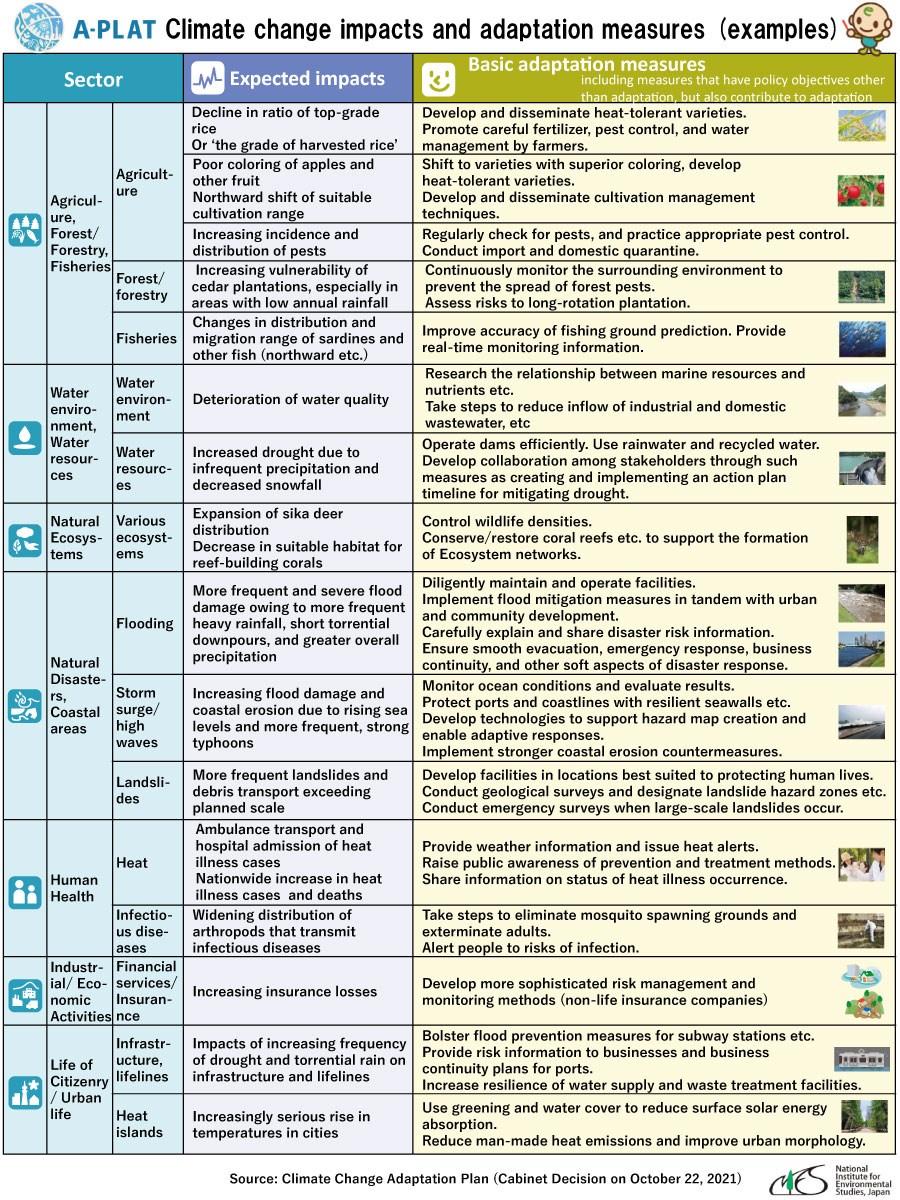
For these seven sectors, the plan gives priority to categories deemed in the Assessment Report to have high significance and urgency, outlining (1) impacts (current status and projections), (2) basic approach to adaptation, and (3) basic measures.
See the following table for details of specific measures.
Fundamental measures
A cross-sectoral approach is essential to promoting adaptation.
As such, basic measures that apply to all sectors are referred to in the plan as fundamental measures. The plan identifies and outlines the following five such measures.
- Enhancement and utilization of scientific findings on climate change
- Securing systems to collect, organize, analyze, and provide climate change information
- Promotion of climate change adaptation measures of local governments
- Promotion of climate change adaptation by business operators etc., and business activities contributing to climate change adaptation
- Development of international collaboration and cooperation on climate change
Plan follow-up
Climate change adaptation cannot be achieved in a limited time frame and requires sustained implementation of the plan. As such, a Climate Change Adaptation Promotion Council established under the Climate Change Adaptation Act and made up of representatives from relevant ministries and agencies will conduct follow-up activities to evaluate the progress made each year on measures being implemented by the relevant ministries and agencies, and compile an annual follow-up report.