Greenhouse Gas Emissions and Mitigation Measures
This section focuses on climate change mitigation (as opposed to adaptation), covering greenhouse gas emission levels and specific examples of mitigation.
Greenhouse gas emissions and climate change
Greenhouse gas emission status
Which sectors and regions generate the most greenhouse gases? The graph below shows net anthropogenic greenhouse gas emissions per capita and for the total population, per region.
You can see that overall, the share of emissions from fossil fuels and industry (blue in the graph) is high. In some regions, emissions from land use, land-use change, and forestry (orange) are relatively higher. Per capita emissions also vary, indicating differences in emission profiles across regions.
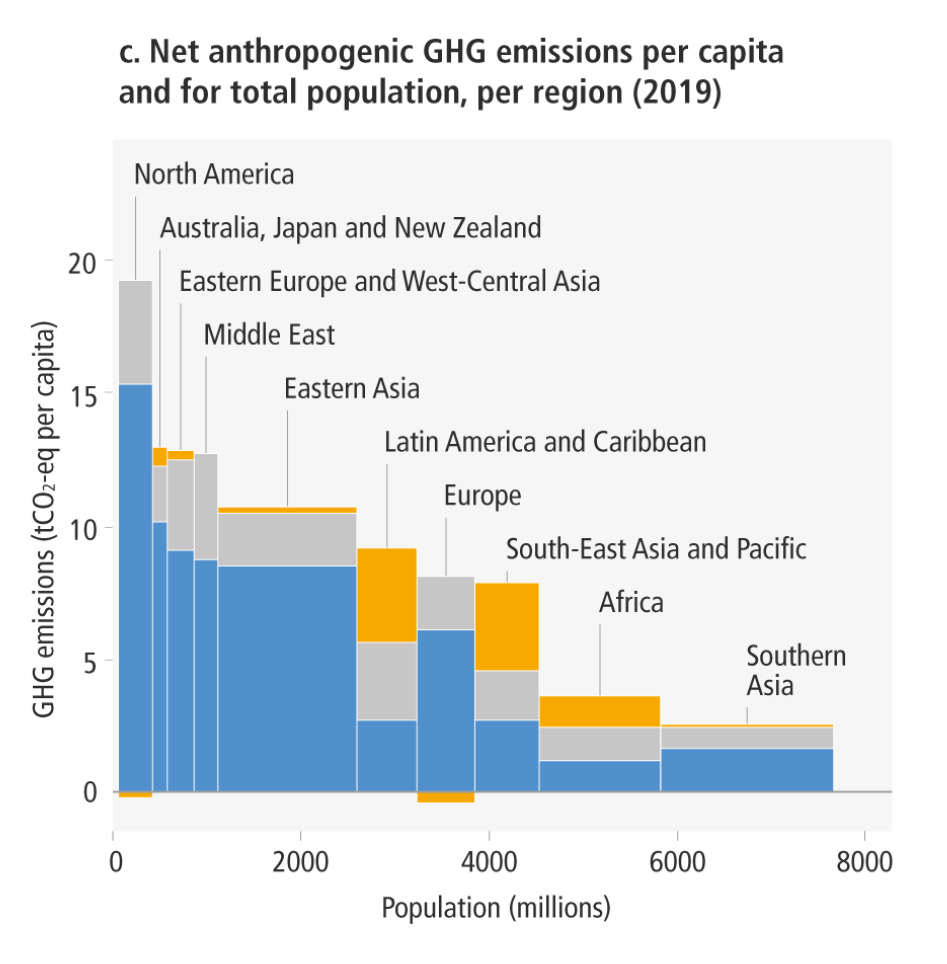
IPCC Sixth Assessment Report, Working Group III: Mitigation of Climate Change, Figure SPM.4
The need for substantial greenhouse gas reductions
Greenhouse gas emissions need to be reduced to curb climate change, but to what extent?
Global greenhouse gas emissions shown in the graph below indicate that with only current mitigation measures, the continuing high level of emissions (red line in the graph) is projected to result in a rise of 2.2–3.5 °C by the end of the century compared with pre-industrial levels.
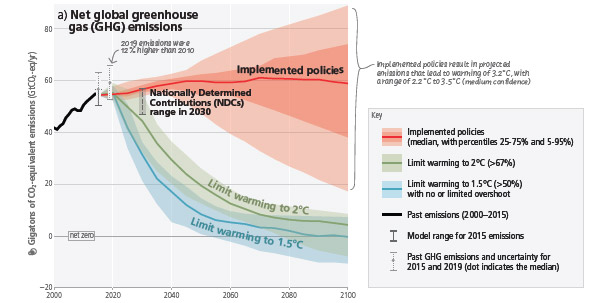
IPCC AR6 WGⅢ SPM.5(a); IPCC, 2021
To shift to a pathway limiting warming to a 1.5 °C rise in global average temperature (blue line in the graph), the two targets detailed below need to be met. “Net-zero” means balancing the amount of greenhouse gases emitted with the amount removed from the atmosphere by forests, oceans, and other means.
- A 40% reduction in global greenhouse gas emissions by 2030 compared to 2019 levels
- Net-zero CO2 emissions by the beginning of 2050s (carbon neutrality)
The degree of temperature rise is determined by the cumulative emissions of greenhouse gases (the total of past and future emissions)1. There is thought to be very little leeway to release any more greenhouse gases if warming is to be kept within 1.5 °C, which means that swift and substantial reductions in emissions are required.
- 1 The estimated upper limit of cumulative emissions to keep warming below a specific level is called “carbon budget.” (Source: IPCC Glossary)
Carbon neutrality goals
The Paris Agreement goal of 1.5 °C or less
The Paris Agreement, an international framework for climate change, set a global long-term goal to hold global temperature increase to well below 2 °C above pre-industrial levels (2 °C target) and pursue efforts to limit it to 1.5 °C above pre-industrial levels (1.5 °C target). The Agreement obliges all member states to submit and update their emissions reduction targets (known as nationally determined contributions or NDCs) and are working towards them.
The Japanese government has also set the following targets based on the Paris Agreement:
- Achieve 46% reduction in greenhouse gas emissions by fiscal 2030 compared to 2013 levels, and continue strenuous efforts to meet the lofty goal of cutting its emissions by 50%.
- Achieve net-zero emissions by 2050.
Mitigation measures
Thanks to the efforts of various countries, the growth rate of global greenhouse gas emissions has slowed in recent years, but global emissions are still rising (as of 2022).2
Reduction targets vary from country to country, but since climate change cannot be halted unless global emissions are curbed, those countries with the capacity to do so are providing significant financial and technological support to other countries to help them with their mitigation efforts.
The following table provides examples of mitigation measures currently being implemented.
| Energy | Transition to renewable energy sources |
|---|---|
| Agriculture, forestry and land use | Forest conservation and afforestation (for CO2 absorption), reducing methane from agriculture, cutting food waste |
| Commercial and residential | Promoting energy efficiency, building insulation, and transition to low-carbon lifestyles |
| Transportation | Improving fuel efficiency, promoting electric vehicles, cycling, and public transport |
| Industry | Improving energy efficiency, promoting recycling, switching to power generated by renewables rather than fossil fuels |
However, making further progress on mitigation will require stronger policies (regulations and economic instruments), governance, finance, and international cooperation.
- 2 UNEP, Emissions Gap Report 2022 Global greenhouse gas emissions have continued to increase over the past decade, but the rate of increase has slowed compared to the previous decade
Pursuing both mitigation and adaptation
The adverse impacts of climate change are already evident worldwide, making adaptation—preparing for impacts—as crucial as mitigation.
The key difference between adaptation and mitigation is that adaptation seeks to address the impacts of a changing climate, while mitigation seeks to address the causes of climate change by reducing greenhouse gas (GHG) emissions.
The world is also disproportionately affected by climate change, with per capita greenhouse gas emissions tending to be lower in countries and communities that are more vulnerable. Tackling climate change requires global cooperation on both mitigation and adaptation.