Climate Change Impacts and International Cooperation
This section explains the global impact of climate change and describes how developing and developed countries should cooperate in response.
Climate Change Impacts Worldwide
As highlighted in the IPCC Sixth Assessment Report, climate change impacts have been observed in many regions and sectors worldwide and affect both ecosystems and human systems. For ecosystems, the certainty of impact is considered high in terms of changes to ecosystem structure, shifts in species habitats, and alterations in timing. Regarding human systems, the certainty of impact is especially high for health and well-being, as well as for cities, settlements, and infrastructure.
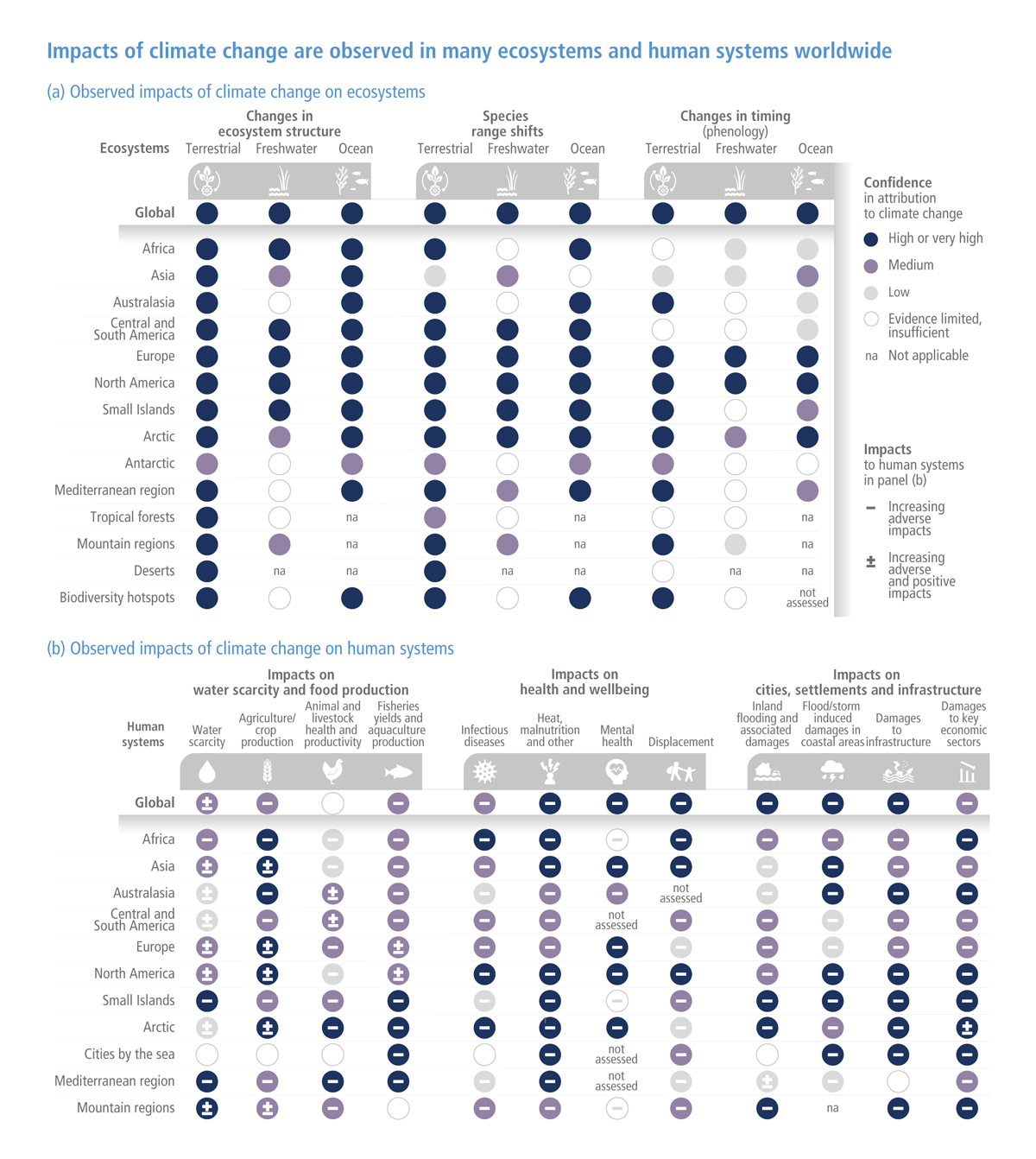
IPCC AR6 WGⅡ-Figure SPM.2; IPCC, 2021
Relationship between Developing and Developed Countries
Many countries vulnerable to climate change are developing countries
Developing countries are generally more susceptible to climate change than developed countries. Examples of highly vulnerable areas include West, Central, and East Africa, South Asia, Central and South America, small island developing states, and the Arctic region.
In these regions, especially in sub-Saharan Africa and the East Asia and Pacific region, many people are forced to leave their homes due to extreme weather events. These individuals are sometimes referred to as “climate refugees.” This forced migration not only displaces people but also worsens living conditions due to increased population density and impedes their return home.
Responsibilities of developed countries and need for support (based on COP27)
Developing countries are vulnerable to climate change, but most of the greenhouse gas emissions driving climate change have historically been contributed by developed countries. Although climate change responsibility is shared globally, the principle of differentiated responsibility, also known as “common but differentiated responsibilities,” is based on countries' contributions and capacities.
The inability of developing countries to adapt to climate impacts is termed “loss and damage,” which includes rapid changes from extreme weather events, such as cyclones, droughts, and heatwaves, as well as slow-onset changes, such as sea-level rise, desertification, glacial retreat, land degradation, ocean acidification, and salinization. Developing countries have long demanded the creation of substantive mechanisms and new funds to address this “loss and damage.”
At COP27 held in Egypt in 2022, financial support for “loss and damage” was formally included on the agenda, leading to an agreement to establish a dedicated fund for this purpose.
At COP28 held in the United Arab Emirates in 2023, the Fund for Responding to Loss and Damage (FRLD) was officially operationalized as part of the financial mechanisms under the UNFCCC and the Paris Agreement. Under its initial operational framework, known as the Barbados Implementation Modalities (BIM), USD 250 million in grant financing is expected to be mobilized for 2025–2026, with more than 50% allocated to particularly vulnerable developing countries.