Initiatives by government ministries and agencies
Under the Climate Change Adaptation Act and Climate Change Adaptation Plan, the Japanese government's ministries and agencies work together to comprehensively and systematically implement measures related to climate change adaptation. This section outlines the roles and key initiatives of central government ministries and agencies.
Roles of central government ministries and agencies
The roles of central government ministries and agencies
Promoting climate change adaptation requires both nationwide initiatives and responses tailored to the characteristics of each locality. Central government ministries and agencies are expected to promote the implementation of policies and programs covering the whole country or requiring a nationwide perspective.
This applies also to climate change adaptation policies; various government ministries and agencies work together to implement measures that require a nationwide perspective.
The need for cooperation between relevant government ministries and agencies
Natural ecosystems and human society are deeply interconnected, and the impacts of climate change cascade across sectors. For example, shifts in rainfall patterns alter species distribution, changing ecosystem services and affecting agricultural production.
Because such cross-sectoral impacts cannot be addressed by any single wing of government alone, cross-government collaboration is essential.
Adaptation policies may yield co-benefits, but may also involve trade-offs. Addressing such complexities requires information sharing and coordination between the relevant ministries and agencies.
Establishment and convening of the Climate Change Adaptation Promotion Council
To promote required cross-government collaboration, the government has established the Climate Change Adaptation Promotion Council, chaired by the Minister of the Environment and composed of representatives of relevant ministries and agencies. The council facilitates cross-government coordination, and shares progress regularly to promote unified government action on adaptation.
The council convenes about twice a year to review progress made on implementing the Climate Change Adaptation Plan and share information on the initiatives of each ministry or agency.
Initiatives of each ministry or agency
Ministry of the Environment
MOE has established the foundational legislative framework for climate change adaptation measures, including the Climate Change Adaptation Act and the Assessment Report on Climate Change Impacts, and broadly leads Japan's climate change adaptation initiatives.
One of its key activities is the dissemination of information on climate change, including IPCC assessment reports and other relevant scientific findings and major domestic and international publications. MOE also oversees regional environmental offices, building collaborative relationships between central and local governments to develop timely and detailed environmental policies tailored to local circumstances.
Furthermore, it formulates guidelines and manuals for various fields closely related to adaptation. For example, in light of the increasing severity of natural disasters in recent years, it has published a Guide to Ecosystem-Based Disaster Prevention and Mitigation (Eco-DRR) for Sustainable Community Development to support the utilization of multifaceted ecosystem functions for disaster prevention and mitigation. It also focuses on biodiversity conservation and the use of green infrastructure.
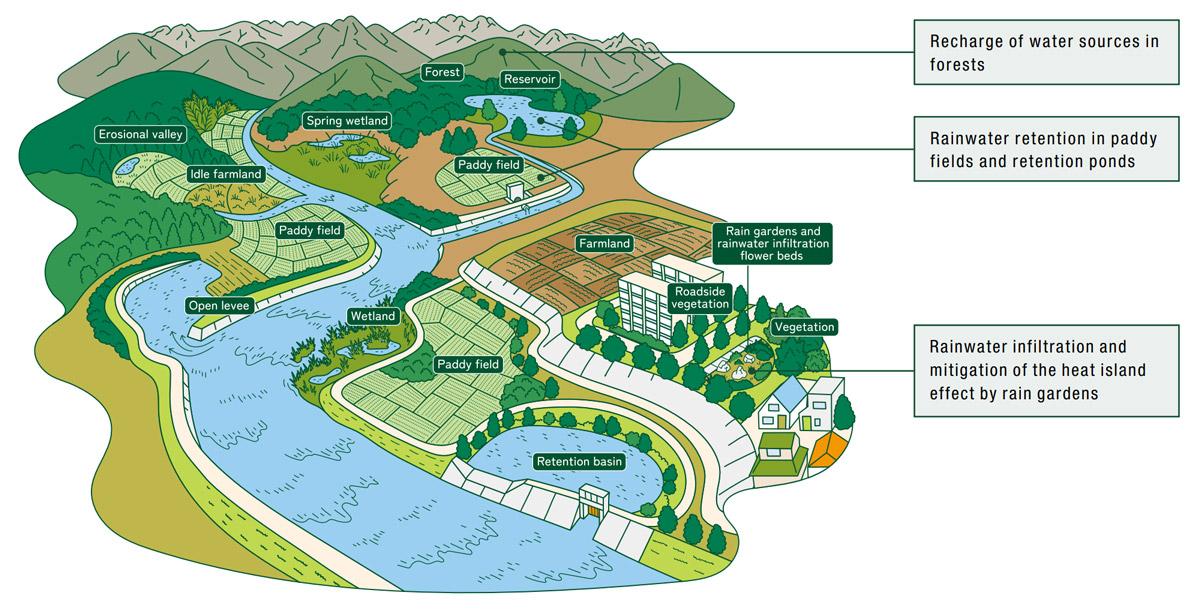
Eco-DRR activities focused on the Ecosystem Conservation/Restoration Potential Map
A Guide to Eco-DRR Practice for Sustainable Community Development [Summary Version], March 2023, Ministry of the Environment, Japan
Cabinet Office
The Cabinet Office has established the Sustainable Development Goals (SDGs) Promotion Headquarters, which is composed of all ministers, to coordinate climate change adaptation and other SDG-related policies with relevant government agencies.
It is also responsible for planning and conducting public opinion polls, including those on public awareness of global warming and other issues. Its 2021 Public Opinion Survey on Climate Change was the first to include questions on climate change adaptation.
Financial Services Agency
Climate change has come to be recognized throughout the world as posing risks to the stability of financial systems and institutions, and it is being increasingly incorporated into risk management and financial supervision. Within this context, the Financial Services Agency (FSA) has issued its Supervisory Guidance on Climate-related Risk Management and Client Engagement. It also endeavors to raise awareness among financial institutions of the need to strategically address the opportunities and risks posed by climate change to their customers and their own management.
In relation to this, FSA has published a Study on Climate-related Scenarios Analysis: Characteristics of NGFS Scenarios and their Applications in Climate-related Financial Risk Analysis to boost understanding of scenario analysis among financial institutions. FSA also promotes sustainable finance (finance to support environmental sustainability) and ESG investment (corporate investment that prioritizes environment, social issues, and governance) by financial institutions, and more thoroughgoing corporate climate-related disclosures to support the achievement of these goals. With its January 2023 amendment of the 1973 Cabinet Office Order on Disclosure of Corporate Affairs, FSA similarly added "Sustainability approaches and initiatives" as a mandatory new section for companies to report on their sustainability-related initiatives.
Ministry of Internal Affairs and Communications
The Ministry of Internal Affairs and Communications (MIC) is primarily responsible for policies related to natural disaster response. It monitors and evaluates administrative measures such as securing housing during disasters, managing disaster-related waste, securing communication services during disasters, and driving agricultural sector recovery after disasters.
Fire and Disaster Management Agency
The Fire and Disaster Management Agency publishes information such as the latest status of ambulance services for victims of heat illness and related historical data. It also helps to enhance community resilience by training voluntary disaster management organizations and other local community disaster management personnel, and conducting surveys on the status of local government operations continuity planning.
Ministry of Foreign Affairs
The Ministry of Foreign Affairs (MOFA) conducts climate change diplomacy, including disseminating information domestically on international frameworks on climate change, and internationally on Japan's climate change initiatives, and discussing international cooperation on climate change adaptation at international summits and conferences. MOFA is also the conduit for Japan's increasing support for adaptation by countries that are most vulnerable to climate change impacts, including contributing to the Adaptation Fund.
Ministry of Education, Culture, Sports, Science and Technology
The Ministry of Education, Culture, Sports, Science and Technology (MEXT) supports basic and foundational research in the fields of environment and energy aimed at tackling climate change and other environmental issues and enhancing industrial competitiveness.
A key project is the joint operation with the Japan Meteorological Agency of the Data Integration and Analysis System (DIAS), which provides data domestically and internationally. DIAS collects, stores, integrates, and analyzes global and regional observation data that it merges with socio-economic information and converts them into useful information to support crisis management related to global environmental problems and large-scale natural disasters. MEXT is also involved in Education for Sustainable Development and other environmental education initiatives.
Ministry of Health, Labour and Welfare
The Ministry of Health, Labour and Welfare collects and disseminates information on heat illness, mosquito-borne infectious diseases and other health hazards that are expected to become more prevalent due to climate change. It has also revised the Drought Countermeasures Manual in light of concerns about increasingly intense drought damage caused by climate change.
Ministry of Agriculture, Forestry and Fisheries
The agriculture, forestry, and fisheries sectors are highly susceptible to the effects of global warming, giving rise to concerns about declining quality and yields of products due to climate change. Based on its Climate Change Adaptation Plan, the Ministry of Agriculture, Forestry and Fisheries (MAFF) is working to mitigate climate change-induced damage by driving the implementation of adaptation measures tailored to these sectors.
Also, recognizing that Japan's food industry and agriculture, forestry, and fisheries sectors are facing challenges such as large-scale natural disasters, rising temperatures, shrinkage of regional production bases, and changes in production/consumption, MAFF is seeking to ensure stable food supply into the future by balancing production improvements with sustainability through its MIDORI Strategy for Sustainable Food Systems.
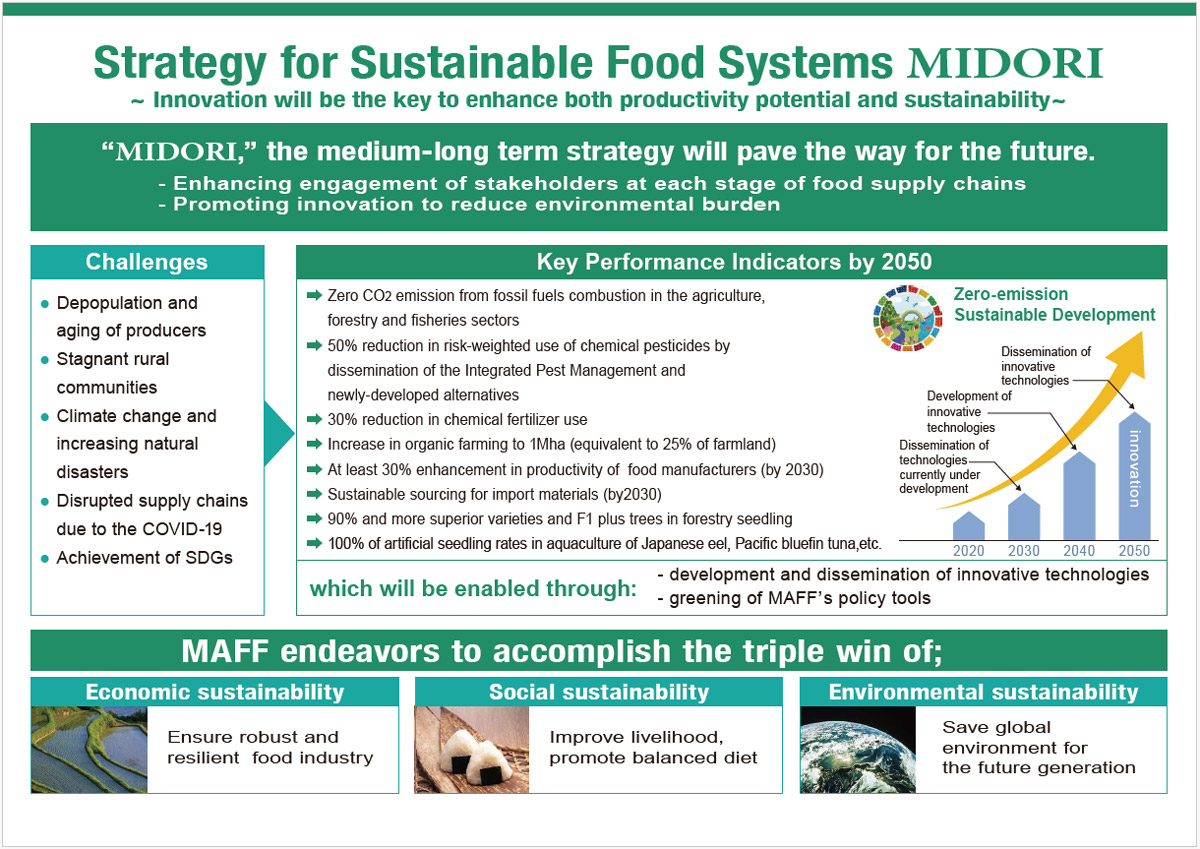
Strategy for Sustainable Food Systems MIDORI
Abstract of the MIDORI Strategy, Ministry of Agriculture, Forestry and Fisheries, Japan
Ministry of Economy, Trade and Industry
Responding to increasingly active climate change-related investment and financial services industry developments, the Ministry of Economy, Trade, and Industry disseminates information related to ESG investment and the Task Force on Climate-related Financial Disclosures (TCFD). It is also driving private sector adaptation business by sharing information on promising adaptation businesses and technologies.
Ministry of Land, Infrastructure, Transport and Tourism
The Ministry of Land, Infrastructure, Transport and Tourism (MLIT) had been systematically managing its environment-related policies under its MLIT Environmental Action Plan, but in 2021, it completely overhauled this plan to strengthen all of its environmental policies, including climate change mitigation and adaptation and biodiversity conservation, and integrated its Climate Change Adaption Plan into this plan.
The revised plan highlights the need to strengthen efforts particularly in sectors such as natural disasters, water environment/water resources, and the lives of citizens and urban life, and fundamental measures related to enhancement and utilization of scientific findings on climate change.
In the natural disasters sector, MLIT has launched an All-Out Disaster Prevention/Disaster Reduction Project in response to the increasing severity and frequency of natural disasters in Japan. It is also reviewing its flood control plans to accommodate increased rainfall and other factors. In the water resources/water environment sector, droughts are predicted to increase in severity, and MLIT is enhancing countermeasures based on drought risk assessments.
Under its Green Infrastructure Promotion Strategy, MLIT is also promoting the creation of attractive, sustainable urban and rural communities through green infrastructure that leverages the functions of the natural environment.
Japan Meteorological Agency
The Japan Meteorological Agency (JMA) monitors climate change and greenhouse gas trends and publishes its findings and projections regarding global warming and climate change.
The information JMA disseminates includes the following: information on global warming and climate change in Japan on its Climate Change Information Portal site; the latest information on greenhouse gases that induce global warming and on the status of the ozone layer in its Climate Change Monitoring Report on climate change around the world and in Japan; and Global Warming Projection Information, which is based on the IPCC's RCP8.5 scenario. JMA also collaborates with MOE, MEXT, MLIT and many other government ministries and agencies.