Climate change around the world
This section explains specific examples of climate change that have already occurred around the world. It also describes methods used to identify long-term trends in climate change.
Types of climate change
Climate change patterns: gradual shifts and extreme events
Climate change manifests itself in two key patterns: gradual shifts over a long period, such as a rise in average annual temperature by a few degrees over a century, and extreme weather events such as intense heatwaves or heavy rainfall that occur suddenly at a specific time and place. Both patterns can significantly impact our lives. Extreme events can cause heatstroke from scorching temperatures or flooding from heavy rain, while gradual warming can impact crop growth and cause sea levels to rise, leading to coastal erosion and inundation.
Climate change worldwide
Climate change has already impacted regions throughout the world in various ways.
The increase in the global mean surface temperatures for 2081–2100 relative to 1850–1900 is projected to range from 1.0 °C to 5.7 °C. At the same time, sea surface temperatures are rising, and various other climate changes are occurring.
Alongside the gradual rise in sea surface temperatures, marine heatwaves that can last from days to years are occurring with increasing frequency. The map below shows examples of marine heatwaves that have been observed in the past 20 years.
Red indicates the maximum increase in ocean temperature during each event.
Studies suggest that anthropogenic climate change has made marine heatwaves in the Alaska Sea, western equatorial Pacific, northeast Pacific, Tasman Sea, and southwest Atlantic much more likely to occur. The number of marine heatwaves has reportedly doubled since the 1980s.
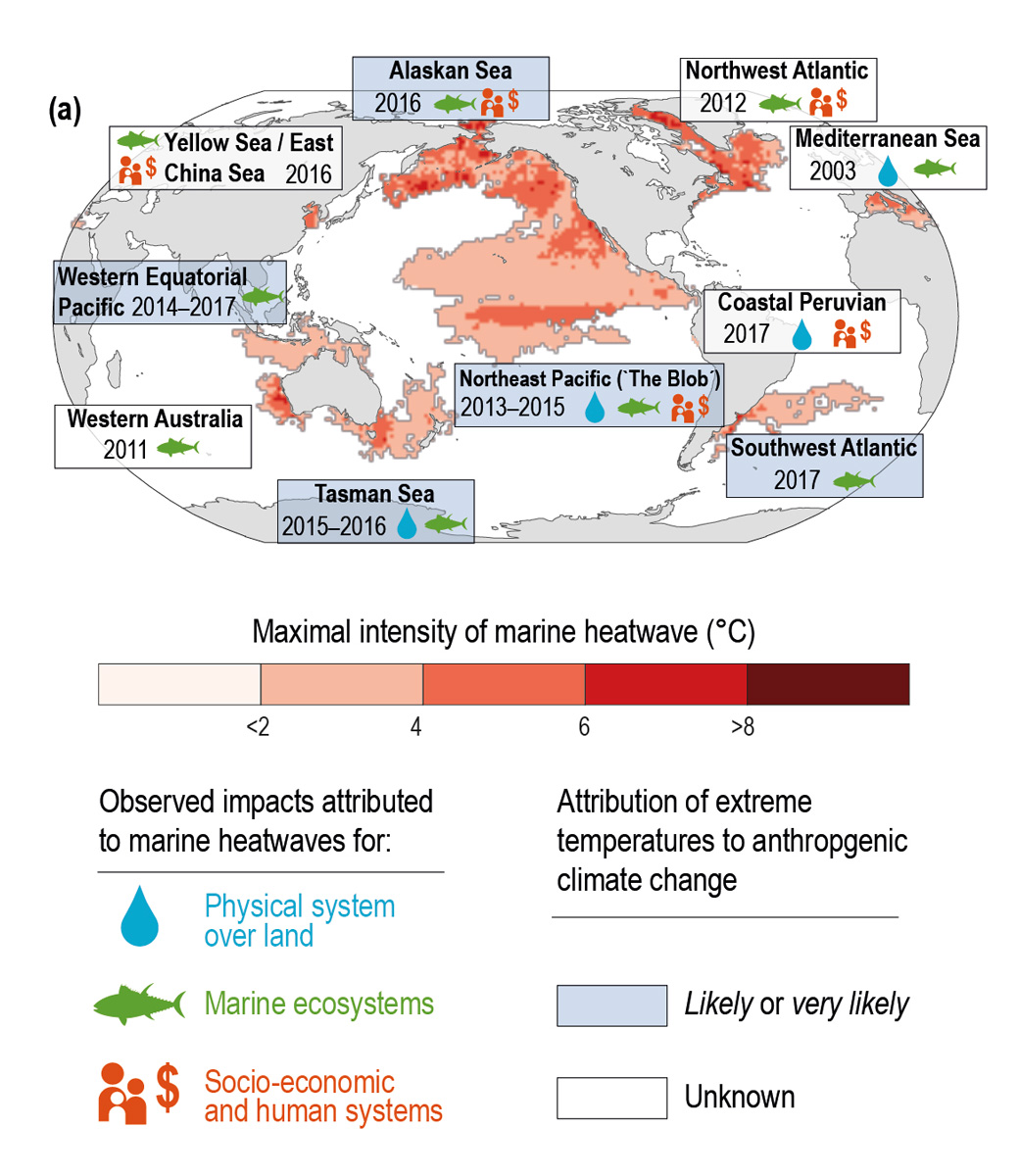
Examples of documented marine heatwaves (MHWs) over the last two decades
IPCC, Special Report on the Ocean and Cryosphere in a Changing Climate TS.6 Extremes, Abrupt Changes and Managing Risks
Other observed changes include the shrinking of Arctic sea ice, the retreat of glaciers worldwide, and the acidification of the oceans. Melting glaciers and warming seas have contributed to a rise in sea level of an estimated 0.20 meters between 1901 and 2018.