Impacts across different sectors
This section provides a broad overview of the impacts of climate change across different sectors, examining what these impacts are and how they are assessed. It also explains how the interaction of multiple factors can lead to more widespread and severe effects.
Impacts of climate change
Climate change impact assessment
The impacts of recent climate change are wide-ranging and affect numerous sectors. These impacts need to be assessed from the perspectives of significance (degree of impact, likelihood, etc.), urgency (when an impact manifests itself, and when adaptation measures should be initiated or crucial decisions should be taken), and confidence (reliability of information). These assessments inform the development of effective adaptation measures and updates to climate change adaptation plans. Climate impact assessments are conducted both on the basis of observing and monitoring current circumstances and on future projections.
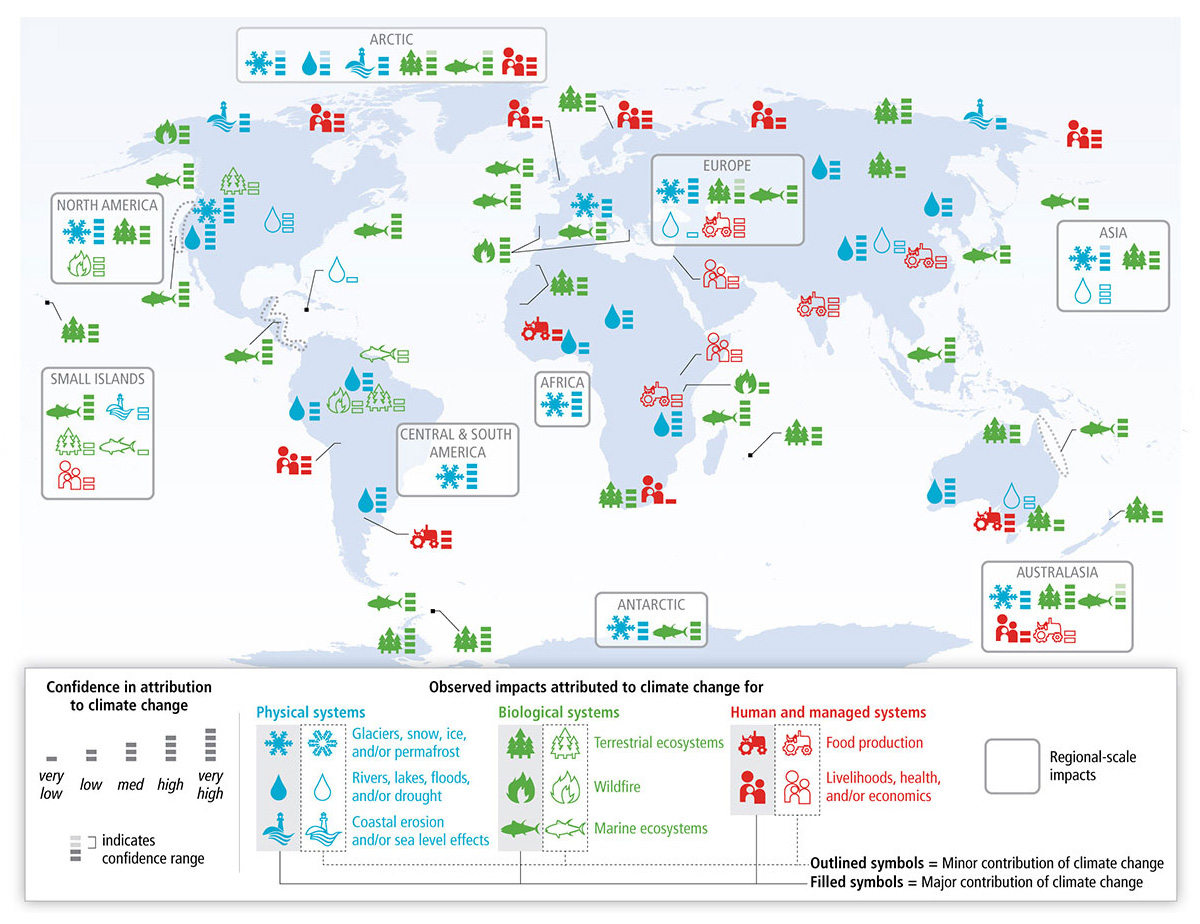
Global patterns of impacts in recent decades attributed to climate change. Impacts are shown at a range of geographic scales. Symbols indicate categories of attributed impacts, the relative contribution of climate change (major or minor) to the observed impact, and confidence in attribution (IPCC, 2014).
Global patterns of impacts in recent decades attributed to climate change
IPCC AR5 WGⅡ-Figure SPM.Figure SPM.2(A); IPCC, 2014
Impact assessment based on observation and monitoring
By consulting various sources, including statistical analyses of observational data or studies of major disasters and other events likely triggered by climate change, we can deepen our understanding of the extent of impacts already occurring and the mechanisms behind them, and assess them from the perspectives of significance, urgency, and confidence.
The Study Team for Observing and Monitoring the Impacts of Climate Change, a group of experts organized by the National Institute for Environmental Studies, compiled this literature into a Climate Change Database Collection (2022)(Japanese A-PLAT website). Examples of the many sources of Japanese information contained in the collection include statistical data detailing impacts on crop yields and other relevant areas, the scale and other aspects of flood damage, and Heatstroke Ambulance Transport Data detailing the location, age distribution and other attributes of heat stroke victims transported to hospital.
Impact assessment based on future projections
This approach uses climate scenarios that project how temperature and precipitation will change in the future (for further details, see Future climate) to estimate the extent of impacts. Methods include using simulation models to estimate impacts on crop yield and quality, expansion of flood inundation zones, and other sectors, or using the results of experiments such as cultivating plants in artificially created environments simulating future temperature rises to project impacts.
Model-based simulations using climate scenarios developed by various research institutions are being conducted to assess impacts occurring in the mid- or late 21st century and beyond.
Uncertainty in impact assessment
There are many uncertainties surrounding these impact assessments. The first uncertainty concerns future greenhouse gas emissions, which will vary greatly depending on the success of mitigation measures and the trajectory of future socioeconomic development. The second uncertainty concerns climate change projections, stemming from uncertainties in the approximations and assumptions of physical laws embedded in the models used to make such projections. The third is uncertainty in impact assessment methods owing to the fact that different models and methods used to assess impacts can produce different results. This means that variability between models must be considered when using different models to assess the same impact.
Compound and Interacting climate change impacts
Compound disaster impacts
Natural disasters triggered by climate change include floods, storm surges, and landslides. Although such disasters can occur in isolation, they often interact and amplify each other, leading to complex disaster impacts that are more widespread and devastating than the sum of their parts. (See schematic below.)
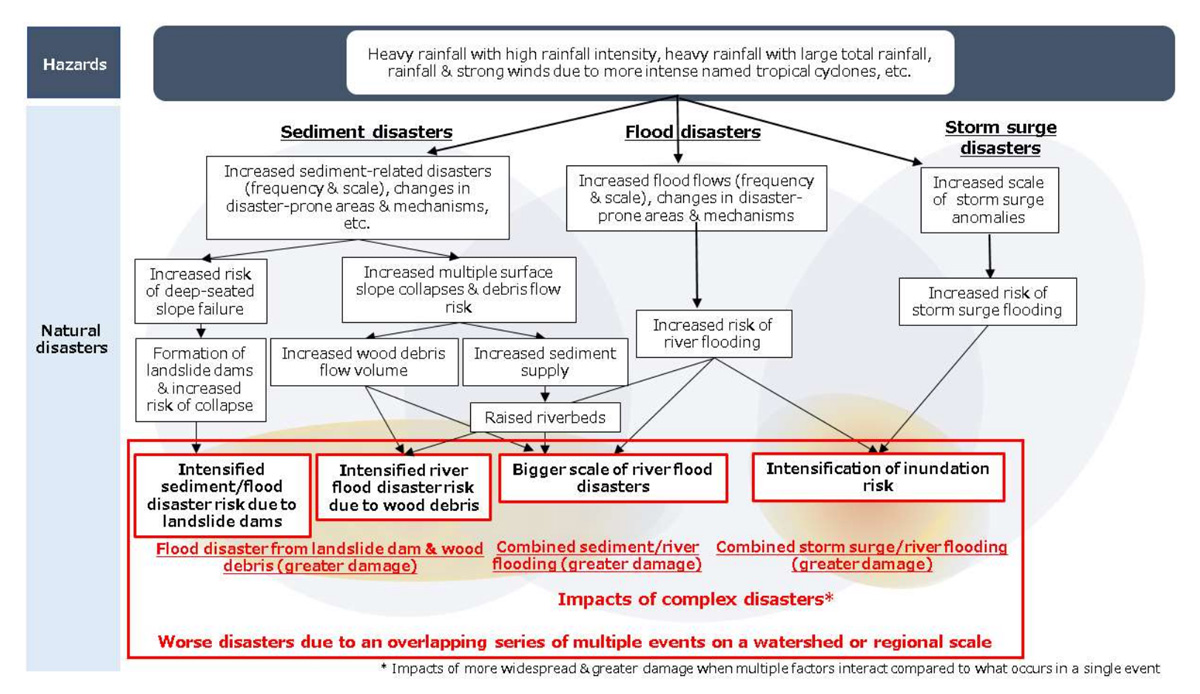
Assessment Report on Climate Change Impacts in Japan, Figure 3-8., December 2020, Ministry of the Environment, Japan
Inter-sectoral impact linkage
An impact in one sector may trigger impacts in others, or impacts may occur sequentially in different sectors to amplify overall damage. The term “inter-sectoral impact linkage” is used to describe such phenomena. (See schematic below.)
For example, a climate change-induced natural disaster can damage urban infrastructure and disrupt lifelines. Disruption to power systems in particular can cause further impacts on agriculture, forestry, fisheries, and other sectors and hinder industry and business activities.
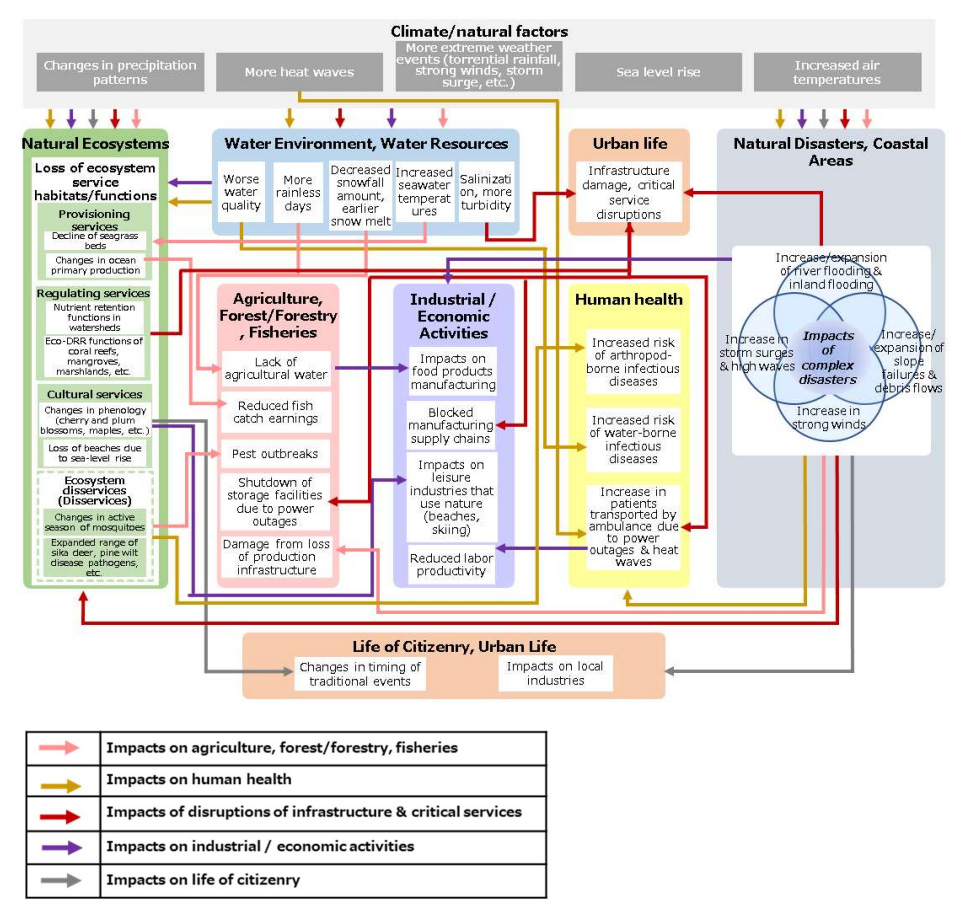
Assessment Report on Climate Change Impacts in Japan, Figure 3-12., December 2020, Ministry of the Environment, Japan