IPCC
This section focuses on the Intergovernmental Panel on Climate Change (IPCC), covering its role as an organization and the nature of its assessment reports.
What is IPCC?
IPCC stands for Intergovernmental Panel on Climate Change. Established by the United Nations Environment Programme (UNEP) and the World Meteorological Organization (WMO) in 1988, the IPCC provides policymakers of member states with regular scientific assessments of climate change, its impacts, future risks, and options for mitigation and adaptation. As of January 2026, 195 countries participate.
The IPCC is comprised of the IPCC Plenary, which serves as its highest decision-making body, three working groups that assess the physical science basis of climate change; impacts, adaptation, vulnerability; and mitigation measures, and the Task Force on National Greenhouse Gas Inventories (TFI), which develops and promotes the methodology used to calculate national greenhouse gas emissions.
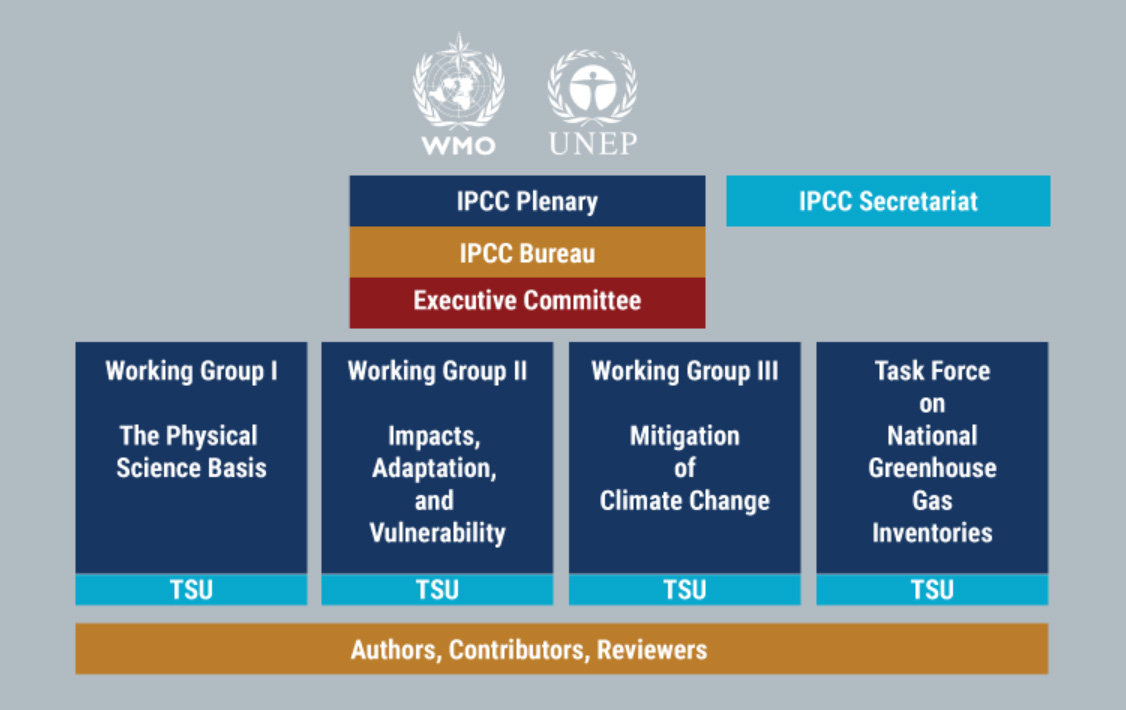
IPCC, ABOUT
The role of each working group is to compile scientific assessments on their respective themes. Their findings are compiled into assessment reports that are published periodically.
The IPCC itself does not conduct the research that goes into its assessment reports; rather, thousands of scientific papers published each year are assessed by researchers nominated as assessment report authors by the governments of member states. Their comprehensive summaries are then approved and adopted by government representatives at the IPCC Session before publication.
Given the large size of full reports, a Summary for Policymakers (SPM) is also produced. Both the full reports and SPMs serve as key scientific foundations for international negotiations at UNFCCC COPs and for national policymaking.
IPCC reports and other outputs
The First to Sixth Assessment Reports
Including the First Assessment Report in 1990, six assessment cycles have been completed, with the Sixth Assessment Report (AR6) being released in stages from 2021 to 2023.
In recent cycles, reports from the three working groups are published first, followed by a Synthesis Report.
- Working Group I: Assesses the physical science basis of the climate system and climate change.
- Working Group II: Assesses the vulnerability of socio-economic and natural systems to climate change, negative and positive consequences of climate change and options for adapting to it.
- Working Group III: Focuses on climate change mitigation, assessing methods for reducing greenhouse gas emissions, and removing greenhouse gases from the atmosphere.
Thousands of scientific papers on climate change are published each year, adding to the store of knowledge on climate change. The IPCC bases its assessments on such papers, and confidence in its assessments of the impact of human activity on global warming has increased with each new assessment report. While the First Assessment Report went no further than suggesting that human activity could be contributing to temperature rise, the Sixth Assessment Report uses much stronger language, stating that “It is unequivocal that human influence has warmed the atmosphere, ocean and land.”
| Reports | Publication year | Assessment of the Contribution of Human Activities to Global Warming | |
|---|---|---|---|
| First Assessment Report 1990 (FAR) |  |
1990 | “We are certain that emissions resulting from human activities are substantially increasing the atmospheric concentrations of greenhouse gases, resulting on average in an additional warming of the Earth’s surface.” Source: IPCC, 1990: Climate Change: The IPCC Scientific Assessment. |
| Second Assessment Report: Climate Change 1995 (SAR) |  |
1995 | “The balance of evidence suggests a discernible human influence on global climate.” Source: IPCC, 1995: Climate Change 1995: The Science of Climate Change. |
| Third Assessment Report: Climate Change 2001 (TAR) |  |
2001 | “There is new and stronger evidence that most of the warming observed over the last 50 years is attributable to human activities.” Source: IPCC, 2001: Climate Change 2001: The Scientific Basis. |
| Forth Assessment Report: Climate Change 2007 (AR4) | 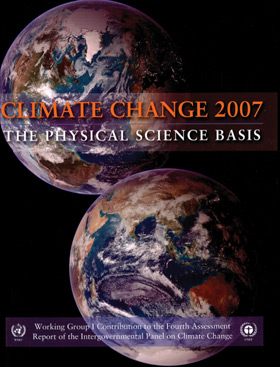 |
2007 | “Most of the observed increase in global average temperatures since the mid-20th century is very likely due to the observed increase in anthropogenic greenhouse gas concentrations.” Source: IPCC, 2007: Climate Change 2007: The Physical Science Basis. |
| Fifth Assessment Report: Climate Change 2013 (AR5) | 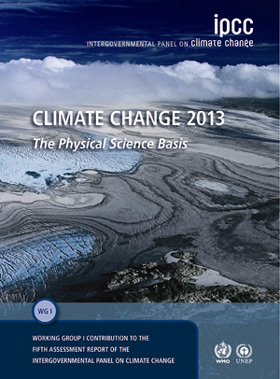 |
2013 | “It is extremely likely that human influence has been the dominant cause of the observed warming since the mid-20th century.” Source: IPCC, 2013: Climate Change 2013: The Physical Science Basis. |
| Sixth Assessment Report: Climate Change 2021 (AR6) | 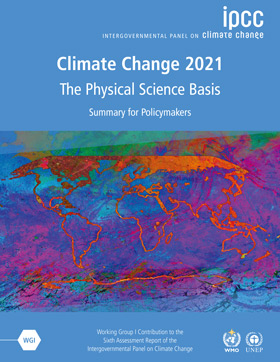 |
2021 | “It is unequivocal that human influence has warmed the atmosphere, ocean and land.” Source: IPCC, 2021: Climate Change 2021: The Physical Science Basis. |
The assessment reports also document projections such as increases or decreases in extreme weather events. The likelihood of these occurrences is expressed using a calibrated scale of 10 levels, based on scientific analysis of their probability—ranging from “exceptionally unlikely” (0-1%) to “virtually certain” (99-100%).
The Special Report on Global Warming of 1.5 °C
The Special Report on Global Warming of 1.5 °C was published by the IPCC in October 2018 in response to a call for such a report, including related greenhouse gas emission pathways, made at the 21st Conference of the Parties (COP21) to the UNFCCC, at which the Paris Agreement was adopted.
The Special Report states that warming has already reached approximately 1.0 °C above pre-industrial levels, and if it continues at the current speed, it is very likely to reach 1.5 °C between 2030 and 2052; that there are clear differences in impacts and risks between 1.5 °C and 2 °C warming; and that to achieve a greenhouse gas emission pathway that does not significantly exceed 1.5 °C, net CO2 emissions must be reduced by approximately 45% by 2030 compared to 2010 levels, and must reach net-zero by around 2050.
The report also assesses the need for transformational adaptation—fundamentally changing lifestyles and urban development—to address future risks, as well as the synergies and trade-offs between adaptation measures and the United Nations Sustainable Development Goals (SDGs).
Other special reports
- The Special Report on Climate Change and Land (SRCCL)
- Published in August 2019, this report assessed scientific findings on sustainable land use and found that approximately 21-37% of anthropogenic greenhouse gas emissions are associated with the food system (production, processing, distribution, etc.) via agriculture and related activities, and stressed the need to reduce food loss and waste, which accounts for about 8-10% of these emissions, to enable low-emission scenarios.
- The Special Report on the Ocean and Cryosphere in a Changing Climate (SROCC)
- Published in September 2019, this report assessed new findings on changes in the ocean and cryosphere and their impacts in high mountain areas, oceans, and elsewhere. It documented phenomena such as the shrinking of glaciers and Arctic sea ice, and permafrost temperature rise; warned of impacts including sea-level rise and effects on marine life; and stressed the need for action related to the ocean and cryosphere.
- 2019 Refinement to the 2006 IPCC Guidelines for National Greenhouse Gas Inventories (2019 Refinement)
- This document updated and refined the methodologies provided in the 2006 IPCC Guidelines for National Greenhouse Gas Inventories for countries to estimate their greenhouse gas emissions and removals.