Assessment Report on Climate Change Impacts
The Climate Change Adaptation Act requires the Minister of the Environment to issue an Assessment Report on Climate Change Impacts approximately every five years. This section explains the contents of the Assessment Report on Climate Change Impacts, starting with an overview and an explanation of its significance.
Overview and significance of the Assessment Report on Climate Change Impacts
Overview of the Assessment Report on Climate Change Impacts
Based on scientific findings, the Assessment Report on Climate Change Impacts assesses the impacts of climate change on the seven sectors (agriculture, forestry and fisheries; water environment and water resources; natural ecosystems; natural disasters and coastal areas; human health; industrial and economic activities; and lives of citizens and urban life) from the three perspectives of significance, urgency, and confidence.
Note that the report is issued in two parts: the Details part provides detailed information about the impact assessment, while the Synthesis Report summarizes this detailed information and also provides an overview of climate change in Japan, and of current initiatives, challenges, and prospects related to impact assessment. This section is devoted primarily to explaining the Synthesis Report.
For more detailed information, see the Japanese page on the Ministry of the Environment website: https://www.env.go.jp/earth/earth/tekiou/page_00003.html
Background to drafting of the Assessment Report on Climate Change Impacts
In 2015, the Ministry of the Environment's Central Environment Council published a "Report on the Assessment of the Impacts of Climate Change in Japan and Future Challenges" as a submission to the Minister of the Environment.
Based on the scientific findings presented in the report, the Climate Change Adaptation Act was enacted in 2018. Article 10 of the Act stipulates that the Minister of the Environment shall prepare and publish an Assessment Report on Climate Change Impacts approximately every five years.
Deliberation process for preparing the Assessment Report on Climate Change Impacts
In preparing this report, six sectoral working groups (WGs) were established to conduct detailed discussions in the following areas: Agriculture, Forestry and Fisheries; Water Environment and Water Resources; Natural Disasters and Coastal Areas; Natural Ecosystems; Health; and Industry and Economic Activities, Citizens’ Lives and Urban Life.
Following discussions in these WGs and related bodies, the Central Environment Council issued its recommendation in 2026 entitled “Evaluation of Climate Change Impacts.” Based on this recommendation, the Assessment Report on Climate Change Impacts was compiled and published in two versions: Overview and Detailed Version.
The report references 2,186 scientific sources, including findings from the IPCC Sixth Assessment Report.
As scientific knowledge on climate change has expanded, it has become possible to conduct more detailed assessments of significance, urgency, and confidence, which are discussed later in this report.
Utilization of the Assessment Report on Climate Change Impacts
The report is intended to support the formulation and revision of the government's Climate Change Adaptation Plan, and the development of adaptation plans by local governments, businesses, and other stakeholders. It helps stakeholders to efficiently identify sector-specific impacts, consider appropriate adaptation measures, and gather information relevant to these purposes.
Key components of the Assessment Report on Climate Change Impacts
The Assessment Report on Climate Change Impacts contains observations and projections of climate change, assessment of climate change impacts, and initiatives for planning adaptation measures.
The key components of the most recent report, published in 2026, are as follows.
Climate change observations and projections
Past climate observations in Japan are conducted by the Japan Meteorological Agency (JMA), the Ministry of Education, Culture, Sports, Science and Technology (MEXT), the Ministry of the Environment (MOE), and other relevant institutions.
These observations are carried out through fixed land-based monitoring stations, research vessels, and Argo floats, which are instruments that drift in the ocean while monitoring conditions below the sea surface. In recent years, observations have also been conducted using satellites such as GOSAT (“Ibuki”) and GCOM-C (“Shikisai”).
Future climate projections are assessed based on Climate Change in Japan 2025, published by MEXT and JMA.
This report primarily uses climate projections for areas around Japan based on the Representative Concentration Pathway (RCP) scenarios used in the IPCC Fifth Assessment Report.
Accordingly, the Assessment Report on Climate Change Impacts presents climate projections based on the RCP2.6 scenario (hereafter referred to as the “2 °C warming scenario”) and the RCP8.5 scenario (hereafter referred to as the “4 °C warming scenario”). The following figure provides an example of such projections.
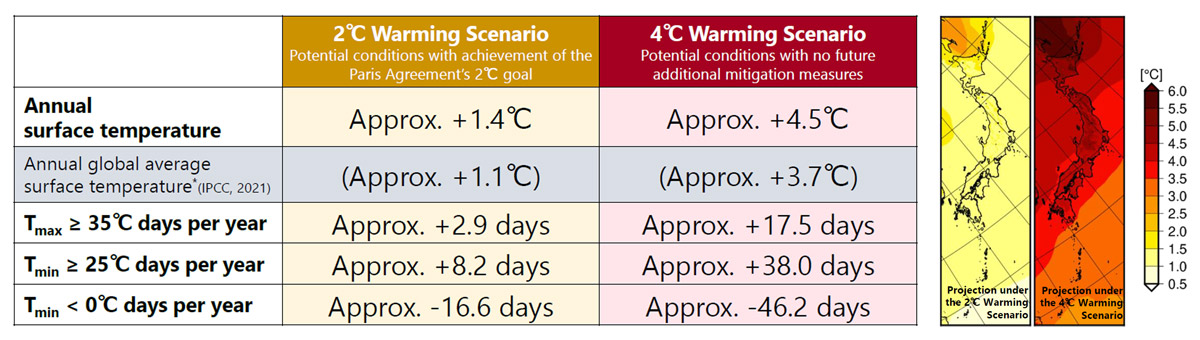
Projected Changes in Annual Mean Temperature ( °C) Based on Japan Meteorological Agency Projections (Example)
Source: Climate Change in Japan 2025, Ministry of Education, Culture, Sports, Science and Technology (MEXT) and the Japan Meteorological Agency (JMA).
Future projections indicate that the annual mean temperature will increase by the end of the 21st century (average for 2076-2095) compared with the end of the 20th century (average for 1980-1999) under all scenarios. The increase is projected to be larger under the 4 °C warming scenario. Under the same scenario, the magnitude of warming is also expected to be greater at higher latitudes.
In addition, projections indicate that by the end of the 21st century, the number of extremely hot days (days with a maximum temperature of 35 °C or higher) and tropical nights (nights when the minimum temperature remains at or above 25 °C) will increase, while the number of winter days (days when the minimum temperature falls below 0 °C) will decrease.
Climate change impact assessment
Climate change impacts are assessed from the three perspectives of significance, urgency, and confidence.
- Significance: Assessment based on three viewpoints: social, economic, and environmental
- Urgency: Assessment based on two viewpoints: when an impact manifests itself, and when adaptation measures should be initiated or crucial decisions taken
- Confidence: Assessment based on two viewpoints: the type of research/report and the degree of consensus among views, referencing the concept of confidence levels used in the IPCC's Fifth Assessment Report
In this assessment report, the significance of climate change impacts is evaluated under three temperature scenarios: current conditions, 1.5-2 °C warming, and 3-4 °C warming. The degree of impact is classified into three levels:
- Level 1: Impacts are observed
- Level 2: Significant impacts are observed
- Level 3: Particularly significant impacts are observed
This classification makes it easier to identify which impacts are especially severe.
Based on these criteria, assessments were conducted for 80 items across seven sectors: agriculture, forestry and fisheries; water environment and water resources; natural ecosystems; natural disasters and coastal areas; health; industry and economic activities; and citizens’ lives and urban life.
The results show that 52 of the 80 items (65%) were assessed as Level 2 or higher, indicating significant or particularly significant impacts. Among them, 23 items (29%) were evaluated as Level 3, meaning particularly significant impacts.
Regarding urgency, 54 items (68%) were assessed as Level 3: high urgency. Of these, 47 items (59%) were judged to require early decision-making, because adaptation measures would take a long time to become effective compared with the expected timing of the impacts.
In terms of confidence, 39 items (49%) were rated as Level 3: high confidence for significance, and 34 items (43%) were rated as Level 3: high confidence for urgency.
Overall, the assessment indicates that climate change impacts are both significant and urgent across a wide range of sectors.
For detailed information on impacts in each sector, see Climate change impacts and adaptations in each sector.
Examples of significant impact assessments and projections: The impact of climate change on disasters caused by extreme weather events
In recent years, Japan has suffered a great many serious disasters caused by extreme weather events, significantly impacting people's lives, industry, and other sectors. Although research on the relationship between climate change and weather events like typhoons and heavy rainfall is still limited, some studies suggest that climate change may influence typhoon trajectories and where typhoons reach their maximum intensity.
Regarding future impacts, although trends will vary by region, projections indicate that by the latter half of the 21st century, rising temperatures will likely increase the frequency of strong winds and intense typhoons, and heavy rainfall events capable of causing flooding in Japan's major river basins are expected to rise significantly by the end of this century.
Complex disaster impacts
The heavy rainfall events that struck northern Kyushu in July 2017 and in many parts of Japan in July 2018 caused both landslides and flooding at the same time, with interaction between the two impacts amplifying the damage they caused.
Although the impact of climate change on past disasters remains unclear, projections indicate a likely increase in the frequency of heavy rainfall events and powerful typhoons. Based on this, the report describes current impacts and highlights complex disaster impacts in which multiple factors - for example, sediment runoff from heavy rain raising riverbeds and exacerbating flooding - interact to cause broader and more severe damage than if they occurred independently.
Inter-sectoral impact linkage
We have so far described impact assessment applied separately to the seven sectors, but properly addressing climate change impacts requires that we also pay attention to the linkage of impacts across sectors and categories. For example, recent disasters caused by extreme weather events have had major social and economic impacts due to damage to infrastructure and disruption of lifelines.
The report defines the term "inter-sectoral impact linkage" as phenomena in which one impact triggers further impacts in other sectors, or in which interactions between impacts occurring consecutively in different sectors amplify damage. It also provides a number of examples and outlines concerns related to such linkage.
However, the mechanisms behind such impact linkage are complex and current scientific knowledge is limited. Further research is needed to enable more accurate assessment of such linkage.
Impact assessment issues and prospects
Formulating climate change adaptation measures based on scientific findings requires continuous observation and monitoring of climate change and its impacts. Drawing up adaptation measures is, however, hampered by limited access to data (e.g., unpublished, non-digitized, complicated access procedures), poor continuity (limited long-term data accumulation), low spatial and temporal resolution, narrow scope of coverage, and other such constraints.
Furthermore, to promote climate change adaptation by all stakeholders, collaboration among relevant organizations and the development of information platforms are essential. Strengthening cooperation and building information systems will be key to advancing these efforts.