Field Report: Identifying Suitable Areas for Coral Conservation and Rehabilitation in Subtropical Islands
INTRODUCTION
Through AP-PLAT, we introduce NIES research on coral reef ecosystems in subtropical island regions, focusing on current conditions and climate change adaptation measures. Following our previous field report, this article highlights ongoing research on the environment and ecosystems of Japan’s coral reef areas.
Japan extends from north to south between 20°N and 45°N, and coral reefs are commonly found along the subtropical coastline in the southwestern part of the country. Coral reef ecosystems provide a wide range of benefits, but they are increasingly affected by environmental stresses at both global and regional scales. As a result, the degradation of coral communities, including declines in coral coverage, has been observed in many areas.
As part of efforts to conserve and rehabilitate coral communities, in situ coral aquaculture is being conducted in the sea areas of Okinawa and Kagoshima Prefectures. As cultivated corals grow, they are expected to be used for transplantation to other locations and to release larvae that can disperse over a wide area. Coral farming also provides valuable opportunities for environmental education.
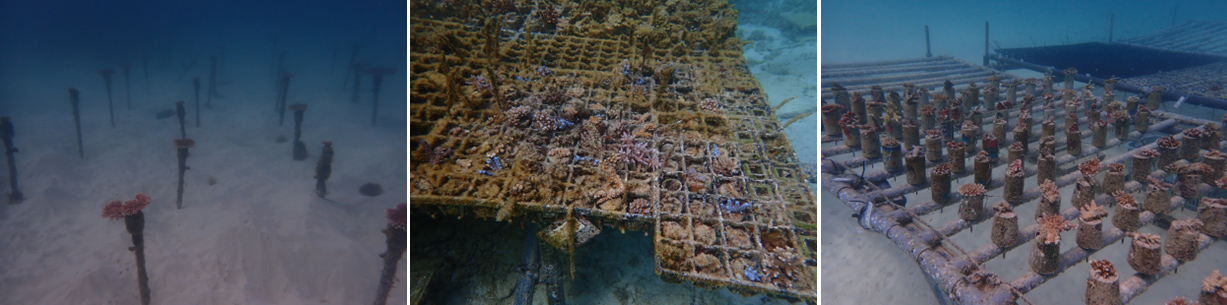
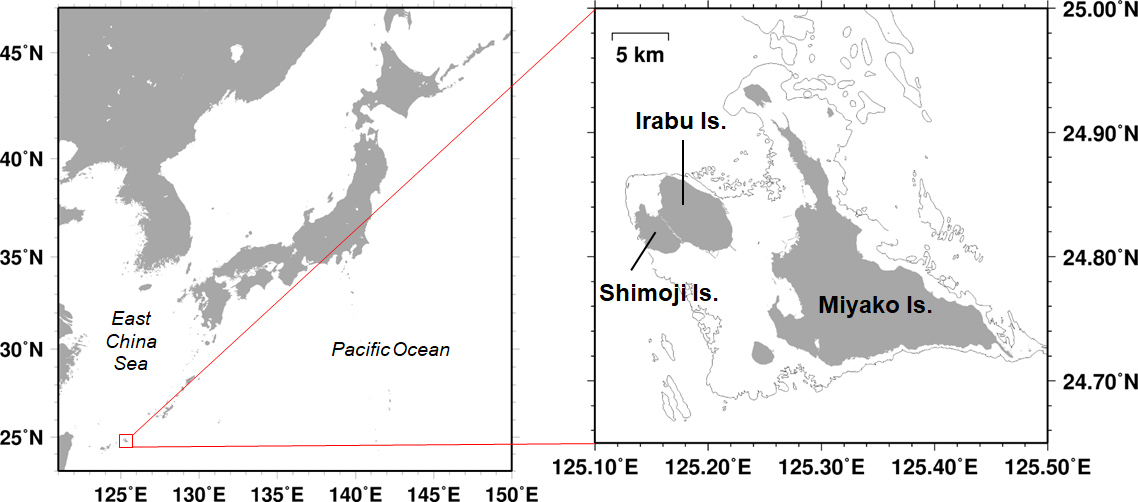
However, if the conditions at a coral farm are not optimal, low growth and survival rates can become major challenges. Therefore, in addition to understanding the present conditions of existing coral aquaculture sites, identifying sites with more favorable environments and assessing their sustainability in the face of future climate change are key research priorities. In this article, we will introduce the research being conducted around Irabu Island and Shimoji Island in Okinawa Prefecture.
| Adaptation Sector/Theme | Agriculture, Biodiversity, Coastal areas, Fisheries, Tourism |
|---|---|
| Study Area | Irabu Island and Shimoji Island, Okinawa Prefecture, Japan (24.7–24.9°N, 125.1–125.2°E) |
| Survey Period | May 2026 |
MONITORING & INSIGHTS
In Situ Environmental Monitoring
The growth and survival of corals are influenced by various environmental factors, including water temperature, salinity, current velocity, wave height, nutrient concentrations, and sediment deposition. Because these parameters are subject to significant spatial and temporal variations, in situ observations are essential for understanding local environmental conditions.
By installing measuring instruments such as water temperature sensors and current meters near the seafloor, researchers can closely monitor changes in the physical environment. In addition, observations using water quality meters, as well as the collection and analysis of seawater and sediment samples, provide insights into water quality and seabed sediment characteristics.

(a) Continuous measurement of the physical environment using instruments installed near the seafloor;
(b) measurement of water quality by dropping a multi-parameter water quality sensor from a boat;
(c) collection of seawater samples from near the seafloor; and (d) collection of seabed sediment samples.
Other Analytical Methods
Field observations in the target sea area make it possible to assess coral habitats with high accuracy and temporal resolution. However, there are limitations to the observable spatial range and time period.
Therefore, to understand environmental changes in areas and periods where on-site observations are not available, it is important to conduct parallel analyses using satellite remote sensing and numerical simulations that model marine environments on computers. Many research institutions provide global satellite observation and simulation datasets that are publicly available, often free of charge (e.g., NOAA Coral Reef Watch, Copernicus Marine MyOcean Viewer).
However, it remains difficult to fully characterize highly localized environments such as coral aquaculture sites using these broad-scale datasets alone. For this reason, monitoring and analysis that reflect the specific characteristics of each region are essential.
AP-PLAT also provides access to various publicly available climate change-related datasets through ClimoKit.
FUTURE OUTLOOK
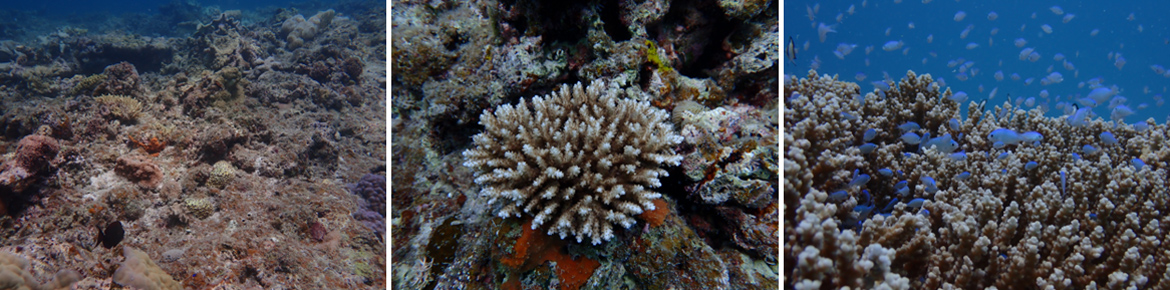
The marine areas currently under investigation have been affected by high water temperatures and other factors, leading to mass coral bleaching and subsequent mortality, most recently in 2024. In the summer of 2025, water temperatures did not rise significantly, and this survey revealed the recruitment of new coral colonies. Although coral coverage is currently low, it is expected to recover steadily.
However, concerns remain about the impacts of long-term increases in water temperature and marine heatwaves associated with climate change. The possible development of El Niño conditions in 2026 may influence temperature and rainfall patterns across the Pacific region, potentially adding further stress to coral reef ecosystems. Therefore, it is increasingly important to promote conservation and adaptation measures—such as continuing to monitor the marine environment and ecosystems, identifying optimal aquaculture sites, strengthening conservation efforts, and mitigating environmental stress at the regional level.
AP-PLAT/CCCA will continue conducting research activities, including environmental monitoring and future projections, in various regions. In addition, AP-PLAT’s Adaptation Database also provides several case studies related to coral reefs.
ACKNOWLEDGEMENT
This research is supported by the Climate Change Adaptation Research Project at the National Institute for Environmental Studies. In addition, field surveys are conducted with the cooperation of local fishermen.
RELATED INFORMATION
Research Papers
- Coupling high-resolution coral bleaching modeling with management practices to identify areas for conservation in a warming climate: Keramashoto National Park (Okinawa Prefecture, Japan)
- Priority coral conservation areas under global warming in the Amami Islands, Southern Japan
- Priority sites for coral aquaculture in Kume Island based on numerical simulation
AP-PLAT Adaptation Database
- Fine-scale Aquatic Data and Land Use Maps to Help Assess Ecosystem Risk in Asia-Pacific
- Launching the InCORE Project: Reviving Coral Reefs in the Philippines for a Sustainable Future
- Reef Restoration Drives Tourism and Climate Action in the Maldives
- Climate-resilient Coral Varieties in Port Vila, Vanuatu
- Coral Regeneration Project in Okinawa, Japan
- Great Sea Reef Resilience Program in Cakaulevu, Fiji
EXPLORE ADAPTATION
- Nature-based Solutions (NbS) Good Practices for Coastal Area in the Asia-Pacific
- Climate Change and Biodiversity Synergy –Bridging Science and Policy for a Resilient Asia-Pacific
A-PLAT (Japanese website)
Reported by Hiroya ABE
(Posted : 29/Jun/2026)
