Field Report: Nature-based-Solutions (NbS) for Resilient Societies to Climate Change in Marshall Islands
INTRODUCTION
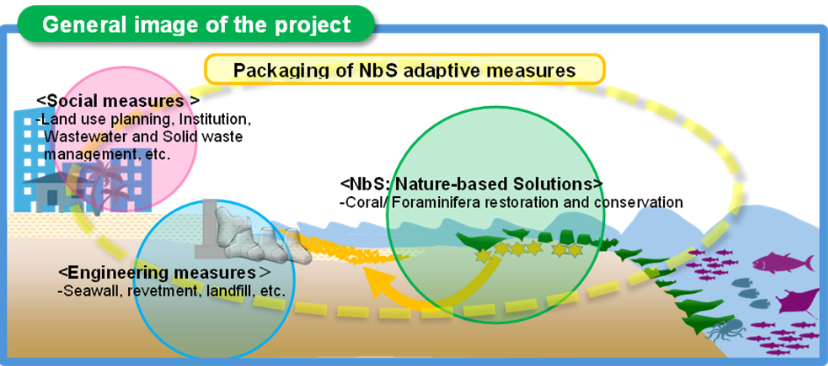
Through AP-PLAT, we introduce a research project on NbS in a Pacific atoll nation (NbS-PATS) in which NIES researchers are participating (Fig. 1). This field report focuses on Majuro Atoll in the Republic of the Marshall Islands and introduces field surveys and analyses related to coral reef ecosystems, coastal environments, and climate change adaptation. Pacific atoll nations are highly vulnerable to climate change because of their very small land area and low elevation. They are exposed to long-term sea-level rise as well as short-term extreme events such as storm surges and high tides. Rising water temperatures also threaten coral reef ecosystems, which are among the key coastal ecosystems supporting atoll environments and communities.
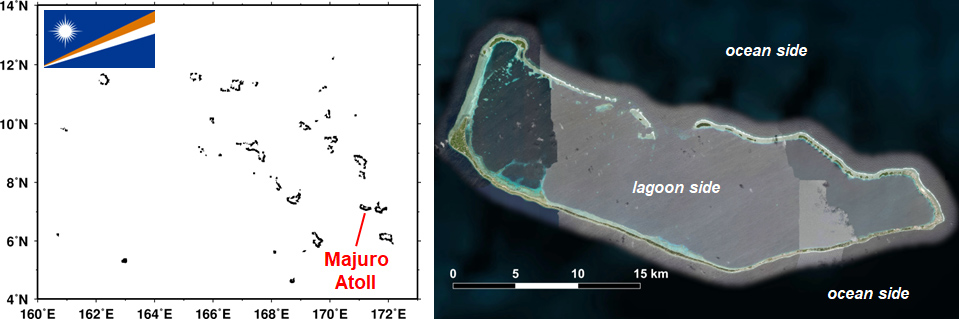
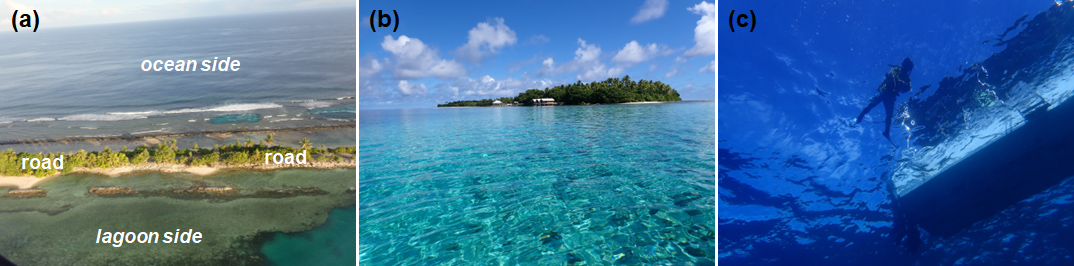
Majuro Atoll, the capital area of the Republic of the Marshall Islands (Fig. 2) is located roughly in the central in the Pacific Ocean. Majuro Atoll is the location of the capital of the Marshall Islands and is characterized by its high level of human activity. The atoll consists of a lagoon side, surrounded by islands, and an ocean side facing the open sea. Waves on the lagoon side are relatively calm, but the land is often very narrow. In some areas, it is only wide enough for a road (Fig. 3a). Except in areas affected by severe water pollution, the lagoon features clear waters that support marine activities such as diving and snorkeling (Fig. 3b, c).
At the same time, Majuro faces serious climate risks. According to a World Bank study, projected sea-level rise could endanger 40 percent of existing buildings in Majuro, while 96 percent of the city could be at risk of frequent flooding induced by climate change. These findings highlight the urgent need to consider adaptation options, including nature-based solutions, land raising, seawalls, and other measures to protect homes, infrastructure, livelihoods, and ways of life.
| Adaptation Sector/Theme | Biodiversity, Coastal areas, Fisheries, Tourism |
|---|---|
| Study Area | Majuro Atoll, Republic of the Marshall Islands (7.0–7.3°N, 171.0–171.4°E) |
| Survey Period | July 2026 |
FIELD SURVEYS AND ANALYSIS
Our research team focuses on the theme of “Spatial Planning and Maximizing the Use of Coral Reef Ecosystem Services,” with the following as our primary objectives. 1) To identify priority conservation areas for corals in the lagoon, 2) to investigate the potential use of reef-flat-derived sediments for beach nourishment, and 3) to investigate the possibility of using the excavation pits as a coral farm. In this article, we will provide an overview of the monitoring of ecosystems and seafloor sediments.
This article provides an overview of ecosystem and seafloor sediment monitoring conducted as part of this broader research.
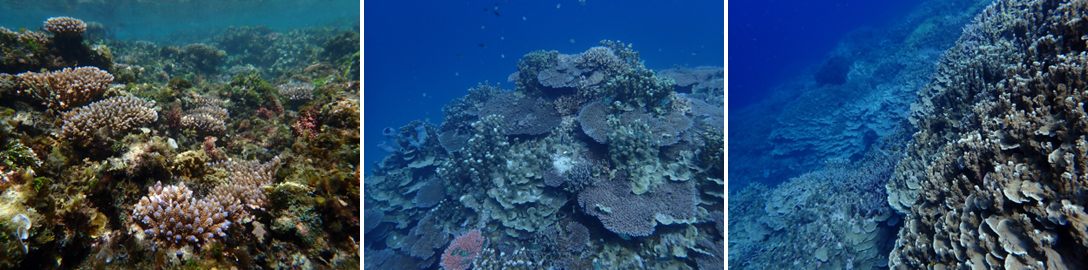
A flourishing coral reef ecosystem has formed within the lagoon, where diverse coral communities and fish species can be observed (Fig. 4). However, according to local stakeholders, rising water temperatures in recent decades have caused a decline in coral cover, posing a serious problem. Most recently, a relatively large-scale coral bleaching event occurred in the fall of 2024 (Fig. 5a), and many coral populations subsequently died (Fig. 5b). Crown-of-thorns starfish, which prey on corals, have also been observed on the lagoon side of Majuro Atoll. Although their numbers are currently low, continued monitoring is needed to detect potential mass outbreaks (Fig. 5c). Coral reef ecosystems are extremely important for reducing wave energy. They also support fisheries, tourism, biodiversity and local livelihoods. For low-lying atolls such as Majuro, coral reefs can function as natural infrastructure that helps protect coastlines from waves and erosion. Ensuring the conservation and recovery of coral reef ecosystems is therefore essential under the impacts of climate change.
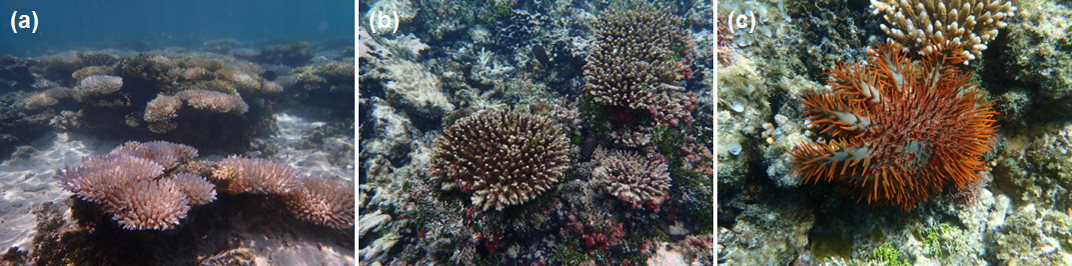
(b) coral community that died after bleaching and is then covered in algae (photo taken in February 2025), and (c) coral-eating seastars (crown-of-thorns starfish) on the lagoon side of Majuro Atoll.
The skeletons of dead and fragmented corals are a key components in the formation of coral reef topography. However other biological communities also play important roles in forming and maintaining atoll environments. For example, foraminifera are widely distributed on reef flats, grow rapidly, and produce large quantities of shells that can be found on sandy beaches and on the seafloor in shallow waters (Fig. 6a). In addition, calcareous green algae (Halimeda) are widely distributed in coral reef areas (Fig. 6b) and can accumulate in large quantities on the seafloor after they die.
Understanding these biological and sedimentary processes is important for examining adaptation options such as beach nourishment and the use of reef-flat-derived sediments. Such knowledge can support the design of measures that work with natural processes rather than relying only on hard infrastructure.
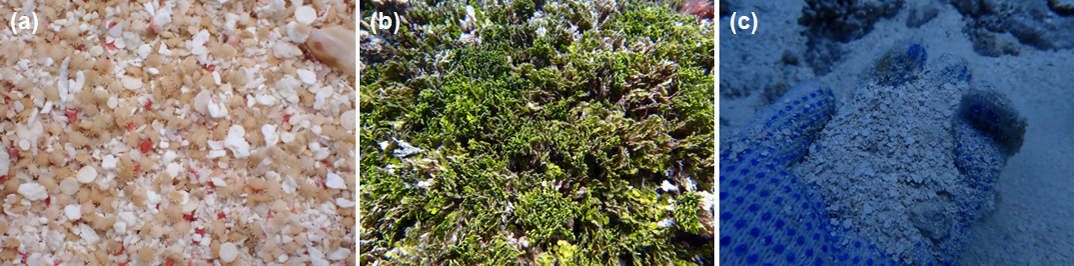
(a) Foraminifera, (b) and (c) living and dead calcareous green algae (Halimeda), respectively.
International Support and Adaptation Initiatives
Majuro’s coral reef and coastal adaptation challenges are part of a broader context of international support for climate resilience in the Marshall Islands.
One example is the Blue-Green Atolls Project, supported by UNDP, the Global Environment Facility Trust Fund, and the Special Climate Change Fund. The project aims to strengthen climate resilience in the Republic of the Marshall Islands by protecting water, land, ecosystems, and atoll communities. It emphasizes hybrid nature-based solutions, such as groundwater recharge, permeable salinity barriers, groundwater recharge swales, coastal buffer restoration, and improved water infrastructure.
Other projects and initiatives have also supported climate change adaptation and coastal resilience in the Marshall Islands. Together, these efforts show that coral reef conservation and coastal ecosystem management are not only environmental issues, but also central to adaptation planning, disaster risk reduction, water security, and community resilience in atoll nations.
FUTURE OUTLOOK
In addition to monitoring ecosystems and sediments as described here, our research team is simultaneously conducting surveys and analyses that utilize continuous measurements using instruments, satellite observations, and numerical simulations. By incorporating these results, we will gain a better understanding of the impacts of climate change on the coastal environment and ecosystems, and we will continue to explore adaptation measures to mitigate its effects on the atoll.
For Majuro and other low-lying atolls, adaptation requires a combination of approaches. These may include conserving and restoring coral reef ecosystems, identifying priority areas for coral protection, exploring the use of natural sediments for beach nourishment, improving coastal management, and considering nature-based and hybrid solutions alongside engineering and social measures. AP-PLAT/CCCA will continue conducting research activities, including environmental monitoring and future projections, in various regions. In addition, AP-PLAT’s Adaptation Database also provides several case studies related to coral reefs.
ACKNOWLEDGEMENT
This research is supported by the Climate Change Adaptation Research Project at the National Institute for Environmental Studies (NIES) and the Environment Research and Technology Development Fund of the Environmental Restoration and Conservation Agency (ERCA) provided by Ministry of the Environment of Japan (MOEJ). The field survey is being conducted under a permit issued by Republic of the Marshall Islands Environmental Protection Authority (RMIEPA).
RELATED INFORMATION
Project homepage
Source
- World Bank, Marshall Islands: New Climate Study Visualizes Confronting Risk of Projected Sea Level Rise, Published on October 29, 2021.
- UNDP, Marshall Islands Secures Major UNDP–GEF Investment to Protect Water, Land, and Atoll Communities from Climate Change, Published on December 29, 2025
AP-PLAT Adaptation Database
- Marshall Islands Sets Unique Adaptation Pathway to 2150
- Pacific Regional Framework on Climate Mobility
EXPLORE ADAPTATION
- Nature-based Solutions (NbS) Good Practices for Coastal Area in the Asia-Pacific
- Climate Change and Biodiversity Synergy –Bridging Science and Policy for a Resilient Asia-Pacific
A-PLAT (Japanese website)
Reported by Hiroya ABE
(Posted : 28/Jul/2026)
