 Oceania - Marshall Islands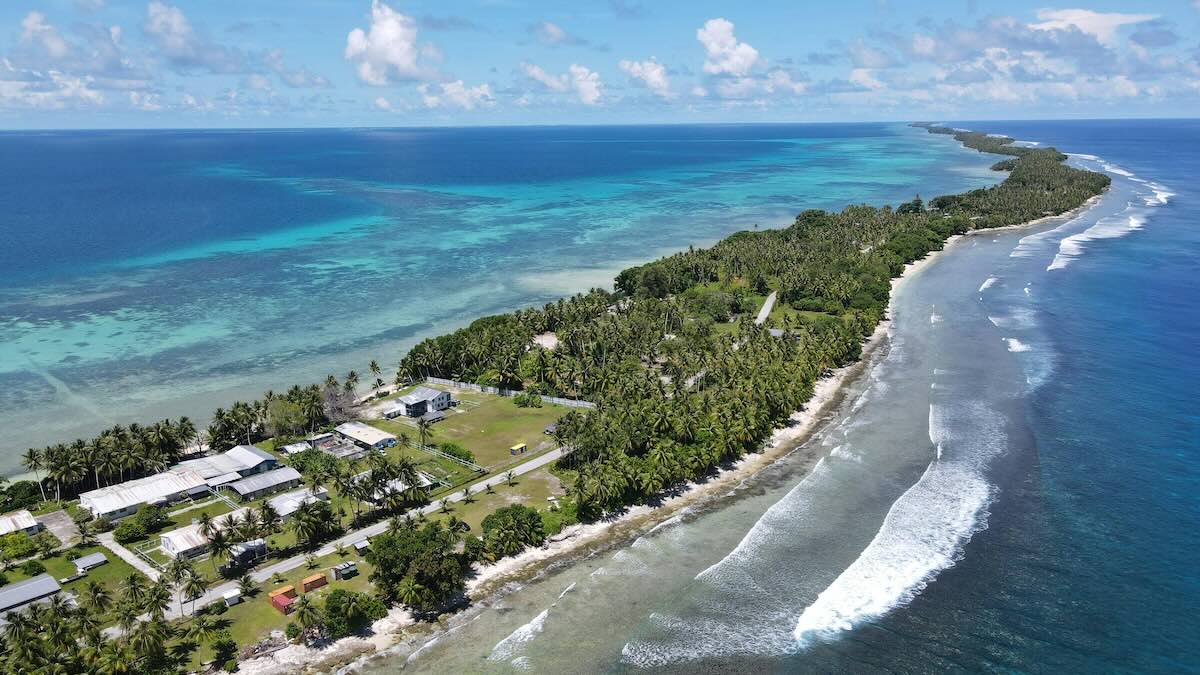
Challenge
The Marshall Islands face escalating climate risks and need a long-term adaptation strategy that protects people, livelihoods, and atoll ecosystems across generations.
Solution
The 2023 NAP sets a unique four-phase adaptation pathway to 2150, combining risk assessment, capacity building, and progressively more transformative measures.
Overview
The Republic of the Marshall Islands is an atoll nation in the Pacific Ocean and is highly exposed to climate change because of its low-lying land. Rising sea levels, stronger high tides, and more intense extreme weather events threaten livelihoods, culture, and socio-economic stability. Fisheries and tourism are central to the national economy, and climate impacts on coasts and marine ecosystems directly affect these sectors.
Observed and projected climate impacts already create pressure across the islands. Sea level rise leads to inundation and coastal erosion. Droughts cause water shortages, and coral bleaching changes marine ecosystems that communities depend on for food and income. These changes pose risks not only to daily life but also to the country’s long-term development prospects.
In response, the government prepared a National Adaptation Plan as part of the World Bank’s Pacific Resilience Project – Phase II. The NAP, submitted in 2023, sets out a long-term strategy to strengthen adaptive capacity and support sustainable development. It emphasizes community participation and combines traditional knowledge with scientific information to design adaptation measures.
A four-phase adaptation pathway to 2150
A distinctive feature of the Marshall Islands’ NAP is a four-phase adaptation pathway that extends to 2150. NAP Section E, “The National Adaptation Pathway for Survival,” presents this approach as a long-term roadmap with goals and measures for each phase.
The pathway sequences issues and actions according to projected climate impacts. The first phase emphasizes risk assessment, capacity building, and knowledge sharing. Later phases expand work on infrastructure, ecosystems, and, if needed, relocation as climate impacts intensify.
The four phases are described as follows:
- Phase 1 (present–2030) Building a Resilient Foundation: Focuses on risk assessment, capacity building, and dissemination of climate information.
- Phase 2 (2030–2050) Implementing and Mainstreaming: Implements adaptation measures and integrates them into society, including infrastructure, ecosystems, and livelihoods.
- Phase 3 (2050–2070) Transformative Adaptation: Considers and implements more far-reaching changes in systems in anticipation of worsening impacts.
- Phase 4 (2070–2150) Resilience and Sustainability: Aims to maintain a resilient and sustainable society under long-term, severe climate impacts.
Through this structure, the NAP links near-term actions with a long-range vision for survival and resilience.
Connections to transformational adaptation
The adaptation pathway in the Marshall Islands’ NAP relates to international discussions on transformational adaptation. Transformational adaptation involves more far-reaching measures that change basic features of society and the economy, in contrast to incremental adjustments.
A technical paper published in 2024 under the United Nations Framework Convention on Climate Change explores the concept and need for transformational adaptation. It describes transformational adaptation as an intentional process to change social, economic, and ecological systems so they can cope with climate impacts. The paper highlights the value of long-term vision, multi-sector approaches, and attention to equity and justice.
The Marshall Islands’ NAP reflects several of these elements. Its extended time horizon, phased structure, and openness to major changes, including potential relocation, show how an atoll country can organize adaptation planning around long-term survival. The NAP provides a unique example of how transformational adaptation concepts are being applied in a specific national context.
Acknowledgements
This report is based on publicly available information on the Republic of the Marshall Islands’ National Adaptation Plan and associated resilience initiatives.
Related information
- World Bank: Against the rising tide: The Marshall Islands’ National Adaptation Plan
https://blogs.worldbank.org/en/climatechange/against-the-rising-tide–the-marshall-islands–national-adaptati - SPREP: Ambitious National Adaptation Plan for the Republic of the Marshall Islands launched at COP28
https://www.sprep.org/news/ambitious-national-adaptation-plan-for-the-republic-of-the-marshall-islands-launched-at-cop28
 DISCOVER MORE

