Evolving Landscape of Global Adaptation Ahead of COP31
October 2026

OVERVIEW
As COP31 approaches, global adaptation efforts are shifting from framework-setting towards practical implementation. This article introduces two recent publications and explores how regional platforms such as AP-PLAT can help bridge global frameworks and implementation across the Asia-Pacific.
FROM GLOBAL FRAMEWORKS TO REGIONAL IMPLEMENTATION
As the international community prepares for the 31st Conference of the Parties to the United Nations Framework Convention on Climate Change (COP31), climate change adaptation is entering an important new phase. Over recent years, international discussions have increasingly focused not only on establishing global frameworks for adaptation, but also on how these frameworks can be translated into effective implementation at the national and local levels.
At the center of these discussions is the Global Goal on Adaptation (GGA), established under the Paris Agreement to enhance adaptive capacity, strengthen resilience and reduce vulnerability to climate change. Since its establishment, Parties have worked to make the GGA more concrete and measurable. A major milestone was reached at COP30 in 2025 with the adoption of the 59 Belém Adaptation Indicators, designed to support assessment of progress towards the 11 targets under the GGA.
The adoption of the indicators, however, is not the end of the process. Attention is now shifting towards how they can be applied in practice, how they can support meaningful monitoring, evaluation and learning (MEL), and how global assessment can remain responsive to diverse national circumstances and priorities. These questions are expected to remain highly relevant in the lead-up to COP31 and beyond.
For adaptation practitioners in the Asia-Pacific region, developments in international negotiations are important because global frameworks increasingly shape how adaptation progress is understood, monitored and supported. At the same time, negotiations often involve issues on which reaching agreement can take time, including because of differing political and national circumstances, and progress may therefore be gradual. This makes practical cooperation outside the negotiating process increasingly important. Regional platforms and networks can help bridge global frameworks and implementation by facilitating knowledge exchange, institutional learning and capacity development across countries. The Asia-Pacific Climate Change Adaptation Information Platform (AP-PLAT) is one such mechanism. By supporting knowledge sharing and capacity development across the region, AP-PLAT can help connect international policy discussions with the practical experiences and needs of countries and practitioners. Such regional cooperation becomes particularly valuable as global adaptation governance moves from framework-setting towards implementation.
RESOURCES FOR UNDERSTANDING THE EVOLVING ADAPTATION LANDSCAPE
Researchers from the Institute for Global Environmental Strategies (IGES), who also support the operation of AP-PLAT’s capacity development activities, have recently contributed to two publications aimed at helping policymakers and practitioners understand these evolving international discussions.
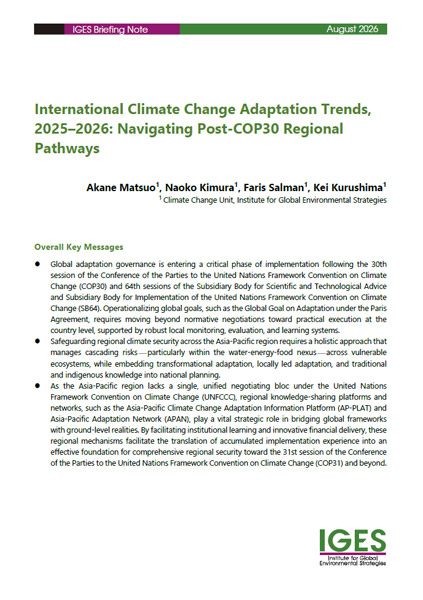
The IGES Briefing Note, International Climate Change Adaptation Trends, 2025–2026: Navigating Post-COP30 Regional Pathways, reviews major international adaptation trends following COP30 and the 64th sessions of the UNFCCC Subsidiary Bodies. It covers the GGA as well as transformational adaptation, locally led adaptation, integrated planning, MEL, traditional and Indigenous knowledge, and adaptation finance. A central message of the briefing is that global adaptation governance is moving towards implementation, increasing the importance of regional cooperation in connecting global frameworks with national and local action. In this context, the briefing highlights AP-PLAT and other regional knowledge-sharing networks as important mechanisms for translating implementation experience into regional learning and cooperation.
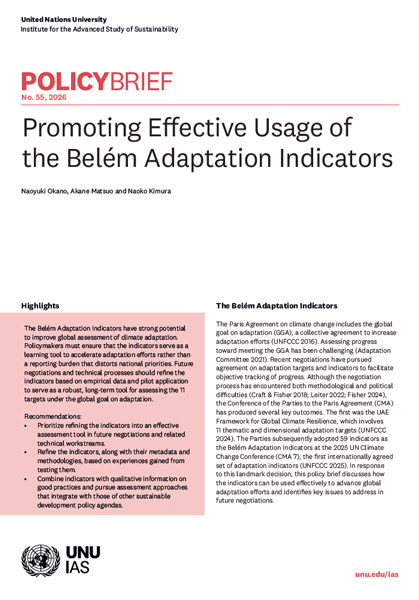
For those interested in exploring the significance and practical use of the newly adopted indicators in greater depth, the United Nations University Institute for the Advanced Study of Sustainability (UNU-IAS) Policy Brief, Promoting Effective Usage of the Belém Adaptation Indicators, provides a focused examination of the GGA indicators. It examines how the 59 indicators can contribute to global assessment and national MEL while maintaining country-driven adaptation. The brief stresses the importance of using the indicators as tools for learning and accelerating adaptation, rather than allowing them to become an additional reporting burden, and recommends further refinement based on practical testing and empirical experience.
Together, the two publications provide background for understanding the changing international adaptation landscape ahead of COP31, while also highlighting an increasingly important question: how global agreements can be translated into meaningful adaptation action on the ground. Regional platforms such as AP-PLAT have an important role to play in helping make that connection.
(Posted : 15/Oct/2026)
