CENTER FOR CLIMATE CHANGE ADAPTATION (CCCA)
BACKGROUND OF THE ESTABLISHMENT
The Center for Climate Change Adaptation (CCCA) was established on December 1, 2018, under the National Institute for Environmental Studies (NIES), which plays a central role in Japan in formulating integrated responses to environmental issues both domestically and internationally across a wide range of research fields. The date is the same as the one when the Climate Change Adaptation Act was enacted.
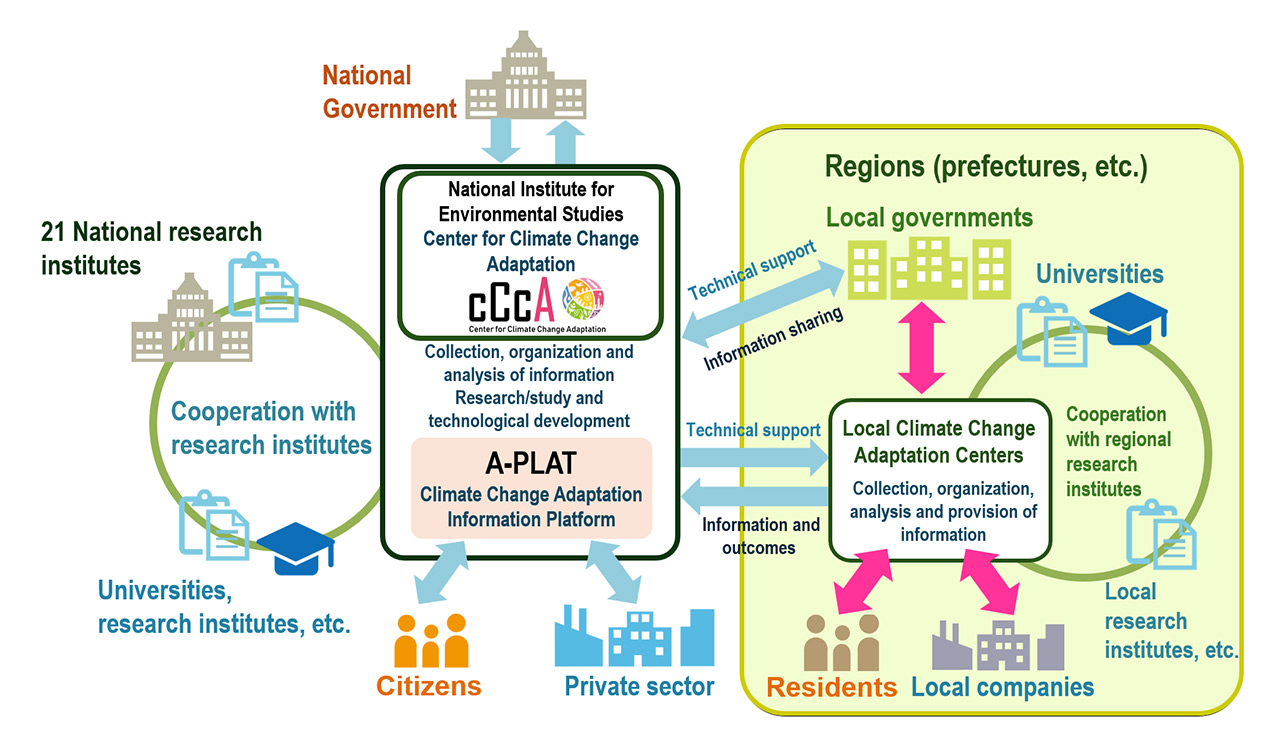
The Act was promulgated in June 2018 to address intensifying unavoidable impacts of climate change. Under the Act, NIES is responsible for collecting, organizing, analyzing, and providing information on climate change impacts and adaptation. It also provides technical advice to local governments and Local Climate Change Adaptation Centers (LCCACs) on their climate change adaptation efforts.
And thus, the CCCA was established to serve as a hub.
MISSIONS OF CCCA
CCCA contributes to the formulation of climate change adaptation plans and the implementation of adaptation measures by national and local governments. It also supports various entities including businesses and individuals to take measures for climate change adaptation. CCCA plays a central role in collecting, organizing, and analyzing information and promoting research on climate change impacts and adaptation.
KEY ACTIVITIES
CCCA was established to fulfill NIES’s role under the Climate Change Adaptation Act in acting as the scientific information infrastructure. Information provided will help local governments, businesses and all people in Japan, including foreign visitors, to take measures to adapt to climate change.
Specifically, its roles are as follows:
- collecting, analyzing, organizing and providing information on climate change impacts and adaptation;
- providing technical advice and other technical assistance to Prefectures and municipalities on formulation and promotion of their local climate change adaptation plans; and
- providing technical advice and other technical assistance to LCCACs, local governments, businesses and all people in Japan. In addition, CCCA extends its support broadly across the Asia-Pacific region.
CCCA promotes adaptation initiatives by broadly providing information, obtained from support activities for local governments, businesses and all people in Japan and research on climate change impacts and adaptation, in an easy-to-use format through the Climate Change Adaptation Information Platform (A-PLAT).
CCCA also continuously improves and enhances the Asia-Pacific Climate Change Adaptation Information Platform (AP-PLAT), established in 2019 to support developing countries in the Asia-Pacific region to formulate and implement their adaptation plans. Through global networks involving major countries and international organizations, as well as local networks within the region, CCCA facilitates international coordination and cooperation in climate change adaptation.
ORGANIZATION
- Director
- Deputy Directors (Administration and Research)
- Senior Research Coordinator
- Office for Climate Change Adaptation Coordination
- Climate Change Impacts Monitoring Research Section
- Climate Change Impacts Assessment Research Section
- Climate Change Adaptation Strategy Research Section
- Asia-Pacific Climate Change Adaptation Research Section
The following introduces concrete examples of CCCA’s support activities. They are divided into six areas: support for local governments; support for private sector; support for individuals; promotion of international cooperation; development of information platform; and collaboration with research institutes.
In addition, a brief overview of research activities aimed at promoting climate change adaptation, which form the foundation of these support efforts, is provided at the end.
Support for local governments
Support for LCCACs to Formulate Local Climate Change Adaptation Plans and Other Measures
CCCA offers guidance by dispatching experts to committees and councils to formulate local climate change adaptation plans. As well as this, conducting various training and seminars for local government officers and LCCAC staff is one of the important CCCA’s tasks. Through A-PLAT, CCCA also provides a variety of tools and information: a support tool to develop local climate change adaptation plans; easy-to-grasp infographics that use illustrations to explain climate change adaptation measures; WebGIS to support data collection and dissemination; a collection of specific case studies of climate change adaptation measures; and an operational guidebook for LCCACs.
Support for LCCACs to Pursue Research
CCCA has launched and conducted multiple joint research projects with LCCACs on topics related to climate change adaptation, such as frost damage on fruit trees, heat-related health issues and green infrastructure.
Organization of Training and Seminars
- A Training Course for New Staff
- A training course is designed to provide newly appointed staff in relevant departments of local governments and LCCACs with a basic introduction to climate change and climate change adaptation. It is an e-learning course that concludes with a completion test.
- Briefings on the Local Climate Change Adaptation Plan Formulation Manual and Climate Change Adaptation Training
- For local governments under consideration for formulating local climate change adaptation plans, CCCA holds briefings to provide the basic knowledge and methods to progress this. The briefings explain the Local Climate Change Adaptation Plan Formulation Manual and introduce case studies of local governments that have formulated plans and planning support tools.
- Seminars on Climate Change Adaptation
- CCCA holds seminars to brief officials and researchers from relevant government ministries and agencies on the latest developments in areas of climate adaptation such as heat, landslides, and agriculture. It also organizes panel discussions that provide participants with an opportunity to hear various opinions from diverse perspectives.
Provision of Opportunities to Discuss for Promoting Climate Change Adaptation at the Local Level
Through meeting prepared by CCCA, LCCACs and local governments from various regions can have opportunities to discuss for promoting climate change adaptation. These meetings provide them with a platform to share experiences and build professional networks.
Support for private sector
Adaptation Support Tools and Information Provided Through A-PLAT
CCCA provides a wide range of resources to support private sector to take climate change adaptation through A-PLAT. These include the Climate Change Projection WebGIS, which enables users to visualize future climate and impact projections. CCCA also offers sector-specific and cross-sectoral infographics, illustrating climate impacts and adaptation measures. Adaptation-related publications issued by government ministries and other organizations are also available.
Case Studies and Risk Analysis Tools to Encourage Private Sector to Consider Climate Change Adaptation
CCCA collects and publishes case studies on climate adaptation by private sector covering climate risk management, adaptation business and environmental information disclosure. Furthermore, the Climate Change Risk Analysis Information Site is operated under A-PLAT. Targeting at corporate practitioners. It provides information on disclosure trends, analytical methodologies and tools to support business impact assessments related to physical climate risks.
Collaborative Networks Supporting Climate Change Adaptation and Symposiums
CCCA established the Climate Change Risk Public-Private-Academic Collaboration Network in partnership with the Ministry of the Environment and other organizations. The network regularly holds subcommittee meetings and networking events to support utilization of climate risk and physical risk data. In addition, other symposiums and events are also planned to enhance corporate understanding of climate change adaptation.
Support for individuals
Let’s Adapt!
To encourage people to adapt to climate change in their everyday lives, this campaign introduces 15 actions for ensuring a comfortable life by preparing for climate change impacts in adaptation categories such as lifestyle, food, housing and sports/leisure.
Interviews
Interviews with changemakers challenging to address climate change impacts are released through A-PLAT. They cover a wide variety of areas including Local Adaptation Plans, adaptation measures, adaptation businesses and Local Climate Change Adaptation Centers.
Educational Content for Children
CCCA produces videos for children that explain climate change and adaptation in simple terms, as well as worksheets that can be used as materials for independent study.
Materials to Raise Public Awareness and Their Rental
CCCA has developed Future Earth gachapon capsule toys, a make-your-own Road to Climate Change Adaptation board game and other items that can be borrowed to foster awareness of climate change impacts and adaptation. It also publishes an annual A-PLAT YEAR BOOK that introduces A-PLAT for handing out at events. Since it uses manga and other easily readable formats, it helps readers to understand climate change adaptation measures.(English version: A-PLAT YEAR BOOK 2025)
Surveys on Public Understanding of Climate Change Adaptation
Dividing Japan into seven regions, a nationwide online survey on public understanding of climate change adaptation is conducted every year. The results are used not only to understand differences between regions and years, but also to help promote and support climate change adaptation efforts within each region.
Promoting international cooperation
CCCA organizes the International Climate Change Adaptation Platforms Meeting in collaboration with experts from various countries involved in managing climate change adaptation information platforms. This aims at sharing knowledge and expertise related to the development and operation of these platforms.
Development of information platform

A-PLAT is an information platform designed to support climate change adaptation activities in Japan. In collaboration with relevant government ministries and agencies, it aims to provide tailored information to local governments, businesses and all people in Japan, developing and providing tools to support adaptation actions, as well as collecting, organizing and disseminating best practices.
Background of the Establishment
A-PLAT was launched in August 2016 with the aim of supporting efforts by national and local governments, businesses, all people in Japan and other stakeholders to consider and formulate adaptation measures to ease the adverse impacts of climate change. CCCA has fulfilled NIES’s role stipulated in the Climate Change Adaptation Act by disseminating scientific findings on climate change impacts and adaptation measures, and information on adaptation initiatives and other relevant topics through A-PLAT. A-PLAT disseminates information mostly through the following six sections:
- What Is Climate Change Adaptation?, which explains climate change adaptation from six perspectives, including past data, forecasts and an introduction to various adaptation measures;
- Let’s Adapt!, which introduces adaptation measures that people can put into practice in their everyday lives;
- Case Studies and Data, which presents examples of climate change adaptation initiatives along with monitoring data and forecasts on climate change and its impacts;
- Public Awareness and Learning Tools, which provides tools for learning about climate change and adaptation;
- Local Governments and LCCACs, which is aimed at local government and LCCAC personnel spearheading climate change adaptation; and
- Private Sector, which provides information and materials on climate change adaptation for businesses.

AP-PLAT website is an information platform aimed at building partnerships with relevant organizations both in the world and the Asia-Pacific region. It supports activities related to climate change adaptation in the region.
Collaboration between research institutes in Japan
Twenty-one Japanese national research institutes are participating in a research project aiming at cooperating to drive the societal implementation of climate change adaptation in their respective fields by utilizing the research results. LCCACs also participate in research presentations, sharing information and views while seeking to make national research institute initiatives to meet local needs.
Research Institutes Participating in Climate Change Adaptation Study Groups
- AIST | National Institute of Advanced Industrial Science and Technology
- BRI | Building Research Institute
- FFPRI | Forestry and Forest Products Research Institute
- FRA | Japan Fisheries Research and Education Agency
- JAMSTEC | Japan Agency for Marine-Earth Science and Technology
- JAXA | Japan Aerospace Exploration Agency
- JICA Ogata Research Institute | JICA Ogata Sadako Research Institute for Peace and Development
- JIHS | Japan Institute for Health Security
- JIRCAS | Japan International Research Center for Agricultural Sciences
- JST | Japan Science and Technology Agency
- MRI | Meteorological Research Institute
- NARO | National Agriculture and Food Research Organization
- NICT | National Institute of Information and Communications Technology
- NIED | National Research Institute for Earth Science and Disaster Resilience
- NIES | National Institute for Environmental Studies
- NILIM | National Institute for Land and Infrastructure Management
- NIPH | National Institute of Public Health
- NIPR | National Institute of Polar Research
- PARI | Port and Airport Research Institute
- PWRI | Public Works Research Institute
- RIKEN | RIKEN
RESEARCH
CCCA conducts adaptation research projects to scientifically support local governments and other stakeholders to take climate change adaptation measures. Its research activities can be divided into four areas: observation of climate change impacts and analysis of mechanisms; assessment of climate change impacts; formulation of climate change adaptation strategies; and implementation of adaptation strategies at the local level.
Research Sections and Activities
- Climate Change Impacts Monitoring Research Section:
- research on monitoring climate change and its impacts and analysis of mechanisms involved
- Climate Change Impacts Assessment Research Section:
- research on improving methods to predict climate change impacts
- Climate Change Adaptation Strategy Research Section:
- research on adaptation strategies tailored to societal change
- Asia-Pacific Climate Change Adaptation Research Section:
- research on climate change adaptation in the Asia-Pacific region
