Exchange between the Center for Climate Change Adaptation (CCCA) and The Climate Adaptation Services (CAS)
| Event | Discussion between CCCA and CAS |
|---|---|
| Date | 12 December 2025 |
| Location | National Institute for Environmental Studies (NIES), Tsukuba, Japan |
Climate Adaptation Services (CAS) is a non-profit organization based in The Netherlands that translates climate research into practical knowledge and tools. Building on research programs and instruments such as the Climate Adaptation Atlas, CAS supports evidence-based decision-making. It works with policymakers, professionals, and the public to strengthen climate resilience and adaptation, nationally and internationally.
During the visit, each team from the Center for Climate Change Adaptation (CCCA) presented its activities, followed by an exchange of views with Dr. Kim.
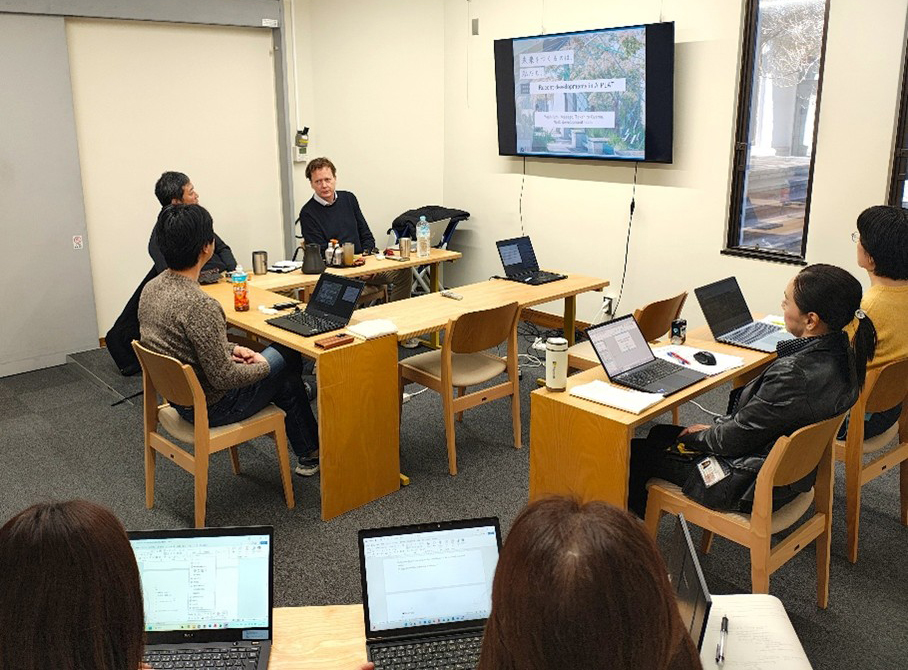
Climate Adaptation Services – Kim van Nieuwaal
Dr. Kim van Nieuwaal presented an overview of CAS and its recent developments, drawing on his experience in managing climate adaptation platforms.
He explained that CAS seeks to strengthen collaboration among government, science, and business, while expanding international engagement.
Using the Netherlands as an example, he introduced three key monitoring questions focused on actions, outcomes, and progress toward goals, noting that clear goal-setting remains a challenge.
He also compared approaches, highlighting Japan’s strength in quantitative evaluation and the Netherlands’ emphasis on dialogue with local communities.He concluded by emphasizing the importance of focusing on foundational elements such as water and soil to ensure effective and sustainable adaptation.
Local Government Support Team – Tomohiro Fujita
Dr. Fujita outlined the five-year targets of the Local Government Support Team and introduced LCCAC’s step-by-step, evidence-based framework for adaptation, emphasizing the importance of identifying key tasks and evaluating effectiveness.
Dr. Kim noted that CCCA’s focus on databases and evaluation is appropriate, and shared an example of community-based monitoring approaches used in the Netherlands.
He also introduced the “adaptation pyramid,” a framework for climate adaptation investments that prioritizes natural systems, followed by technical measures and the management of residual risks. The Adaptation Pyramid can be used as a practical tool to support the development of a climate-proof, resilient system—one that’s not only built to withstand shocks, but to prevent future crisis scenarios. The framework helps local governments assess whether their decisions and spending align with long-term, soil- and water-based adaptation goals rather than short-term, engineering-focused solutions.
Web Developing Team – Yoshifumi Masago
Dr. Masago introduced the newly redesigned A-PLAT website, which focuses on accessibility for first-time visitors, while providing separate entry points for local governments and the private sector who visit the site more frequently.
Website access increases sharply in summer, partly due to extreme heat events and climate-related school assignments.
A-PLAT supports policy use through maps, datasets, CSV files, and infographics.
Dr. Kim and Dr. Masago discussed how scientific data can be used in policymaking.
They also discussed the growing importance of trustworthy public data sources and data literacy as information access shifts to AI tools.
Private Sector Team – Fuyuki Harada
Ms. Harada outlined the team members and outlined both the long-term goals for promoting private-sector adaptation and the goals for this fiscal year. She also explained support for the private sector through tool provision, as well as the operation of the Climate Change Risk Industry–Government–Academia Collaboration Network.
Dr. Kim emphasized the importance of motivating businesses to invest in adaptation by clearly communicating the benefits. He noted that effective messaging is essential, as private-sector decisions are largely driven by value and returns.
Asia Pacific Climate Change Adaptation Research Section – Reiko Seki
Ms. Seki presented recent activities and future developments of AP-PLAT, along with challenges in enhancing its visibility.
Dr. Hijioka also highlighted the importance of SNS outreach and collaboration through the CCCA programme.
Dr. Kim commented that AP-PLAT content is practical, relevant, and engaging.
He also noted growing interest in climate issues among younger generations and highlighted the value of photos and visuals in improving visibility.
Closing Remarks
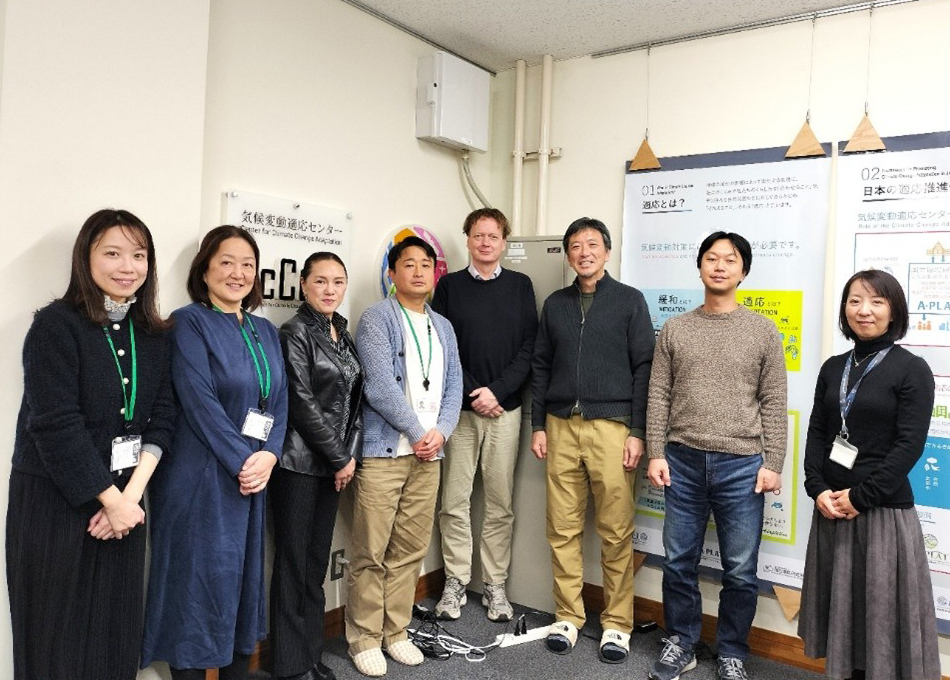
We sincerely thank Dr. Kim for taking the time to share valuable advice with each CCCA team.He praised the strong visual appeal of the Japanese tools, highlighting the importance of effective visuals for engagement. Dr. Kim complimented the team by saying: “We have been working together for quite some years now, but each time we meet I am impressed by the progress CCCA is making, working in such a structured manner and using state of the art knowledge, which continues to inspire us at CAS also. Thank you for that.”
Dr. Kim also expressed appreciation for the ongoing collaboration and shared his hope for larger, more impactful joint projects in the future.
The repeated message, “We can learn from each other,” clearly reflected CAS’s strong commitment to communication and mutual learning.
(Posted : 03/Feb/2026)
