 Asia - Japan
 KEY COFFEE INC
Industry: Manufacturing
| Updated | October 29, 2025 (Posted on June 8, 2026) |
|---|---|
| Publication date | November 22, 2018 |
| Sector | Industrial and Economic Activities / Agriculture, Forestry, Fisheries |
Company Overview

Since its founding in 1920 (Taisho 9), KEY COFFEE INC has pursued its corporate philosophy: “pursue the ultimate in coffee, focus on our customers, and create a coffee culture which enriches the heart.” As a leading coffee company in Japan, it constantly pursues world-class quality and the flavors that meet the evolving preferences of each era. Its comprehensive business spans from overseas coffee plantation operations to coffee manufacturing and sales, related coffee businesses.
Climate Change Impacts
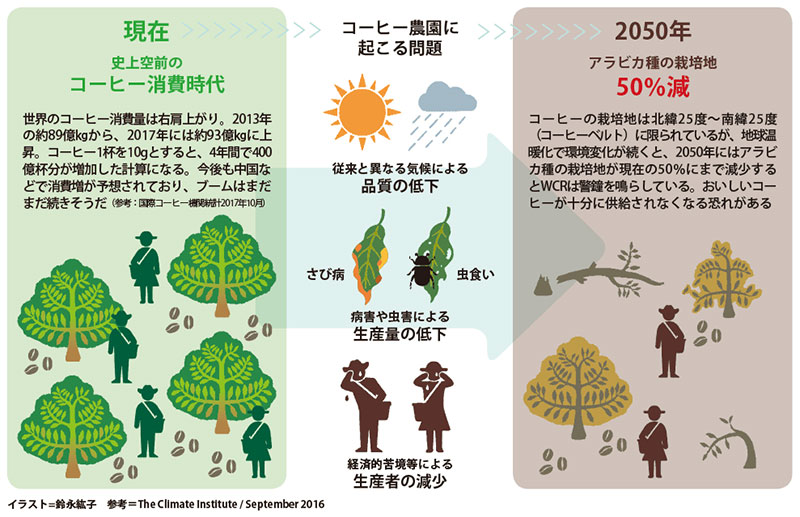
Rising temperatures and humidity, along with changes in rainfall volume and seasonal patterns associated with climate change, are affecting coffee producing regions. Higher temperatures and humidity increase the incidence of coffee leaf rust, one of the most serious diseases affecting coffee crops, resulting in reduced yields and declining quality.
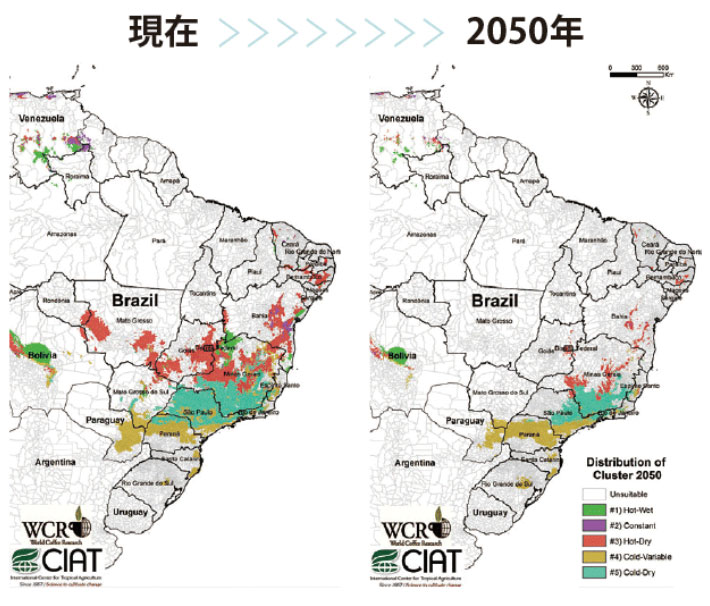
If climate change continues to intensify, it is projected that the land suitable for coffee cultivation will significantly decrease (Fig. 1 and Fig. 2).
Adaptation Initiatives
We have operated our own plantation in the Toraja region of Indonesia since the 1970s and launched “Toarco Toraja” in Japan in 1978. Since then, we have continued to produce high-quality coffee in collaboration with small-scale coffee producers and local stakeholders. Leveraging more than 50 years of experience in coffee-producing countries and the knowledge accumulated through these activities, we were commissioned by Japan’s Ministry of the Environment in 2024 to support small-scale coffee producers in Ethiopia. We continue to advance initiatives to achieve sustainable coffee production and safeguard the future of coffee.
1. Cultivation Trials in Indonesia: “International Multi-Location Variety Trial”
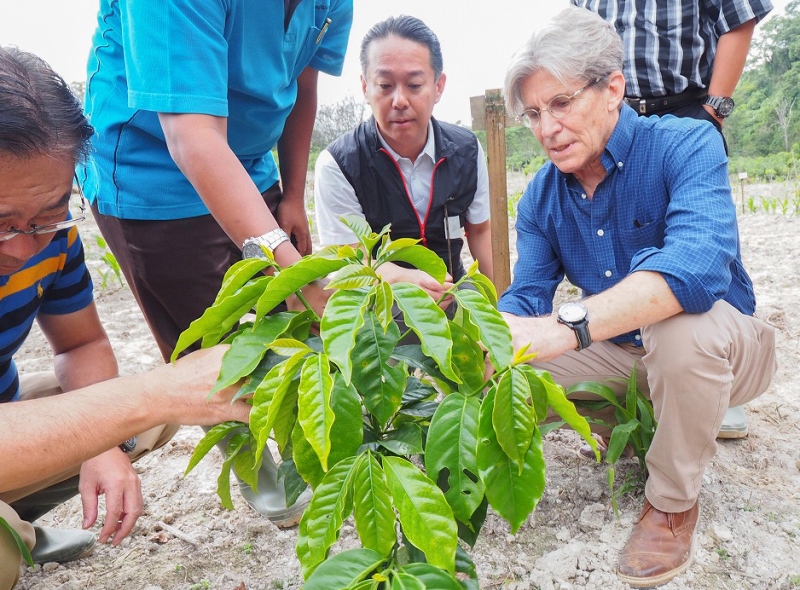
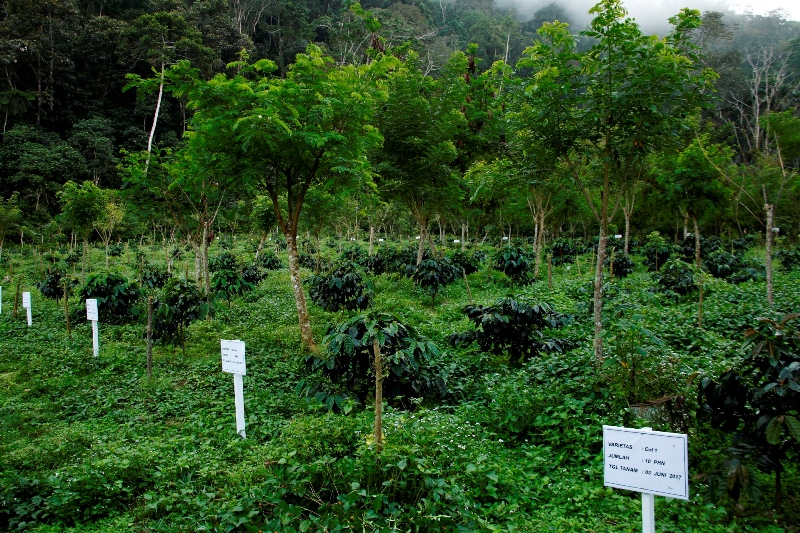
Since 2016, we have collaborated with the World Coffee Research (WCR), an international coffee research organization, on the IMLVT (International Multi-Location Variety Trial) which contributes to the development of varieties adapted to climate change (Fig. 3). Under the IMLVT program, high-quality Arabica varieties collected from around the world are propagated at the WCR headquarters, and cultivated in trial sites across multiple producing countries. These cultivation trials aim to identify superior varieties that possess resistance to climate change, pests, and diseases while maintaining rich flavor characteristics.
At the company-operated Padamaran Farm in Indonesia, a designated research area planted with approximately 40 varieties of coffee seedlings originating from countries such as Colombia and Panama has been provided as a research site, where joint trial activities are conducted.
After trial seedlings were planted in the field in 2017, large-scale flowering was observed for the first time in several varieties in 2019, the third year of research. In 2021, cup tests (flavor evaluations) were conducted locally for the first time using coffee harvested from the trial fields. Subsequently, the flavor characteristics of dozens of varieties showing stable growth were evaluated together with yield data. As of 2025, the IMLVT program remains ongoing, with data collected from participating countries analyzed by the WCR.
2. Support for Smallholder Farmers in Ethiopia
In 2024, we were commissioned for a Ministry of the Environment project titled “FY 2024 Proposal for a Bright Future for Small-Scale Coffee Producers Vulnerable to Climate Change”. Employees from our “Future of Coffee Department”—a division newly established in April 2022 under the president’s direct supervision to promote sustainable coffee production—visited Ethiopia, considered the birthplace of Arabica coffee, on multiple occasions. They conducted field inspections of local farms, interviewed small-scale coffee producers, and investigated how climate change is affecting coffee production.
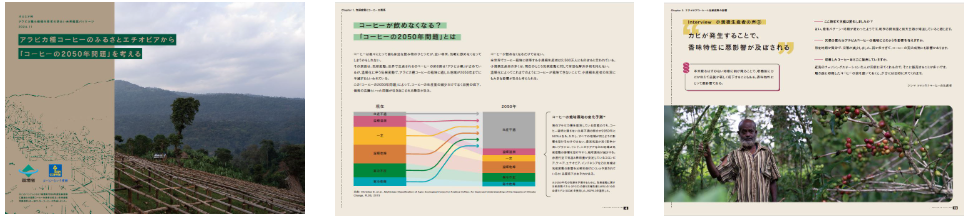
The findings were compiled into a document titled “Communication Product” prepared in Japanese, English, and Amharic, one of Ethiopia’s official languages. Farming seminars were also held for small-scale coffee producers and local researchers. In Ethiopia, harvested coffee cherries are typically sun-dried with the pulp still attached. However, changes in rainfall cycles due to climate change have increasingly resulted in rainfall during the drying period, leading to quality deterioration and reduced yields. To address this issue, we brought manual wooden pulping machines (hand pulpers) from Japan to the region. During the farming seminars, we demonstrated the pulp removal techniques to small-scale coffee producers (Fig. 4) and proposed a method in which harvested coffee cherries are depulped prior to sun-drying.
Effects/Expected Benefits
By identifying varieties optimized for climate change conditions based on trial results and sharing information and technology with local communities, we expect to achieve increased yields, improved quality, and enhanced economic benefits for producers. Furthermore, distributing newly identified varieties to coffee producers will contribute to the realization of sustainable coffee production.
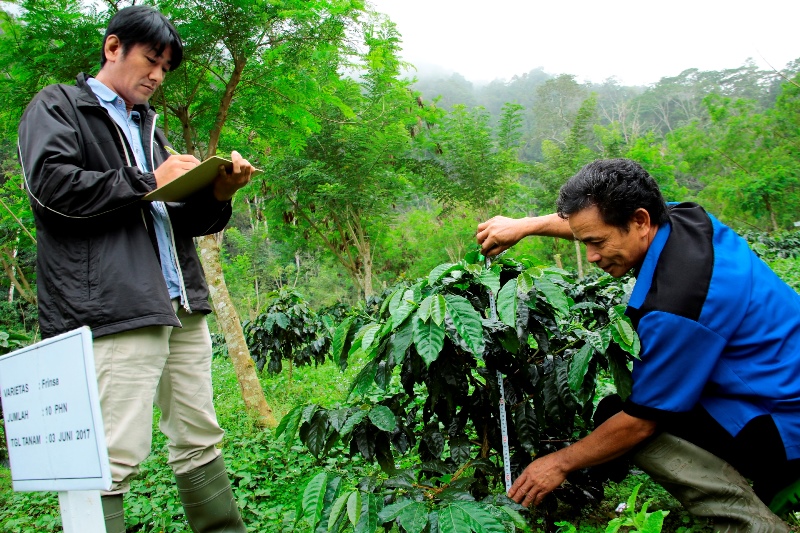
IMLVT (International Multi-Location Variety Trial) Initiatives
Fig. 3: Overview of IMLVT Activities

 DISCOVER MORE
