 Oceania - Australia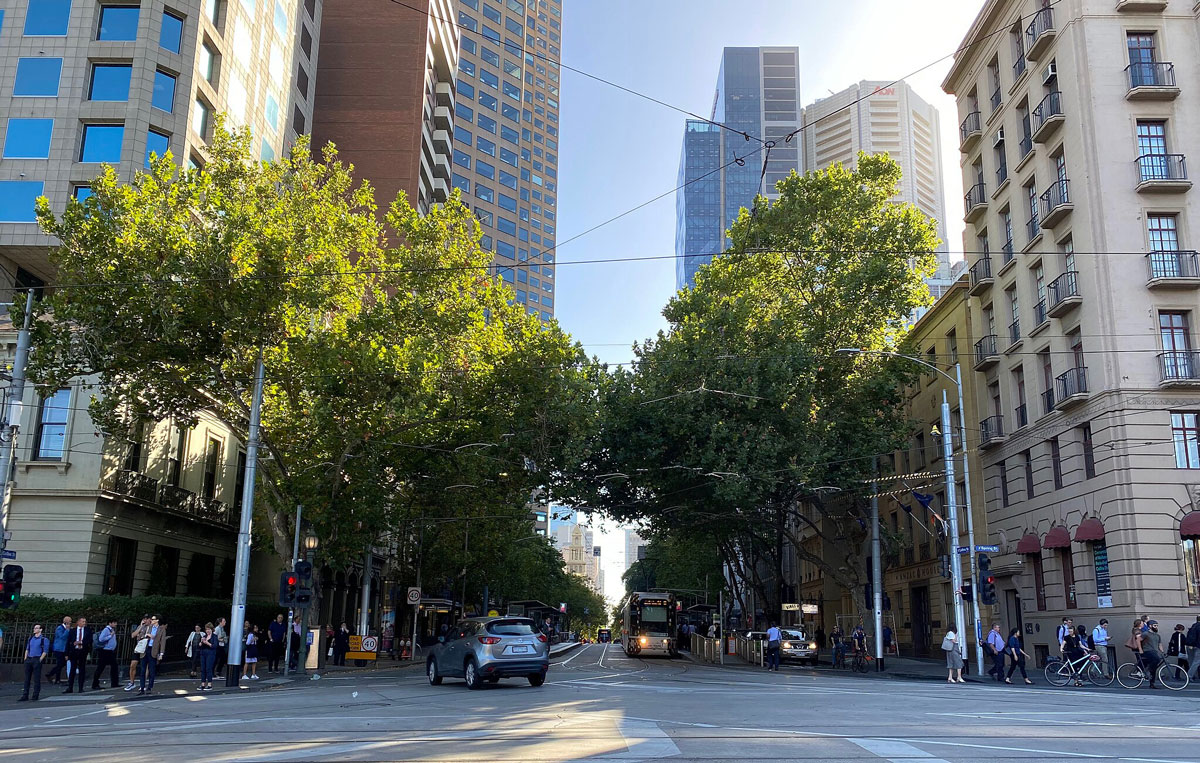
Challenge
Melbourne’s Missing Middle housing development requires a clear vision to ensure equitable access to the diverse benefits provided by trees.
Solution
YIMBY Melbourne Inc. frames trees as public infrastructure, using a model to estimate costs and planting needed for full, shady tree cover in developing neighborhoods.
Overview
The “Missing Middle Street Trees” in Melbourne is a report based on a model developed to support policy making on street tree planting in response to the growth of Missing Middle housing (medium-density homes that sit between single-family houses and high-rise apartments). It examines approaches to urban greening aimed at addressing changes in urban canopy structure associated with increasing housing supply. Using satellite imagery analysis (CHM data: Canopy Height Model, representing tree heights) to map current canopy and road networks, the report aims to increase the overall mature tree canopy coverage by 10% across the city.
This report also highlights the multiple public benefits provided by street trees. Previous studies have shown that street trees reduce surface temperatures on roads and buildings by blocking solar radiation and cool surrounding air through evapotranspiration (cooling air by 3.1–5.8°C). The project’s own analysis further demonstrates that areas with higher canopy cover tend to experience lower temperatures, confirming the important role of street trees in urban heat mitigation, thereby enhancing climate resilience through climate change adaptation. In addition, the placement of even a small number of street trees has been shown to reduce wind speeds, suggesting that street trees may help mitigate the deterioration of wind conditions associated with higher-density development. Previous studies have also documented the contribution of street trees to improving overall living environments, including reducing stormwater runoff and enhancing urban landscapes.
As Missing Middle housing development in Melbourne, expected to deliver about 400,000 new homes over the next decade, continues, trees in private backyards are expected to decline, leading to changes in the overall urban canopy structure. How to maintain and enhance urban green environments while accommodating housing growth has therefore become a major challenge. Moreover, this report and related studies indicate that tree distribution shows socio-economic disparities, with higher canopy cover concentrated in wealthier areas. As a result, there is concern that access to the benefits of urban trees may become increasingly uneven across communities.
The “Missing Middle Street Trees” model responds to these patterns by aiming to strengthen and complement canopy coverage through the planned expansion of street trees in public spaces. In doing so, it seeks to ensure that residents can equitably access the benefits of urban greenery, even as residential density increases. By repositioning street trees as essential public infrastructure rather than merely aesthetic elements, the model proposes a structural shift in how urban greening is delivered.
Spanning the next decade, the project sets a target of planting approximately 60 street trees per 100 new dwellings and estimates the required public investment at about AUD 1,840 per dwelling. Cost calculations are based on a model that assumes 20 representative tree species and average canopy size. However, the selected species do not fully meet the City of Melbourne’s Urban Forest Diversity Guidelines and are biased toward specific plant families. The authors clarify that the project focuses on modelling and cost estimation rather than professional arboricultural evaluation, and that biodiversity considerations should be addressed through future expert assessment.
This investment model incorporates the costs of planting, establishment, and long-term maintenance, as well as assumptions about mature canopy development. It provides a long-term framework for enhancing urban greening in parallel with housing growth. In addition, the project offers a canopy comparison tool covering more than 200 suburban areas, enabling the visualization of local conditions and supporting policy development and public engagement.
| Project title | Missing Middle Street Trees |
|---|---|
| Objectives | To model street tree expansion alongside Missing Middle housing to sustain urban canopy and promote equitable access to green benefits. |
| Implementing Body | YIMBY Melbourne Inc. |
| Target Area | Melbourne Metropolitan Area, Australia |
| Timeframe | Medium to long term (10+ years) |
Acknowledgements
This article is based on publicly available materials and data published by YIMBY Melbourne.
Related information
- YIMBY Melbourne: Melbourne’s Missing-middle
https://www.yimby.melbourne/missing-middle - YIMBY Melbourne: Missing Middle Street Trees (source for this article)
http://trees.yimby.melbourne/
 DISCOVER MORE

