 Asia - China, Japan, Mongolia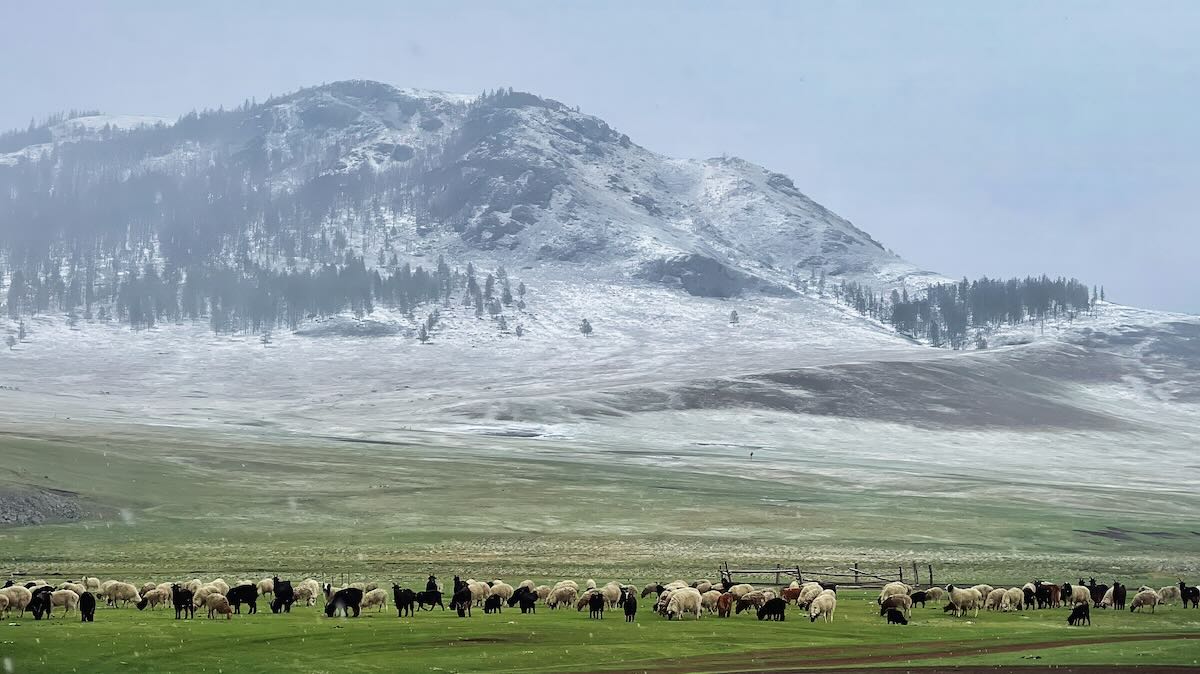
Challenge
Local adaptation planning in Mongolia and China needs detailed socioeconomic climate vulnerability information at the herder and county level.
Solution
Researchers assessed herder vulnerability and adaptation policies, then used combined results to recommend local, science-based climate plans.
Overview
Climate change is increasing climate-related hazards in arid and semi-arid regions of Mongolia and northern China, and herders face rising risks to livestock, pastures, and livelihoods. Effective local adaptation in these regions requires locally specific measures that are grounded in natural, geographical, and socioeconomic conditions and that build on traditional local knowledge and management practices. Altanbagana Myagmarsuren (Mongolian Academy of Sciences, Mongolia) led a project supported by the Asia-Pacific Network for Global Change Research (APN), to assess climate risk and vulnerability in herder–livestock–pasture systems and analyze adaptation policies in Mongolia and China.
The project focused on Khovd province in western Mongolia and the Ulaanqab region/prefecture in Inner Mongolia, China. The researchers combined environmental, social, and economic indicators with local policy analysis to develop science-based recommendations for provincial and local adaptation planning.
Study areas and vulnerability assessment
The project developed an environmental, social, and economic risk assessment framework in the study areas, and it developed and used 26 risk components and indicators to assess a risk index at the local level.
In Khovd, environmental, social, and economic risk assessment was conducted in 16 soums (counties), along with assessment of climate hazards including drought and dzud (severe winter disasters). In Ulaanqab, the assessment considered livestock systems and rural socioeconomic conditions in relation to climate hazards.
The project produced environmental, social, and economic risk and vulnerability maps and an atlas for the study areas, including a vulnerability map of Ulaanqab and a Vulnerability Atlas of Khovd for science-based decision making.
Policy gap analysis and planning support
Adaptation policy analysis was carried out at provincial and soum levels based on the Nationally Determined Contribution (NDC) and National Adaptation Plan to Climate Change of Mongolia.
The researchers synthesized results from the vulnerability assessment and policy analysis to develop adaptation policy recommendations for local governments. The work informed climate change adaptation planning processes in Mongolia, including work related to the National Adaptation Plan and a provincial adaptation plan for Khovd.
The project also strengthened collaboration among Mongolian, Chinese, and Japanese researchers working on climate risk, vulnerability, and adaptation planning.
Stakeholder engagement and capacity development
Workshops, meetings, and field activities engaged policymakers, local authorities, herders, civil society organizations, and researchers in western Mongolia and Inner Mongolia. Stakeholder workshops in Khovd brought together officials from environmental, agriculture, social welfare, education, health, and statistical departments, along with university researchers.
Field studies in Khovd and Ulaanqab included focus group interviews and household surveys with herders and farmers, as well as visits to ecological research stations, livestock farms, processing facilities, and rural tourism sites. Training activities in Khovd gave local stakeholders opportunities to discuss vulnerability findings, policy gaps, and options for strengthening climate-resilient local development.
Outcomes and results
- Contributed to development of 2 policy documents (National Adaptation Plan to Climate Change and Adaptation Plan of Khovd province) and 1 national report (Mongolia Voluntary National Review 2023: Implementation of the Sustainable Development Goals).
- Developed an environmental, social, and economic risk assessment framework with 26 variables for local-level climate vulnerability analysis.
- Conducted risk and vulnerability assessment in 16 Khovd soums.
- Produced environmental, social, and economic risk and vulnerability maps for the study areas, including a Vulnerability Atlas with 46 thematic maps for Khovd.
- Organized 3 regional workshops in Mongolia, China, and Japan.
- Organized 4 local stakeholder workshops in Khovd and 1 meeting in Ulaanqab.
- Conducted 5 field studies in Khovd and 1 field study in Ulaanqab.
- Organized training for 60 participants, including herders, local government officials, policymakers, civil society representatives, and young researchers.
- Supported the training of 3 doctoral students and 2 master’s students.
- Published 3 articles in scholarly journals with 3 more submitted for review, and published 1 paper in domestic conference proceedings and 1 abstract in international conference proceedings.
Project details
| Project title | Strengthening local adaptation plans through integrating socio-economic vulnerability assessment and policy gap analysis in Mongolia and China |
|---|---|
| Year started | 2022 |
| Duration | 3 years |
| Countries involved | China, Japan, Mongolia |
| Funding awarded | US$120,000 |
| Funded by | Asia‑Pacific Network for Global Change Research (APN) |
| Grant DOI | https://doi.org/10.30852/p.22134 |
| Program | Collaborative Regional Research Programme (CRRP) |
| Project reference number | CRRP2022-09MY-Myagmarsuren |
| Project leader | Altanbagana Myagmarsuren (Mongolian Academy of Sciences, Mongolia) |
Acknowledgements
This project was supported by the Asia-Pacific Network for Global Change Research (APN) under its Collaborative Regional Research Programme (CRRP). Acknowledgments also go to Suocheng Dong (Institute of Geographic Sciences and Natural Resources Research, Chinese Academy of Sciences, China), Masato Shinoda (Nagoya University, Japan), Chuluun Togtoh (National University of Mongolia, Mongolia), Dagvadorj Damdin (Climate Change and Development Academy of Mongolia, Mongolia), Gomboluudev Purevjav (Information and Research Institute of Meteorology, Hydrology and Environment, Mongolia), Dashtseren A. (Institute of Geography and Geoecology, Mongolian Academy of Sciences, Mongolia), Burmaa Z. (Western Regional Branch of National University of Mongolia, Mongolia), Western Regional Branch of the National University of Mongolia (Mongolia), Agency of Nature and Environment of Khovd Province (Mongolia), Department of Food and Agriculture of Khovd Province (Mongolia), Department of Statistics of Khovd Province (Mongolia), and Meteorology and Environmental Monitoring Center of Khovd Province (Mongolia).
Related information
- Project Permalink
- Project Final Report
- Galtbayar, S., Myagmarsuren, A., Gankhuyag, U., Tsedev-Ish, O., Suocheng, D., Shinoda, M., & Erdenebadrakh, M. (2025). Assessing climate hazard risks for Mongolian herders : A county-level study in Khovd, Bayankhongor, Dundgovi provinces . Mongolian Journal of Geography and Geoecology, 62(46), 118–124. https://doi.org/10.5564/mjgg.v62i46.4124
- Ministry of Environment and Climate Change. (2024). National Adaptation Plan to Climate Change: Mongolia 2024–2030. NAP Elaboration Team. https://unfccc.int/documents/646367.
- Altanbagana, M. (2024). CRRP2022-09MY-Myagmarsuren project’s contribution to the development of the National Adaptation Plan for Climate Change. Mongolian Academy of Sciences. https://www.apn-gcr.org/publication/report-crrp2022-09my-myagmarsuren-projects-contribution-to-the-development-of-the-national-adaptation-plan-for-climate-change/
- Altanbagana, M., Saruul, G., Otgonkhuyag, Ts., & Urantamir, G. (2024). Assessment of the vulnerability and adaptive capacity of pastoral livestock production to climate change at the soum level. In Proceedings of the National Scientific Conference on Climate-Resilient Livestock Sector Development (pp. 58–67). Ulaanbaatar, Mongolia: Institute of Geography and Geoecology, Mongolian Academy of Sciences. https://www.apn-gcr.org/publication/assessment-of-the-vulnerability-and-adaptive-capacity-of-pastoral-livestock-production-to-climate-change-at-the-soum-level/
- Tsedev-Ish, O., & Myagmarsuren, A. (2023). Preliminary results of determining the social variables of rural population’s vulnerability to climate change. Mongolian Journal of Geography and Geoecology, 44. https://doi.org/10.5564/mjgg.v60i44.3067
- Galtbayar, S., Myagmarsuren, A., Bayarjargal, M., Tsedev-Ish, O., Munguntuul, U., & Gankhuyag, U. (2022). Determining variables of social, economic, and ecological vulnerability to climate change. Mongolian Journal of Geography and Geoecology, 42, 30–42. https://doi.org/10.5564/mjgg.v59i43.2510
- APN Facebook
- APN LinkedIn
- APN X
 DISCOVER MORE

