 Asia - Philippines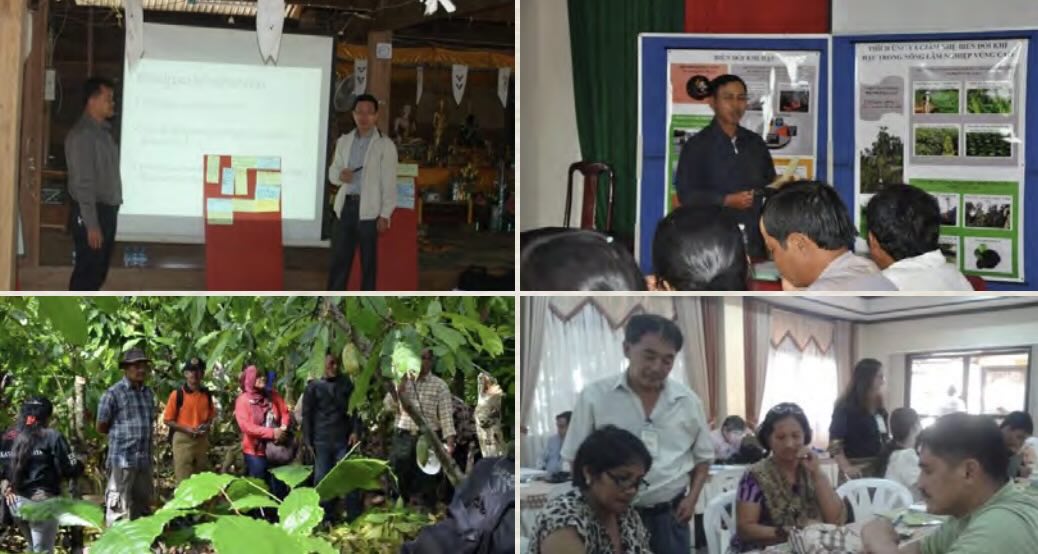
Challenge
Smallholder farmers in Southeast Asia face intensifying climate impacts, yet many proven adaptation solutions remain isolated within local projects.
Solution
Researchers documented and promoted lessons from 10 APN-funded initiatives, producing accessible resources for replication and scaling of effective climate adaptation measures.
Overview
Smallholder farmers in Southeast Asia depend on climate-sensitive livelihoods, including crop cultivation, livestock production, and agroforestry. However, increasingly erratic rainfall, stronger storms, longer droughts, and land degradation threaten their food security and incomes. And although APN-funded projects have developed practical adaptation strategies, these often stay confined to pilot areas.
Leila Landicho (University of the Philippines Los Baños, Philippines) led a communication-focused project to bridge this gap. Her team documented 10 APN-funded capacity development initiatives in the Philippines, Vietnam, and Indonesia, covering topics such as soil conservation, agroforestry, renewable energy, indigenous farming revival, and water resource management. The work led to a 70-page illustrated publication, a 22-minute documentary video, and a live webinar that engaged 260 participants from universities, government agencies, NGOs, and farming communities. (A peer-reviewed article also followed this project’s completion.)
The 10 projects highlighted in the communication materials covered a variety of strategies, including bolstering the technical capabilities of service providers, such as local governments and universities, promoting sustainable farming techniques, and using digital technology for proactive solutions.
The specific themes included:
- Training communicators for climate change
- Developing and implementing conservation farming villages
- Revitalizing indigenous knowledge to build community resilience
- Promoting renewable energy from livestock waste
- Establishing rainwater harvesting facilities

Best practices and lessons learned
The report distilled several key lessons, including the need for a collaborative approach with partnerships between universities, local government units, and farmers. It also emphasized the importance of centering development programs on the felt needs of local communities to ensure their genuine and sincere participation.
Strong local leadership and institutional backing were identified as vital toward success, as was the importance of establishing model farms and demonstration plots to showcase the workability and viability of agricultural technologies and innovations, which can lead to higher uptake.
The documented projects contained specific examples of adaptation measures, including:
- Conservation farming techniques, such as contour plowing and cover cropping, to reduce erosion and maintain yields.
- Agroforestry learning laboratories integrating demonstration plots with farmer-led trials.
- Biogas systems turning livestock waste into household energy, lowering fuel costs and emissions.
- Revitalization of indigenous practices, including intercropping and traditional seed use.
- Community-managed rainwater harvesting systems to secure water during dry seasons.
Each detailed objectives, methods, and results, supported by direct quotes from farmers and local officials. These accounts demonstrated that adaptation is most effective when grounded in local realities and external expertise.
A core finding was that collaboration and partnership were essential to the success of the featured projects. Universities provided technical expertise, while local government units were pivotal for institutionalizing local policies and providing basic social services to communities. This multisectoral partnership ensured that efforts were integrated and sustainable.
Communication, outreach, and outlook
The communication materials – video, publication, and webinar – were developed to serve as a reference for other development organizations, research institutions, and universities.
The 70-page publication blended clear technical instructions with narratives from farmers, making the material accessible and engaging. The video brought viewers into the field, showing project sites before and after interventions, interviews with beneficiaries, and practical demonstrations. The webinar provided a platform for project leaders to present findings, respond to questions, and facilitate peer-to-peer exchanges between communities facing similar climate risks.
These materials can serve as important vehicles for replicating and scaling up the documented experiences, lessons, and best practices to strengthen adaptive capacity in other rural farming communities.
Project details
| Project title | Enhancing Local Adaptive Capacity of Rural Farming Communities in Southeast Asia: Best Practices and Lessons Learned for Scaling Up |
|---|---|
| Year started | 2020 |
| Duration | 1 year |
| Countries involved | Philippines |
| Funding awarded | US$5,000 |
| Funded by | Asia‑Pacific Network for Global Change Research (APN) |
| Grant DOI | https://doi.org/10.30852/p.16143 |
| Program | Early Career Science Communication (ECSC) |
| Project reference number | ECSC2019-02SY-Landicho |
| Project leader | Leila Landicho (University of the Philippines Los Baños, Philippines) |
Acknowledgements
This project was supported by the Asia-Pacific Network for Global Change Research (APN) under its Early Career Science Communication (ECSC) program. Acknowledgements go to the leaders and participants of the 10 featured projects for their contributions.
Related information
- Project Permalink
- Project Final Report
- Landicho, L.D., & Ramirez, M.A.J.P (2022). Enhancing Adaptive Capacity of Rural Farming Communities in Southeast Asia: Experiences, Lessons, and Best Practices for Scaling-up. Asia-Pacific Network for Global Change Research (APN). https://www.apn-gcr.org/publication/enhancing-adaptive-capacity-of-rural-farming-communities-in-southeast-asia-experiences-lessons-and-best-practices-for-scaling-up/
- Landicho, L.D., & Ramirez, M.A.J.P. (2023). Strengthening adaptive capacity of rural farming communities in Southeast Asia: Experiences, best practices and lessons for scaling-up. APN Science Bulletin, 13(1). doi:10.30852/sb.2023.2104
- APN Facebook
- APN LinkedIn
- APN X
 DISCOVER MORE

