 Asia - Vietnam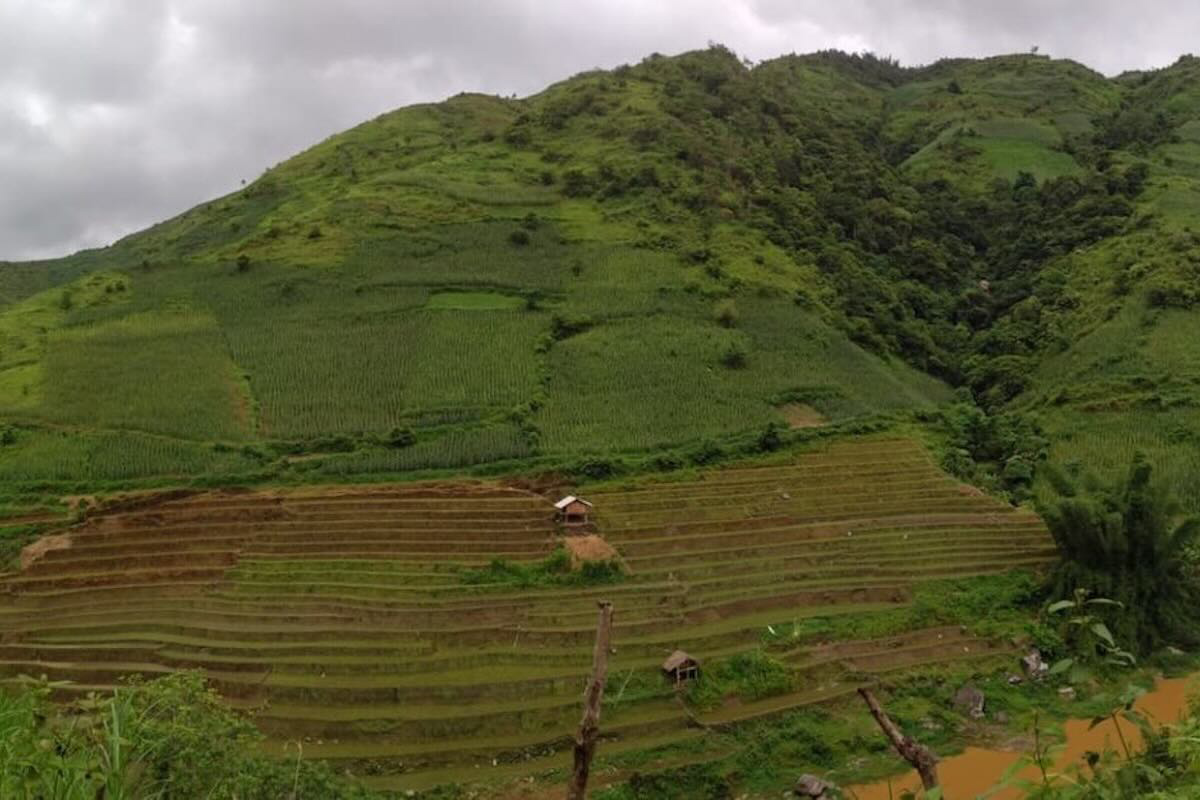
Challenge
Mountain communities in the Da River catchment face intensifying floods and landslides, as well as land degradation, due to climate change.
Solution
Researchers developed practical, site-specific agroforestry models and multilingual guidance to strengthen resilience in vulnerable upland communities.
Overview
The Da River flows through the rugged northwest mountainous region of Vietnam, an area that is both ecologically rich and highly vulnerable to climate change. Communities here, many of them ethnic minorities, depend heavily on agriculture and forestry for their livelihoods. In recent decades, climate change has intensified extreme weather events, disrupted seasonal patterns, and accelerated land degradation.
The Asia-Pacific Network for Global Change Research (APN) supported a project led by Thi Thanh Ha Do (Vietnamese Academy of Forest Sciences, Vietnam). The aim was to provide practical, site-specific agroforestry farming guidance for households and communities in upstream catchment areas. Work focused on upstream communes in Yen Bai and Son La Provinces.
Agroforestry, which integrates trees with crops or livestock, offers multiple benefits for climate adaptation, including improved soil stability, water retention, and diversified income.

Climate change impacts in the region
In the northwest mountainous provinces, communities face increasing frequency and severity of natural hazards. Historical records and community reports highlight flash floods, landslides, and unseasonal frosts. There have been specific events, such as an extreme high temperature of 42.1°C in Mường La in 2012. And in 2017, Mù Cang Chải experienced devastating floods and landslides, which resulted in 10 people dead, five missing, 400 houses destroyed, and damage to more than 200 public facilities. Such events not only threaten lives but also undermine agricultural productivity and food security.
Developing site-specific agroforestry guidance
Recognizing that climate adaptation strategies must be tailored to local conditions, the project team collaborated with farmers in Mường La, Trạm Tấu, and Mù Cang Chải districts to identify effective agroforestry models. These models combined traditional knowledge with scientific recommendations on tree species selection, planting arrangements, and soil and water conservation practices.
Examples include integrating fruit trees or timber species with crops or livestock on hilltops and slopes to protect watersheds, planting tea under forest canopies, and combining contour-aligned crops with scattered trees to reduce erosion. The models developed improve soil stability, water retention, and diversify income.
Multilingual, practical tools for communities
A key output was a practical guidance document, produced in Vietnamese and English, and H’mong, ensuring accessibility for both local communities and wider audiences. The guides explain climate change concepts, local climate hazards, and specific agroforestry techniques suited to each subregion. They also include illustrations and case examples from participating villages, making the content easy to follow for farmers with varying literacy levels.
Engaging local knowledge and participation
The project relied heavily on community participation, using focus group discussions and key informant interviews to gather information. Farmers contributed their experiences with past climate events, crop failures, and successful adaptations. Local leaders and extension workers helped validate the proposed agroforestry models. The project strengthened its relevance and uptake potential by grounding the guidance in science and lived experience.
Policy and scaling potential
The approach offers a model for other upland regions facing similar climate threats. Local authorities and development agencies can use the guidance to promote sustainable land management, support livelihood diversification, and integrate climate resilience into rural development plans.
A peer-reviewed article (Do & Bui, 2023) resulting from the project gives greater detail.
Outcomes and results
- Stakeholder engagement included 33 interviewees from 8 villages across 5 communes, with field visits to 3 locations (Tram Tau, Mu Cang Chai in Yen Bai Province; Muong La in Son La Province), and a workshop with 30 participants, including farmers and local government representatives.
- Practical guidance publication produced in Vietnamese and English, as well as H’Mong; 40 printed copies disseminated.
- Guidance materials explaining local climate hazards and recommended agroforestry options suited to upstream catchments.
- Local authorities indicated interest in using the guidance for policy planning and training; communities showed interest in applying recommended practices.
Project details
| Project title | Climate Change Adaptation Through Site-Specific Agroforestry Farming for Communities and Household in Upstream Catchment Area of Da River—A Practical Guidance |
|---|---|
| Year started | 2020 |
| Duration | 1 year, and extended to November 30, 2021. |
| Countries involved | Vietnam |
| Funding awarded | US$4,860 |
| Funded by | Asia‑Pacific Network for Global Change Research (APN) |
| Grant DOI | https://doi.org/10.30852/p.13776 |
| Program | Early Career Science Communication (ECSC) |
| Project reference number | ECSC2019-01-Do |
| Project leader | Thi Thanh Ha Do (Vietnamese Academy of Forest Sciences, Vietnam) |
Acknowledgements
This project was supported by the Asia-Pacific Network for Global Change Research (APN) under its Early Career Science Communication (ECSC) program. Acknowledgement is given to the participating farmers and local authorities in Mường La, Trạm Tấu, and Mù Cang Chải for their valuable contributions.
Related information
- Project Permalink
- Do, T. T. H., & Bui, M. H. (2023). Potential of agroforestry for climate change adaptation in the Northwest mountainous region of Vietnam. APN Science Bulletin, 13(1), 50–59. doi: 10.30852/sb.2023.2147
- Appendix 1: Climate change adaptation through site specific agroforestry farming for communities and household in upstream catchment area of Da River: A Practical Guidance. https://www.apn-gcr.org/publication/climate-change-adaptation-through-site-specific-agroforestry-farming-for-communities-and-household-in-upstream-catchment-area-of-da-river-a-practical-guidance/
- Appendix 2: Climate change adaptation through site-specific agroforestry farming for communities and households in the upstream catchment area of Da River: A Practical Guidance (Hmong language). https://www.apn-gcr.org/publication/climate-change-adaptation-through-site-specific-agroforestry-farming-for-communities-and-households-in-the-upstream-catchment-area-of-da-river-a-practical-guidance-hmong-language/
- APN Facebook
- APN LinkedIn
- APN X
 DISCOVER MORE

