 Asia - Indonesia, Thailand, Vietnam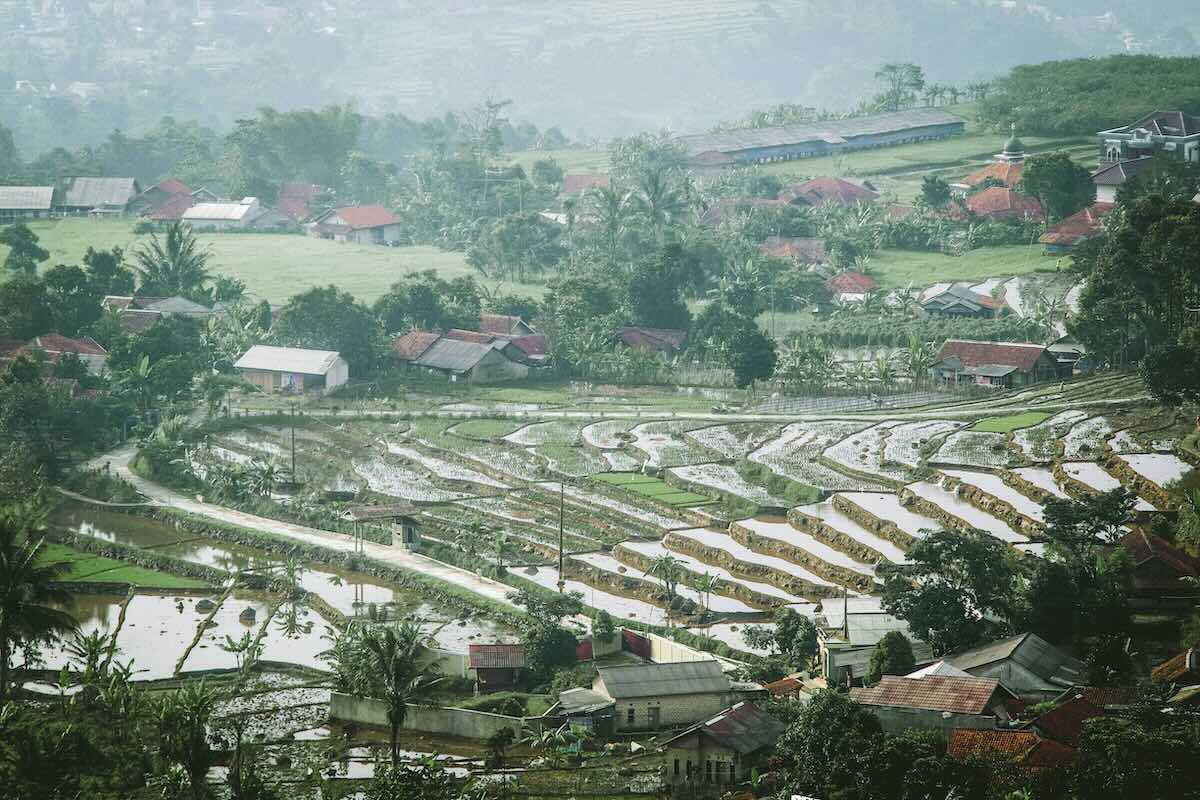
Challenge
Climate change and land use change disrupt irrigation, affecting drought and flood conditions and threatening food security.
Solution
Researchers design and test smart irrigation water management to strengthen resilience and support farmers in Asia.
Overview
Rapid population growth in tropical Southeast Asia is raising food demand, while land use change and climate change undermine the irrigation systems that support rice production. Upstream watersheds are being converted for farming, mining, and other uses, which shifts hydrologic patterns and increases the frequency of droughts and floods. Midstream and downstream areas are also seeing farmland converted to urban and industrial uses, which adds pressure on water availability for crops.
Against this backdrop, an Asia-Pacific Network for Global Change Research (APN) project led by Chandra Setyawan examined how smart irrigation water management can protect food security under combined land use and climate pressures. The project developed and tested Smart Irrigation Water Management (SIWAMA), a framework that integrates land use, climate, and irrigation system information for adaptive irrigation management under future scenarios.
Three work packages covering land use land cover (LULC) projections, climate projections, and assessment of combined land use and climate impacts on irrigation systems, were carried out, supported through regional workshops and training.
Methods
The project combined spatial analysis, hydrological modeling, and participatory engagement. It started with LULC mapping and projections to identify land conversions likely to affect runoff and water availability. The project team then applied hydrologic modeling with tools such as Soil and Water Assessment Tool (SWAT) to estimate how projected rainfall and temperature patterns affect river discharge, evapotranspiration, irrigation water availability, and crop water demand. These modeled results were shared and reviewed through the regional workshops with collaborating institutions and government partners.
Country workstreams
Three regional workshops in Indonesia structured the collaboration. A kickoff meeting in December 2024 set the shared work plan, a midterm workshop in May 2025 reviewed interim land use and climate modeling results, and a final workshop in September 2025 consolidated findings and finalized the SIWAMA framework. Partners in Thailand, Vietnam, and Australia joined through a mix of onsite and online participation.
Outcomes and results
- Technical land use and climate projections for the Kedung Putri (Indonesia) irrigation system, including maps and summary reports that support adaptive irrigation planning.
- A consolidated SIWAMA framework that integrates land use, climate, and irrigation system data for adaptive management under future scenarios.
- Strengthened scientific and institutional capacity among regional partners to assess combined land use and climate impacts on irrigation and to plan responses using SIWAMA.
- At least 2 scientific publications, one on future land use implications for irrigation sustainability and another on projected climate effects on irrigation management and food security in Indonesia, with one already submitted and the other in preparation.
- Capacity building for more than 50 young researchers, students, and junior lecturers in Indonesia, Thailand, and Vietnam through direct involvement in workshops and documentation.
SIWAMA is aimed at giving irrigation managers and policymakers a practical way to improve irrigation efficiency, support evidence-based decisions, and allocate water more efficiently during droughts or erratic rainfall, helping maintain reliable rice production under changing land use and climate conditions.
Project details
| Project title | Adapting the Impact of Land Use and Climate Change Through Smart Irrigation Water Management to Support Food Security (SIWAMA) |
|---|---|
| Year started | 2024 |
| Duration | 1 year |
| Countries involved | Indonesia, Thailand, Vietnam |
| Funding awarded | US$12,500 |
| Funded by | Asia‑Pacific Network for Global Change Research (APN) |
| Grant DOI | https://doi.org/10.30852/p.29714 |
| Program | Collaborative Regional Research Programme (CRRP) |
| Project reference number | CRRP2024-10MY-Setyawan |
| Project leader | Chandra Setyawan (Universitas Gadjah Mada, Indonesia) |
Acknowledgements
This project was supported by the Asia-Pacific Network for Global Change Research (APN) under its Collaborative Regional Research Programme (CRRP). Acknowledgements also go to Asian Institute of Technology (Thailand), Thuyloi University (Vietnam), Thai Nguyen University of Agriculture and Forestry (Vietnam), Flinders University (Australia), Ministry of Agriculture (Indonesia), and Ministry of Public Works (Indonesia) for their collaboration and support.
 DISCOVER MORE

