 Asia - Bangladesh, India, Pakistan, Sri Lanka, United States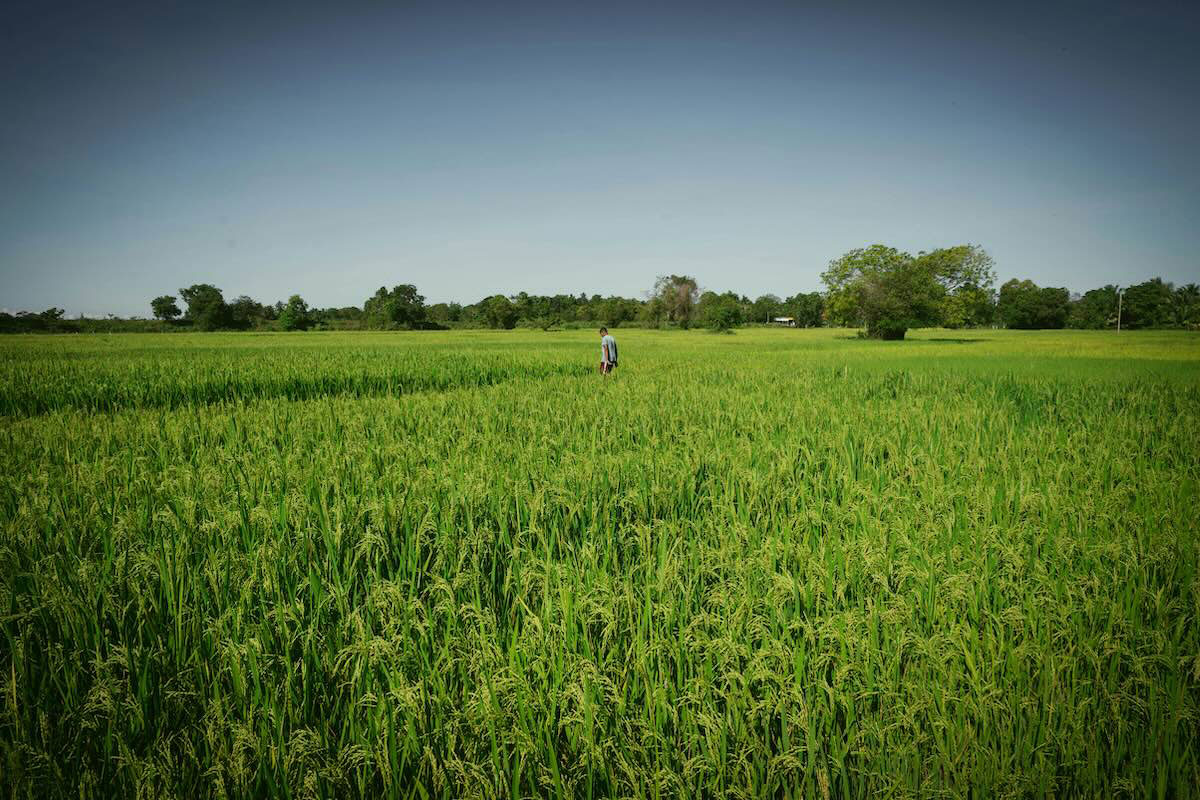
Challenge
Salinity weakens rice yields and can raise farm emissions, while practical, climate‑friendlier field options are unclear for many South Asian sites.
Solution
Test and compare on‑farm practices across affected sites, then recommend options that lower emissions and keep rice productive.
Overview
Salinity in soils and irrigation water undermines rice production across South Asian coastal and inland areas. Salt reaches fields through seawater intrusion in low-lying coasts, and through irrigation and drainage problems inland, which together raise the salt content of soils and water used for crops. This effect limits plant growth and can change greenhouse gas releases from wet fields.
With support from the Asia-Pacific Network for Global Change Research (APN), Erandathie Lokupitiya (University of Colombo, Sri Lanka) led a cross‑country project that examined which field practices work best in salt‑affected rice systems, and how those choices relate to climate outcomes.
The project examined best management practices (field-scale ways of preparing land, planting, watering, and amending soils to manage salinity while keeping crops viable and costs reasonable) and salinity intrusion (saltwater moving into freshwater and soils in coastal and estuarine zones, plus salt build‑up from inland irrigation). It assessed climate effects through three agricultural greenhouse gases: carbon dioxide (CO₂), methane (CH₄), and nitrous oxide (N₂O).
CO₂ comes from soil and plant respiration and decomposition, CH₄ forms in flooded, oxygen‑poor soils, and N₂O comes mainly from nitrogen fertilizers and cycles of wetting and drying.
Project context and approach
Partners in Bangladesh, India, Pakistan, and Sri Lanka mapped salt‑affected rice areas, documented local salinity‑management practices, and ran field comparisons under different options. The work considered transplanting versus broadcasting, water‑level control such as intermittent irrigation compared with continuous flooding, the use of organic amendments (materials derived from once-living plants or animals and added to soil to improve its physical, chemical, and biological properties) compared with mineral fertilizers alone, and crop sequences such as rice–wheat and rice–fallow.
Greenhouse gas fluxes (gas leaving or entering the field) were measured at selected plots alongside agronomic performance to evaluate choices based on emissions and crop viability together. Farmer perspectives and local constraints were gathered to make the recommendations practical for real conditions.
Practice insights and farmer relevance
Across sites, intermittent irrigation lowered methane compared with continuous flooding, and optimizing nitrogen applications helped limit nitrous oxide. Organic amendments, combined with careful water control, supported salinity management and rice performance compared with using mineral fertilizer alone.
In some settings, rice–fallow performed better on emissions and yield measures than rice–wheat under saline conditions. Where transplanting was feasible, it improved seedling establishment under saline conditions compared with broadcasting. These patterns helped farmers and extension officers select options that cut emissions while keeping rice viable in salt-affected areas.
Policy and uptake
The project produced salinity maps to show where practices are most needed, documented farmer-tested options, and prepared practical recommendations for extension. The collaboration built links among institutions in the four South Asian countries and a technical partner in the United States, which supports future work on site‑specific guidance and training. The outputs can inform national and local adaptation plans in rice‑growing zones facing rising salinity.
Results and key findings
- In Sri Lankan trials, a combination of transplanting, organic amendments, and intermittent irrigation performed well when considering net greenhouse gas outcomes together with rice productivity.
- In India, rice–fallow with organic amendments and appropriate irrigation performed better for rice yield and greenhouse gas outcomes than rice–wheat at the tested sites.
- At the tested sites, using only inorganic fertilizers increased greenhouse gas emissions compared with systems that also used organic amendments, while organic amendments supported salinity management and improved performance under saline conditions.
- Greenhouse gas measurements were completed under contrasting practices at multiple sites, and country teams compiled salinity maps that distinguish low-, medium-, and high-salinity areas.
- Farmer recommendations on salinity‑management options were produced, and a cross‑country collaborator network was established to support ongoing work.
Project details
| Project title | Identification of the Best Agricultural Management Practices with Better Greenhouse Gas Benefits in Salinity Affected Areas of South Asia |
|---|---|
| Year started | 2016 |
| Duration | 2 years |
| Countries involved | Bangladesh, India, Pakistan, Sri Lanka, United States of America |
| Funding awarded | US$63,994 |
| Funded by | Asia‑Pacific Network for Global Change Research (APN) |
| Grant DOI | https://doi.org/10.30852/p.4560 |
| Program | Collaborative Regional Research Programme (CRRP) |
| Project reference number | CRRP2016-09MY-Lokupitiya |
| Project leader | Erandathie Lokupitiya (University of Colombo, Sri Lanka) |
Acknowledgements
This project was supported by the Asia-Pacific Network for Global Change Research (APN) under its Collaborative Regional Research Programme (CRRP). Acknowledgements also go to University of Colombo (Sri Lanka); Banaras Hindu University (India); Bangabandhu Sheikh Mujibur Rahman Agricultural University (BSMRAU; Bangladesh); Alternate Energy and Water Resources Institute, National Agricultural Research Center, NARC (Pakistan); and Colorado State University (United States of America).
Related information
- Project Permalink
- Project Final Report
- Lokupitiya, E., Agrawal, M., Pandey, D., Ahamed, T., Mustafa, N., Sirisena, D.N., Seneviratne, G., Udagedara, S. & Paustian, K. (2017). Best Management Practices with Low Greenhouse Gas Emissions for Salinity Management in Paddy Soils of South Asia. https://www.apn-gcr.org/publication/best-management-practices-with-low-greenhouse-gas-emissions-for-salinity-management-in-paddy-soils-of-south-asia/
- Lokupitiya, E., Agrawal, M., Vathani, A., Ahamed, T., Mustafa, N., Ahmad, B., Pandey, D., Seneviratne, G., & Paustian, K. (2018). Coastal salinity intrusion and food security in South Asia: best management practices with greenhouse gas benefits. International Conference on Agricultural GHG Emissions and Food Security – Connecting research to policy and practice. September 10 – 13, 2018 Berlin, Germany. Claudia Heidecke, Hayden Montgomery, Hartmut Stalb, LiniWollenberg (Eds.). Volume of Abstracts. p. 75. https://www.apn-gcr.org/publication/coastal-salinity-intrusion-and-food-security-in-south-asia-best-management-practices-with-greenhouse-gas-benefits/
- Archana, A.S., Lokupitiya, E., Sirisena, D.N., & Seneviratne, G. (2018). Determining the Best Agricultural Management Practices for Salt-Affected Coastal Paddy Soils in Sri Lanka Considering Net Greenhouse Gas Emission Along with Other Socioeconomic Benefits. International Conference on Climate Change-2018 (ICCC 2018), February 15-16, 2018, Book of Abstracts. The International Institute of Knowledge Management (TIIKM), Colombo, Sri Lanka. P 75. https://www.apn-gcr.org/publication/determining-the-best-agricultural-management-practices-for-salt-affected-coastal-paddy-soils-in-sri-lanka-considering-net-greenhouse-gas-emission-along-with-other-socioeconomic-benefits/
- Opatha, K. N., & Lokupitiya, E. (2019). Study of salinity levels and impact of saltwater intrusion on coastal paddy areas of wet zone of Sri Lanka. Proceedings Symposium on agrobiodiversity for climate change adaptation, food and nutrition. Mainstreaming Agrobiodiversity Conservation and Use in Sri Lankan Agro-ecosystems for Livelihoods and Adaptation to Climate Change (BACC) Project & Mainstreaming Biodiversity Conservation and Sustainable Use for Improved Human Nutrition & Wellbeing-Biodiversity for Food and Nutrition (BFN) Project, Colombo, Sri Lanka. p. 71. https://www.apn-gcr.org/publication/study-of-salinity-levels-and-impact-of-saltwater-intrusion-on-coastal-paddy-areas-of-wet-zone-of-sri-lanka/
- Jaiswal, B., & Agrawal, M. (2019). Carbon Footprints of Agriculture Sector. Environmental Footprints and Eco-Design of Products and Processes, 81–99. doi:10.1007/978-981-13-7916-1_4
- Lokupitiya, E., Agrawal, M., Ahamed, T., Mustafa, N., Ahmed, B., Vathani, A., … Paustian, K. (2020). Evaluation of best management practices with greenhouse gas benefits for salt-affected paddy soils in South Asia. APN Science Bulletin, 10(1). doi:10.30852/sb.2020.1042
- APN Facebook
- APN LinkedIn
- APN X
 DISCOVER MORE

