 Asia - Vietnam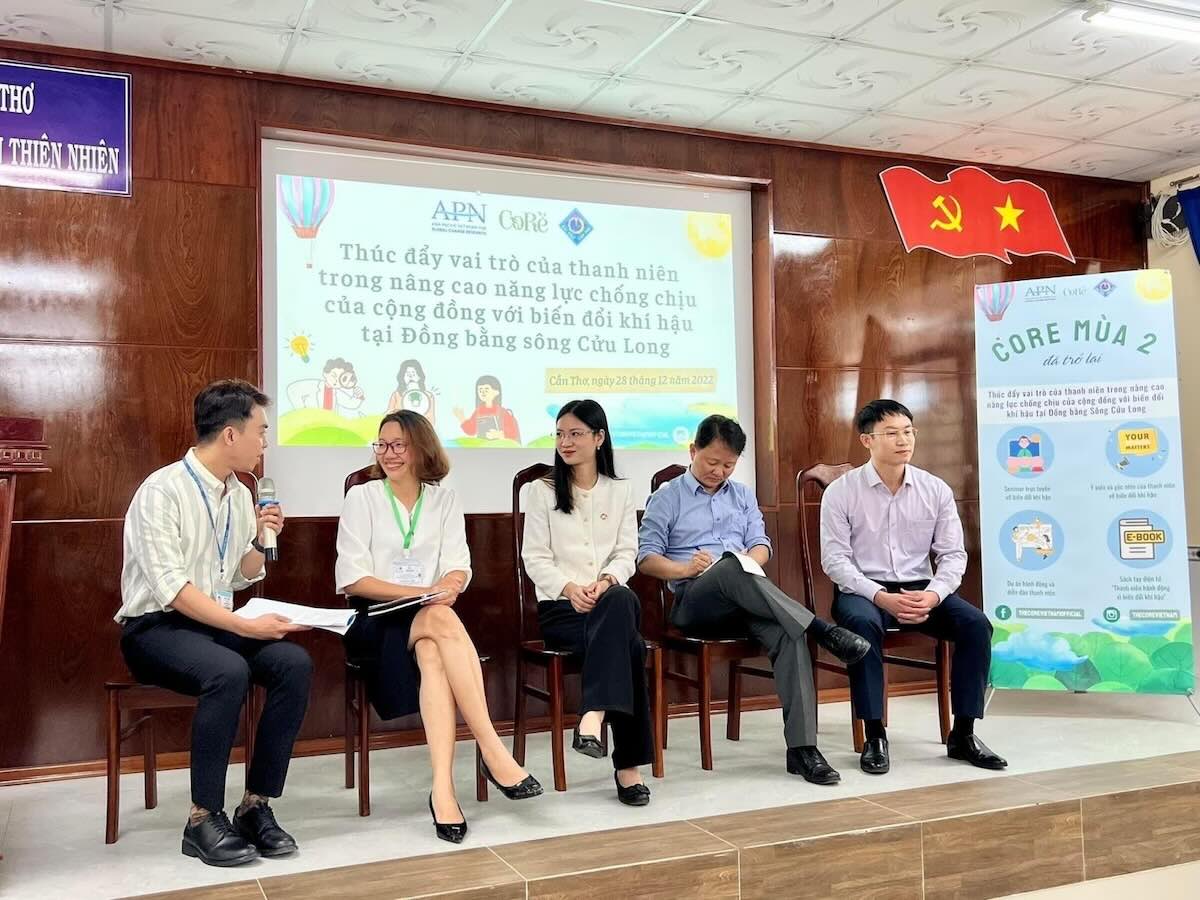
Challenge
Communities in the Mekong Delta face severe climate threats, yet young people have limited roles in formal adaptation planning.
Solution
Mobilize youth through training, workshops, and innovation projects to strengthen community resilience to climate change.
Overview
Vietnam’s Mekong Delta is one of the world’s most climate-vulnerable regions. Sea level rise, saltwater intrusion, flooding, and unpredictable rainfall threatened agriculture, infrastructure, and local livelihoods. At the same time, the region has a young population with strong potential to drive social change, but with limited opportunities to take part in structured adaptation efforts. Recognizing this, an Asia-Pacific Network for Global Change Research (APN)-supported project led by Trung Phan (Can Tho University, Vietnam) promoted youth engagement as a pathway to stronger community resilience.
The project, called Mekong Delta CoRe (Community Resilience), ran in 2022 and 2023 and mobilized youth as active contributors to climate adaptation in their communities. It combined awareness‑raising with practical training and opportunities to lead innovation projects. Through a series of cascading activities, young participants gained knowledge and skills, then applied these in local initiatives to address climate risks.
Training of trainers
ToT programs were held between December 2021 and March 2022, each lasting three days. Sessions took place in Kampot (December 2021), Kep (December 2021), Preah Sihanouk (March 2022), and Koh Kong (March 2022). Each ToT involved 30 provincial officials from departments of environment, agriculture, water resources, women’s affairs, and rural development.
Participants were trained on climate change fundamentals, adaptation planning, climate-smart agriculture, renewable energy, water-saving techniques, agroforestry, salinity-tolerant crops, solar energy, beekeeping, aquaculture, and facilitation skills. Pre- and post-training evaluations showed increased knowledge, with over 80% of participants reporting improved understanding in nearly all topics. ToT objectives included building capacity to mainstream climate change into provincial planning, and evaluation summaries stated the workshops met nearly all the trainees’ expectations.
Opening and awareness raising
The project opened with a workshop in December 2022 at Can Tho University. The session introduced Mekong Delta CoRe objectives and outlined activities to promote youth participation in climate action across the delta. Training of trainers for 36 core students launched at Can Tho University.
Training and capacity building
Youth joined structured sessions on climate science, local impacts in the Mekong Delta, and community‑based adaptation. Training emphasized communication and facilitation so students could work with residents and local partners. The program delivered six webinars and a seven-episode “Delta Youth Talk” series that built climate knowledge and showcased youth actions.
International learning and exchange
A hybrid youth conference in the delta gathered hundreds of attendees and created a platform for youth to showcase achievements and advocate recommendations.
Innovation and cascading training
Student teams designed and implemented community-based action projects on issues such as water management, agriculture, waste, and public awareness. A cascading training in April 2023 engaged students from Can Tho University and Tra Vinh University, with participants from 13 provinces and cities. Youth designed community-based action projects across science, arts, and communication. The organizing committee prepared the foundation for follow on projects, including communication initiatives and scientific research projects.
Lessons learned
The Mekong Delta CoRe project showed how structured opportunities transformed youth from passive stakeholders into active agents of resilience. Participants gained technical knowledge, leadership skills, and hands‑on experience in climate adaptation. Community members benefited from youth‑led awareness activities and practical solutions tailored to local conditions.
Evaluations indicated that the program raised awareness of climate risks and strengthened networks among students, researchers, and local partners. The approach also illustrated how cascading training extended the impact of limited resources, as trained youth became multipliers in their own communities. Lessons from this pilot suggested that scaling similar initiatives could further institutionalize youth roles in Vietnam’s climate policy and adaptation planning.
Outcomes and results
- 6 webinars and 7 “Delta Youth Talk” episodes delivered to build climate knowledge and share youth actions.
- 36 core students completed training of trainers and led peer activities.
- 13 community-based action projects designed and implemented by youth teams.
- 1 hybrid youth conference held in the Mekong Delta.
- 627 participants attended the youth conference.
- 1,034 participants including students, local policymakers, NGOs, and other stakeholders.
- 1 stakeholder and dissemination meeting convened with representatives from Vietnam, Thailand, and international partners.
- An e-book compiled outcomes from the 13 youth action projects for wider use.
Project details
| Project title | Promoting Youth Role in Raising Community Resilience to Climate Change in the Vietnamese Mekong Delta (Mekong Delta CoRe) |
|---|---|
| Year started | 2022 |
| Duration | 1.5 years (18 months) |
| Countries involved | Vietnam |
| Funding awarded | $28,265 |
| Funded by | Asia‑Pacific Network for Global Change Research (APN) |
| Grant DOI | https://doi.org/10.30852/p.22563 |
| Program | Scientific Capacity Development Programme (CAPaBLE) |
| Project reference number | CBA2022-02SY-Phan |
| Project leader | Trung Phan (Can Tho University, Vietnam) |
Acknowledgements
This project was supported by the Asia-Pacific Network for Global Change Research (APN) under its Scientific Capacity Development Programme (CAPaBLE). Acknowledgements also go to partners and participants whose contributions were central to the project’s success.
Related information
- Project Permalink
- Project Final Report
- Can Tho University. (2023). International learning program on the impacts of climate change in the Vietnamese Mekong Delta. https://mekong.ctu.edu.vn/en/tin-ta-c/602-international-learning-program-on-the-impacts-of-climate-change-in-the-vietnamese-mekong-delta.html
- Can Tho University. (2023). Closing ceremony of the cascading training on the innovation projects of youth on responding to climate change in the Vietnamese Mekong Delta. https://mekong.ctu.edu.vn/en/tin-ta-c/597-closing-ceremony-of-the-cascading-training-on-the-innovation-projects-of-youth-on-responding-to-climate-change-in-the-vietnamese-mekong-delta.html
- Can Tho University. (2023). Opening ceremony of the program “Youth community resilience to climate change in the Vietnamese Mekong Delta (Y-CoRe).” https://mekong.ctu.edu.vn/en/tin-ta-c/593-opening-ceremony-of-the-program-youth-community-resilience-to-climate-change-in-the-vietnamese-mekong-delta-y-core.html
- Can Tho University. (2023). Workshop on promoting youth role in raising community resilience to climate change in the Vietnamese Mekong Delta (Mekong Delta CoRe). https://mekong.ctu.edu.vn/en/tin-ta-c/580-workshop-promoting-youth-role-in-raising-community-resilience-to-climate-change-in-the-vietnamese-mekong-delta-mekong-delta-core.html
- APN Facebook
- APN LinkedIn
- APN X
 DISCOVER MORE

