 Asia - Cambodia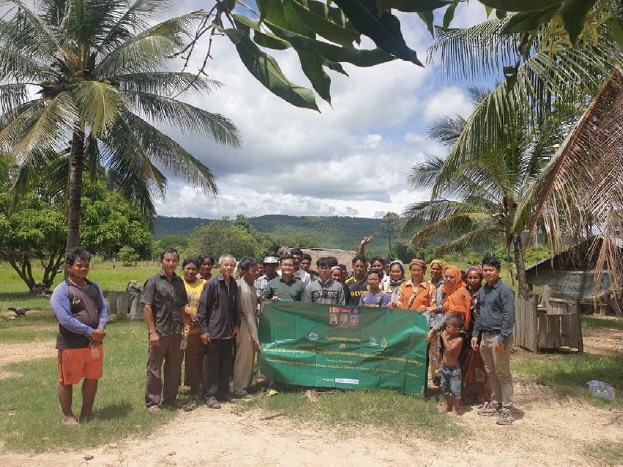
Challenge
Farmers in Cambodia’s coastal provinces face severe climate risks but have limited knowledge and skills to adapt.
Solution
Extension officers and farmers received training on climate change and adaptation practices to strengthen resilience in agriculture.
Overview
Cambodia’s coastal provinces are highly exposed to climate variability, including floods, droughts, and storms. Farmers and local institutions often lack the knowledge and tools to manage these risks, while extension officers (government agricultural advisors who support farmers with technical guidance) play a crucial role in bridging scientific understanding with farming practice.
To address this gap, an Asia-Pacific Network for Global Change Research (APN)-supported project led by Dara Sum (Ministry of Environment, Cambodia, Cambodia) delivered training of trainers (ToT) and farmer workshops across four provinces: Kampot, Kep, Preah Sihanouk, and Koh Kong.
The project aimed to strengthen the adaptive capacity of extension officers and farmers by mainstreaming climate change adaptation into local agricultural practices. This dual approach recognized that sustainable resilience requires technical officers and communities to understand climate risks and apply appropriate responses.
Training of trainers
ToT programs were held between December 2021 and March 2022, each lasting three days. Sessions took place in Kampot (December 2021), Kep (December 2021), Preah Sihanouk (March 2022), and Koh Kong (March 2022). Each ToT involved 30 provincial officials from departments of environment, agriculture, water resources, women’s affairs, and rural development.
Participants were trained on climate change fundamentals, adaptation planning, climate-smart agriculture, renewable energy, water-saving techniques, agroforestry, salinity-tolerant crops, solar energy, beekeeping, aquaculture, and facilitation skills. Pre- and post-training evaluations showed increased knowledge, with over 80% of participants reporting improved understanding in nearly all topics. ToT objectives included building capacity to mainstream climate change into provincial planning, and evaluation summaries stated the workshops met nearly all the trainees’ expectations.
Farmer workshops
Following the ToTs, one-day farmer training workshops were held in June 2022 in all four provinces, each with 30 local farmers. These workshops introduced climate change concepts, adaptation and mitigation strategies, and practical agricultural techniques suitable for coastal conditions.
For some participants, it was their first exposure to climate change and adaptation training. Farmers reported increased awareness of climate risks and began considering how to apply new practices in their farming systems.
Outcomes and lessons
The project combined ToT with farmer-level workshops; the project created a cascading effect: trained extension officers became multipliers, while farmers directly benefited from tailored instruction. Evaluations indicated high satisfaction with the participatory training style, though participants noted that more time and practical field visits would further strengthen learning outcomes.
Overall, the project demonstrated the value of pairing institutional capacity-building with community-level engagement. It established a foundation for mainstreaming climate adaptation into coastal agricultural development and highlighted the need for sustained investment in local training networks.
Outcomes and results
- Four ToT programs were conducted in Kampot, Kep, Preah Sihanouk, and Koh Kong between December 2021 and March 2022, each lasting three days with 30 participants.
- A total of 120 provincial officers from environment, agriculture, water resources, women’s affairs, and rural development departments were trained.
- Pre- and post-training evaluations showed more than 80% of trainees improved from limited to strong knowledge across topics such as climate-smart agriculture, renewable energy, and water-saving techniques.
- Four farmer workshops were held in June 2022 across the same provinces (Kampot, Kep, Preah Sihanouk, and Koh Kong), each with 30 participants, reaching 120 farmers in total.
- Farmers reported greater awareness of climate change and identified suitable adaptation practices for coastal agriculture.
- Training materials and manuals were developed and distributed to support ongoing capacity-building efforts.
Project details
| Project title | Building Capacity of Extension Officers to Help Farmers Better Adapt to Climate Change in the Coastal Area of Cambodia |
|---|---|
| Year started | 2021 |
| Duration | 1 year |
| Countries involved | Cambodia |
| Funding awarded | US$40,000 |
| Funded by | Asia‑Pacific Network for Global Change Research (APN) |
| Grant DOI | https://doi.org/10.30852/p.20543 |
| Program | Scientific Capacity Development Programme (CAPaBLE) |
| Project reference number | CBA2021-11SY-Sum |
| Project leader | Dara Sum (Ministry of Environment, Cambodia, Cambodia) |
Acknowledgements
This project was supported by the Asia-Pacific Network for Global Change Research (APN) under its Scientific Capacity Development Programme (CAPaBLE). Acknowledgements also go to the participating provincial departments in Kampot, Kep, Preah Sihanouk, and Koh Kong, and to the farmers who contributed their time and experience during workshops.
Related information
- Project Permalink
- Project Final Report
- Sum, D., and Sopheak, T. (2023). Training of Trainers, Kamport Province – Enhancing capacity of sub-national institutions to help vulnerable farmers better adapt to climate change and climate variability in coastal area of Cambodia. Evaluation Report. Ministry of Environment, Cambodia, and Royal University of Agriculture, Cambodia. https://www.apn-gcr.org/publication/training-of-trainers-evaluation-report-kamport-province/
- Sum, D., and Sopheak, T. (2023). Training of Trainers, Kep Province – Enhancing capacity of sub-national institutions to help vulnerable farmers better adapt to climate change and climate variability in coastal area of Cambodia. Evaluation Report. Ministry of Environment, Cambodia, and Royal University of Agriculture, Cambodia. https://www.apn-gcr.org/publication/training-of-trainers-evaluation-report-kep-province/
- Sum, D., and Sopheak, T. (2023). Training of Trainers, Preahsihanuk Province – Enhancing capacity of sub-national institutions to help vulnerable farmers better adapt to climate change and climate variability in coastal area of Cambodia. Evaluation Report. Ministry of Environment, Cambodia, and Royal University of Agriculture, Cambodia. https://www.apn-gcr.org/publication/training-of-trainers-evaluation-report-preahsihanuk-province/
- Sum, D., and Sopheak, T. (2023). Training of Trainers, Koh Kong Province – Enhancing capacity of sub-national institutions to help vulnerable farmers better adapt to climate change and climate variability in coastal area of Cambodia. Evaluation Report. Ministry of Environment, Cambodia, and Royal University of Agriculture, Cambodia. https://www.apn-gcr.org/publication/training-of-trainers-evaluation-report-koh-kong-province/
- Sum, D., and Sopheak, T. (2023). Farmers training workshop report on “Mainstreaming appropriate climate change adaptation options to farmers in Kampot Province”. Minute Report. Ministry of Environment, Cambodia, and Royal University of Agriculture, Cambodia. https://www.apn-gcr.org/publication/farmers-training-workshop-mainstreaming-appropriate-climate-change-adaptation-options-to-farmers-in-kampot-province/
- Sum, D., and Sopheak, T. (2023). Farmers training workshop report on “Mainstreaming appropriate climate change adaptation options to farmers in Kep Province”. Minute Report. Ministry of Environment, Cambodia, and Royal University of Agriculture, Cambodia. https://www.apn-gcr.org/publication/farmers-training-workshop-mainstreaming-appropriate-climate-change-adaptation-options-to-farmers-in-kep-province/
- Sum, D., and Sopheak, T. (2023). Farmers training workshop report on “Mainstreaming appropriate climate change adaptation options to farmers in Preasihanuk Province”. Minute Report. Ministry of Environment, Cambodia, and Royal University of Agriculture, Cambodia. https://www.apn-gcr.org/publication/farmers-training-workshop-mainstreaming-appropriate-climate-change-adaptation-options-to-farmers-in-preahsihanuk-province/
- Sum, D., and Sopheak, T. (2023). Farmers training workshop report on “Mainstreaming appropriate climate change adaptation options to farmers in Koh Kong Province”. Minute Report. Ministry of Environment, Cambodia, and Royal University of Agriculture, Cambodia. https://www.apn-gcr.org/publication/farmers-training-workshop-mainstreaming-appropriate-climate-change-adaptation-options-to-farmers-in-koh-kong-province/
- Sum, D., & Thav, S. (2023). Impact of climate change, climate variability and adaptation in the coastal area of Cambodia. APN Science Bulletin, 13(1). doi:10.30852/sb.2023.2435, https://www.apn-gcr.org/publication/impact-of-climate-change-climate-variability-and-adaptation-in-the-coastal-area-of-cambodia/
- APN Facebook
- APN LinkedIn
- APN X
 DISCOVER MORE

