 Asia - Cambodia, Indonesia, Japan, Laos, Thailand, United States, Vietnam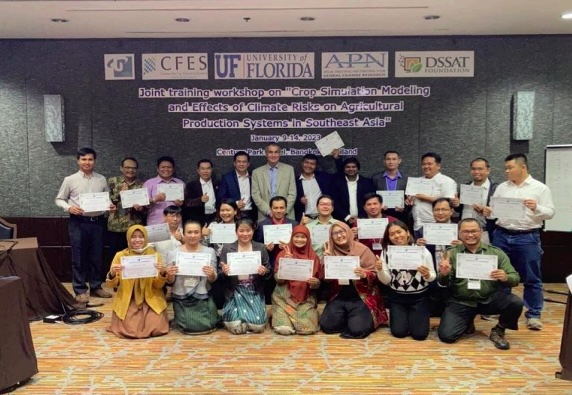
Challenge
Climate risks reduce crop yields, and many Southeast Asian researchers lack the skills to use crop models for adaptation.
Solution
Workshops built skills in crop modeling to assess climate risks, guide farm planning, and support adaptation, strengthening agriculture in Southeast Asia.
Overview
Agriculture across Southeast Asia faces mounting challenges due to climate change, including droughts, floods, and increasingly erratic rainfall. These risks threaten yields and food security for millions of people. Crop simulation models, such as the Decision Support System for Agrotechnology Transfer (DSSAT), offer tools to quantify these risks and evaluate adaptation strategies.
With support from the Asia-Pacific Network for Global Change Research (APN), Mohan Geetha (University of Toyama, Japan) led a project to build scientific capacity in the region by training early-career researchers and practitioners in DSSAT modeling. The initiative involved partners from Cambodia, Indonesia, Laos, Thailand, Vietnam, Japan, and the United States.
Training workshops
The project delivered a sequence of training events that progressively built skills:
- Inception meeting, Can Tho, Vietnam, March 4, 2019: A one-day inception meeting was held to finalize the training workshop’s planning and implementation, including target groups and data sharing.
- Five-day training, Can Tho, Vietnam, March 5–9, 2019: Twenty-one participants from thirteen provinces of Vietnam completed the five-day workshop. Participants learned about DSSAT software installation and practical exercises, and all received completion certificates.
- Six-day training, Chiang Mai, Thailand, August 19–24, 2019: The six-day workshop attracted 20 participants, including 15 APN-funded participants.
- Six-day training, Bangkok, Thailand, January 9–14, 2023: This training program was attended by 21 participants from Cambodia, Indonesia, Laos, and Thailand.
Prioritizing best practices
Through participatory assessment, project partners identified 47 watershed management technologies relevant to the region. These ranged from buffer planting and crop rotation to composting, rainwater harvesting, and salinity management. Using group exercises and voting, participants shortlisted 10 promising interventions per country, and then selected the four most suitable technologies.
For example, Pakistan emphasized checking dams, forestation, rainwater harvesting, and efficient irrigation, while Nepal prioritized checking dams with bioengineering, grasses and legumes, conservation ponds, and irrigation management. In Sri Lanka, irrigation management, critical area planting, and waste management ranked highly.
Curriculum and tools
The curriculum combined theory with application. Lectures addressed potential crop production, soil water balance, nitrogen dynamics, and climate change impacts on yields. Hands-on modules focused on preparing weather datasets, estimating genetic coefficients, running seasonal and spatial analyses, and testing management interventions.
Software tools included: WeatherMan for preparing and quality-checking climate datasets, GLUE for calibrating crop genetic coefficients, XBuild for creating experimental designs, and DSSAT modules for tasks such as model evaluation, seasonal analysis, and uncertainty testing. These were reinforced by exercises on rice, maize, and other crops, ensuring transferability across systems.
Field engagement and farmer perspectives
During the Can Tho training, participants visited Binh Thuy and O Mon districts to interact directly with five farmers. They discussed drought and flood risks, varietal tolerance, and yield gaps, linking modeling exercises to lived realities.
Farmers emphasized the importance of extension services, access to technology packages, and market linkages. These perspectives informed training discussions and underscored the need for applied models that integrate local knowledge.
Participants and regional reach
Across all workshops, 62 individuals completed training, including 48 early-career scientists and 24 female researchers, along with academicians, students and extension officers. Participants represented universities, research institutes, and ministries of agriculture.
The project fostered networks across National Agricultural Research Systems in Cambodia, Indonesia, Laos, Thailand, and Vietnam, strengthened institutional collaboration, and encouraged sharing of climate and crop data. Several participants committed to running local-language training and to embedding DSSAT into university curricula, multiplying impact beyond the original group.
Outcomes and next steps
By the project’s conclusion, trainees could apply DSSAT to simulate yields under varying climate and management conditions, verify input data, and assess adaptation options such as variety selection or altered planting dates. Field experiments were initiated to generate new datasets, and outputs are expected to feed into national adaptation planning.
Participants highlighted the usefulness of DSSAT in assessing fertilizer and irrigation scenarios, providing evidence for farmer advisories. The project recommended continuing regular training, producing localized manuals, and expanding the regional crop modeling network. These steps aim to create a sustained knowledge-sharing platform and ensure that capacity development efforts translate into practical adaptation outcomes.
Project details
| Project title | Capacity Development Training Workshop on Crop Simulation Modelling and Effects of Climate Risks on Agricultural Production Systems in Southeast Asia |
|---|---|
| Year started | 2020 |
| Duration | 2 years |
| Countries involved | Cambodia, Indonesia, Japan, Laos, Thailand, United States of America, Vietnam |
| Funding awarded | US$80,000 |
| Funded by | Asia‑Pacific Network for Global Change Research (APN) |
| Grant DOI | https://doi.org/10.30852/p.4593 |
| Program | Scientific Capacity Development Programme (CAPaBLE) |
| Project reference number | CBA2018-04MY-Geetha |
| Project leader | Mohan Geetha (University of Toyama, Japan) |
Acknowledgements
This project was supported by the Asia-Pacific Network for Global Change Research (APN) under its Scientific Capacity Development Programme (CAPaBLE). Collaborators included the University of Florida, Chiang Mai University, Tokyo University of Agriculture, Royal University of Agriculture (Cambodia), National University of Laos, High Agricultural Technology Research Institute for the Mekong Delta (Vietnam), and Universitas Lampung (Indonesia).
Related information
- Project Permalink
- Geetha, M., Hoogenboom, G., Buddhaboon, C., Nguyen, L.T., Nut, N., Thongmanivong, S., Matsuda, H., Irwan, B.S. (2023). Capacity Development Training Workshop on Crop Simulation Modeling and Effects of Climate Risks on Agricultural Production Systems in Southeast Asia. Project Final Report. Asia- Pacific Network for Global Change Research. https://www.apn-gcr.org/publication/project-final-report-cba2018-04my-geetha/
- Geetha, M., Hoogenboom, G., Jintrawet, A., Buddhaboon, C., & Anothai, J. (2024). Capacity development training workshop on crop simulation modelling and effects of climate risks on agricultural production systems in Southeast Asia. APN Science Bulletin, 14(1), 110–119. https://doi.org/10.30852/sb.2024.2570
- APN Facebook
- APN LinkedIn
- APN X
 DISCOVER MORE

