 Asia - India
Challenge
Kerala’s capacity to finance long-term resilience and low-carbon transitions is challenged by its rising emissions, climate-sensitive economy, and serious flood, heat, and coastal hazards.
Solution
Kerala’s Low-Carbon, Climate-Resilient Development (LCRD) pathway is a collaborative effort in low-carbon energy transitions, resilient infrastructure, targeted adaptation, and sustainable land use, supported by district-prioritised funding and thorough disaster risk management.
Overview
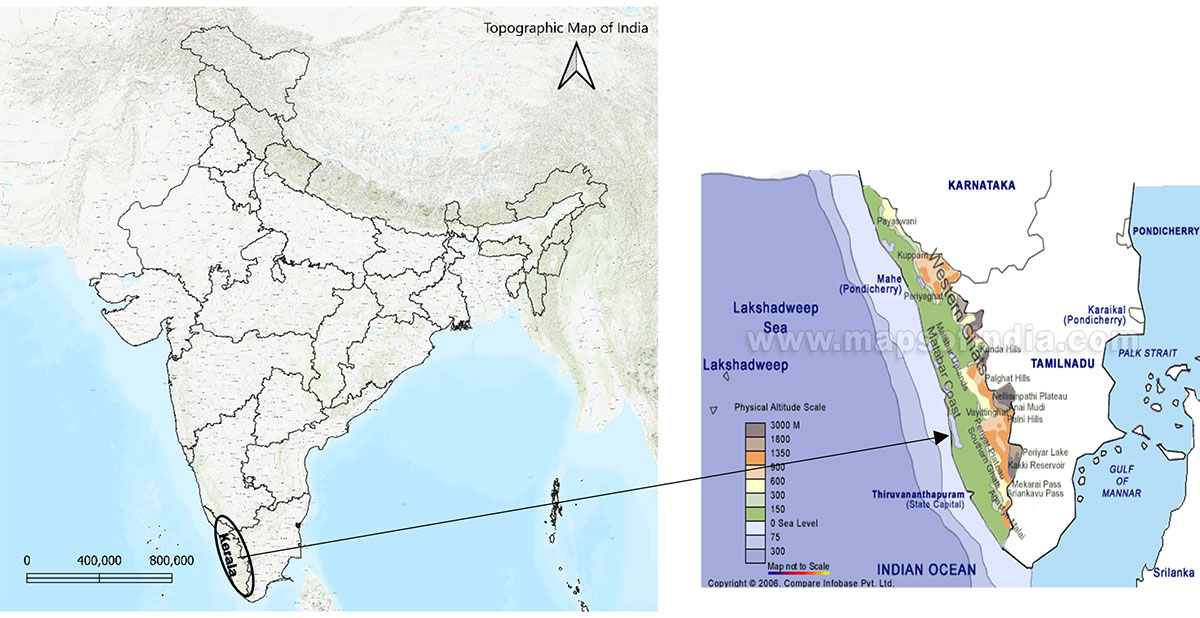
Kerala, the southernmost state on India’s western coast, stands at a critical intersection of climate risk and development ambition. Bounded by the Arabian Sea on one side and the Western Ghats (the oldest mountain ranges along India’s western coast) on the other, the state’s unique topography and intense monsoon patterns intensify its exposure to floods, landslides, sea-level rise, and drought-like conditions during dry spells. Nevertheless, Kerala is densely populated with 35 million people, and known for its high literacy, long life expectancy, and widespread urban-rural settlements across all 14 districts. Its economy and labour-intensive employment are rooted in agriculture, fisheries, tourism, and manufacturing. As a result, Kerala’s service-led economy is highly climate-sensitive because its key sectors depend on stable ecosystems, mobility, and infrastructure that can be easily disrupted by extreme weather.
Kerala’s emissions profile is shaped by transport growth, energy-intensive industries, rapid urbanisation, construction, and expanding consumption patterns. While per capita emissions remain moderate compared to some Indian states, the combination of high electricity demand, expanding services, and fossil fuel dependency creates a rise in the emission trajectory within the state. With climate hazards increasing annually, the state must simultaneously prioritise reducing emissions to protect vulnerable communities and livelihoods.
Scenario Pathways for Low-Carbon Growth
The Kerala LCRD study evaluates development through four modelled scenarios to understand the potential impacts and find the best solutions for the state.
- Business-As-Usual (BAU): Current trends continue, leading to rising emissions, inconsistent adaptation, and increasing exposure of settlements and critical infrastructure.
- State Action Plan on Climate Change (SAPCC)-Aligned Scenario: Implements Kerala’s State Action Plan on Climate Change, strengthening sustainability but with limited emission reductions.
- Low-Carbon Pathway (LC): Prioritises low-emission technologies, energy efficiency, sustainable transport, and optimised land use.
- High-Growth Scenario (HG): Accelerated economic expansion increases energy demand and climate risks unless substantial mitigation is embedded.
These scenarios integrate MESSAGEix model, Computable General Equilibrium (CGE) analysis, InVEST ecosystem service valuation, and Land Use-Land Cover change projections using the PLUS model to understand long-term impacts on emissions, ecosystems, and disaster risk.
Mitigation Strategies
Kerala’s mitigation plan focuses on replacing fossil fuels with cleaner, renewable options across homes, transport, farms, and industries. The State aims to become 100% renewable-powered by 2040 and expand clean energy capacity from today’s 2.6 GW to about 19-19.5 GW by 2050 under the Low-Carbon (LC) scenario while targeting a 33% reduction in final energy demand. All private and commercial vehicles are planned to turn 100% electric, while a few are dependent on biofuel blends. Industries will fully replace coal with biomass and switch entirely to biofuels and green electricity, supported by 0.3 MTOE of green hydrogen production by 2050. Buildings will operate on 100% green power with solar-heated water and efficient appliances. Through these linked actions, along with strong support from the development of nature-based solutions, Kerala can cut emissions by 52 milliontonnes of CO₂ and move steadily toward a net-zero, climate-safe future by 2050.
Adaptation Strategies
Kerala’s adaptation strategy addresses its multi-hazard reality by combining ecosystem restoration, climate-resilient infrastructure, and community-centred approaches, where 5.4 million people remain exposed to recurrent floods, landslides, and coastal surges. Introduction of climate-tolerant crops, modernised farming and development of IoT, is expected to improve agriculture and drainage systems, especially for the 60% of croplands lying below sea level, hence highly sensitive to salinity and floodwaters. Water security interventions emphasise watershed rejuvenation, aquifer recharge, and decentralised storage in 35% of groundwater-stressed blocks. Along the 580 km coastline, the LCRD framework calls for mangrove expansions to reduce wave energy by up to 66% dune rehabilitation, and strict coastal zoning to limit high-risk development. Urban adaptation will focus on green-blue drainage corridors, nature-based flood buffers, and stormwater upgrades in cities where extreme rainfall events have risen by over 45% in two decades. In the Western Ghats, restoration of degraded slopes, forest fire management, and ecological corridor protection strengthen soil stability, biodiversity, and watershed resilience, forming Kerala’s long-term ecological safety net.
Disaster Management Strategies
Given the state’s multi-hazard profile, Kerala’s LCRD embeds interventions addressing recurring floods, landslides, coastal surges, and heatwaves through four major approaches:
- Risk-sensitive planning
- Early warning and preparedness
- Infrastructure resilience
- Community-led disaster governance
The state is building a smarter warning system that uses simple on-ground sensors and real-time monitoring to track rising rivers, heavy rain, and unstable slopes, giving people more time to react. It plans to create a “Smart Disaster Response System” to speed up rescue, relief, and compensation after disasters. Kerala also proposes a government-supported insurance scheme so that families affected by disasters can quickly rebuild their homes and livelihoods without falling into debt.
Financing Needs and Prioritisation
The SAPCC of Kerala estimates a requirement of ₹52,000 crore to mitigate 57 MtCO₂e by 2030. Though figures vary across scenarios, adaptation and resilience need substantial upfront finance in priority sectors such as agriculture, water resources, health, urban systems, biodiversity, forests, and resilient infrastructure. About 28% of the total budget is government-funded, with the rest expected from external sources. Major allocations go to transport (around 18%), followed by power (7%) and agriculture (3%), while construction and industries receive minimal support. Given limited state fiscal space, financing strategies include public investment, convergence with national schemes, climate-linked grants, and mobilisation of development finance through blended finance. Based on vulnerability, economic dependence, ecosystem services, and population exposure, priority districts are identified as Kerala’s focus for early LCRD investments.
Kerala’s integrated LCRD strategy proves that even high-risk, resource-constrained regions can deliver transformative climate action, offering a replicable model for resilient growth across the world.
Project Details:
| Project title | Enabling Low-Carbon and Climate Resilient Development in Kerala |
| Year Started | 2024 |
| Duration | 1.5 years |
| Countries involved | India |
| Funded by | World Bank |
| Project leader | Dr Anindya Bhattacharya |
Acknowledgments
We gratefully acknowledge The Celestial Earth team for conducting this project and for their generous collaboration in publishing it as a case study in the Adaptation Database. We also thank the World Bank for its financial support, which was instrumental in carrying out this project.
 DISCOVER MORE

