 Asia - Bangladesh, Sri Lanka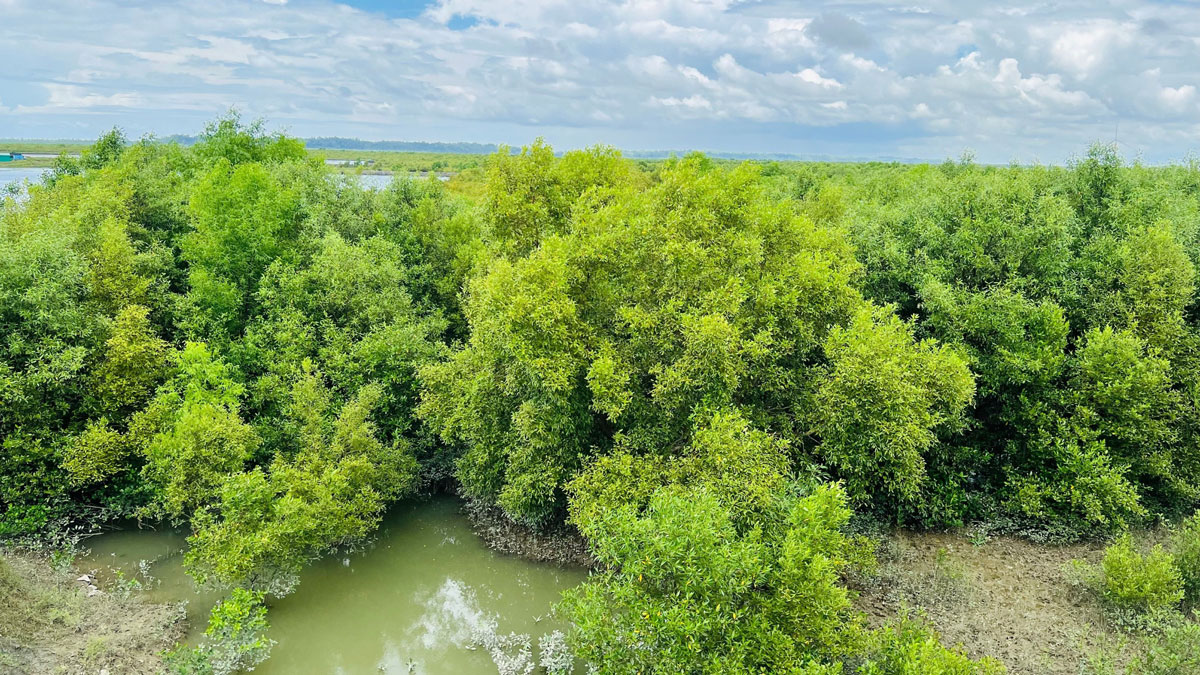
Challenge
At least 30% of the world’s mangroves have been lost to deforestation and overexploitation, threatening coastal communities, biodiversity, and stored carbon.
Solution
Restore degraded mangrove areas, train communities in sustainable livelihoods, and improve living conditions for families in Sri Lanka and Bangladesh.
Overview
The Global Nature Fund (GNF) initiated the Mangrove & Climate Protection project in 2005, focusing on the restoration and conservation of mangrove forests in South Asia. Mangrove forests sequester carbon, stabilize coastlines, and provide habitats for diverse species, yet at least 30% of the world’s mangroves have been lost because of deforestation and overexploitation, at a rate surpassing that of tropical rainforests. This loss releases stored carbon, intensifies coastal erosion, and threatens the livelihoods of millions who depend on these ecosystems for fishing, agriculture, and protection from extreme weather events. The degradation also accelerates biodiversity loss and exacerbates climate change by removing one of the ocean’s most effective carbon stores.
GNF’s approach combines ecological restoration with socio-economic development, working across 20 communities in Sri Lanka and Bangladesh. The project’s aims are to rehabilitate degraded mangrove areas, improve coastal protection, and improve the socio-economic conditions of local communities.
Restoration and education
GNF’s goals include the establishment of 14 community-driven nurseries, cultivating and planting 146,000 mangrove seedlings across degraded coastal areas. This effort aids reforestation and gives local communities direct ownership of conservation activities, building the capacity and commitment needed for long-term habitat recovery.
Another goal is creating two centers dedicated to mangrove education, in Sri Lanka and Bangladesh. These centers can serve as hubs for learning and awareness, building environmental stewardship. They will support the project’s goal of ensuring local communities have the knowledge to sustain conservation efforts over the long term.
GNF also reports that it has restored 375 hectares of mangrove forest, with 750,000 mangrove trees planted.
Livelihoods and community support
The project provides training in mangrove-friendly, income-generating activities, offering an economic alternative to practices that degrade mangrove ecosystems. Skills development focuses on sustainable aquaculture and organic farming. Emphasis is placed on empowering women and young people, equipping them with the skills to generate income in ways that support rather than harm mangrove ecosystems.
The project also addresses basic needs, and 700 families across 20 communities have benefited from improvements in access to clean drinking water, solar energy solutions, measures to reduce soil erosion, and vegetable cultivation and aquaculture adapted to climate change.
Results
The project has produced measurable outcomes:
- Sustainable livelihood programs have helped 700 families increase their incomes.
- Restoration of 15 hectares of mangrove forest, contributing to biodiversity and carbon sequestration.
- Training completed by 240 people, mainly women, in sustainable income generation and community resilience.
- Project measures across the two countries have benefitted 3,000 people.
Outlook
GNF plans to scale up reforestation activities, strengthen environmental education programs, and forge stronger partnerships with local and international stakeholders. The project aims to develop sustainable models that integrate community needs with environmental objectives. These models are intended to be replicable in other regions facing similar pressures of mangrove loss, coastal erosion, and socio-economic vulnerability in coastal communities.
Acknowledgements
This report is based on publicly available information from the Global Nature Fund (GNF). Acknowledgement is given to the organizations that made this knowledge accessible. Reported by IGES, edited and updated by AP-PLAT.
Related Links / References
- Global Nature Fund, Mangrove & Climate Protection
https://globalnature.org/en/project/mangrove-climate-protection/ - Goldberg, L., Lagomasino, D., Thomas, N., and Fatoyinbo, T. (2020). Global declines in human-driven mangrove loss. Global Change Biology, 26(10), 5844
https://doi.org/10.1111/gcb.15275. - Valiela, I., Bowen, J.L., and York, J.K., (2001) Mangrove Forests: One of the World’s Threatened Major Tropical Environments: At least 35% of the area of mangrove forests has been lost in the past two decades, losses that exceed those for tropical rain forests and coral reefs, two other well-known threatened environments, BioScience, Volume 51, Issue 10, October 2001, Pages 807–815
https://doi.org/10.1641/0006-3568(2001)051[0807:MFOOTW]2.0.CO;2
 DISCOVER MORE

