 Asia - Japan
Challenge
Over-reliance on conventional flood infrastructure has created a false sense of security, increasing vulnerability to extreme weather events.
Solution
Traditional Japanese hydraulic controls such as open levees and flood-protecting forests offer a nature-based approach to flood management.
Overview
Extreme weather events are intensifying the need to rethink conventional infrastructure for disaster management. Over-reliance on “gray” infrastructure – such as dams, levees, and paved roads – has created a false sense of security. These structures can increase downstream vulnerability. Even with strong infrastructure, levee failures remain unpredictable, and protection against floods and other disasters by manmade structures is limited, increasing the potential for catastrophic events in densely populated areas.
This situation has led to growing interest in nature-based solutions (NbS) in flood management, shifting from species protection in a narrow sense to a broader ecosystem approach. The International Union for Conservation of Nature defines NbS as “actions to protect, sustainably manage, and restore natural or modified ecosystems that effectively and adaptively address societal challenges and simultaneously benefit human well-being and biodiversity” (Cohen-Shacham et al., 2016).
NbS, continually developing since around 2008, is particularly relevant in Japan, where traditional methods are undergoing a resurgence. Climate change will increase rainfall, heightening the risk of excess flooding. In Japan, traditional hydraulic controls dating back to the 16th century are attracting attention as forms of NbS. These green infrastructure solutions contrast with the post-1896 River Act’s focus on Western-style infrastructure, which was designed for rapid floodwater conveyance but increased downstream vulnerability.
Late 19th-century experts Junchu Odaka and Nishi Moromoto warned against over-reliance on embankments, likening them to armor that can worsen injuries (Takahashi, 1971). They noted that people tend to have a false sense of security and build even stronger and higher banks, which can raise stormwater levels, exposing the vulnerability of dependence on “gray” infrastructure.
Kasumi-tei
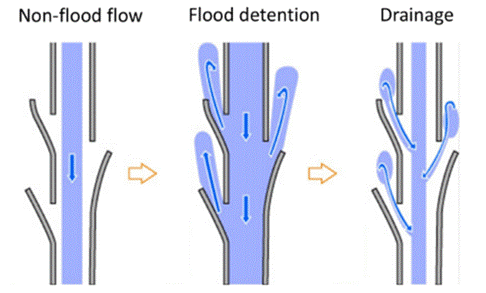
Kasumi-tei (open levees) are discontinuous, funnel-shaped levees dating from the 17th to 19th centuries (Sendo and Ishikawa, 2018). They allow excess floodwater to spread, reducing discharge before returning to the channel. Okuma (1987) noted their varied application in steep and gentle rivers. Simulations have validated their effectiveness (Sendo and Ishikawa, 2018).
Nokoshi and etsuryu-tei
Nokoshi are traditional flood mitigation structures on the Jobaru River that protected villages by controlling overflow. Many have been removed for development (Tanabe and Okuma, 2001), increasing risk. While a dam also provides protection, integrating nokoshi and kasumi-tei offers a more resilient approach. Simulations show their effectiveness in mitigating river level rise (Nakajima and Ogushi, 2012; Teramura and Shimatani, 2021).
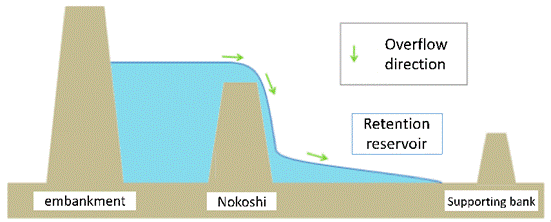
Etsuryu-tei are levees that allow controlled overflow into retention areas. Lowered levee sections divert excess water (MLIT, 2016), and reinforced overflow surfaces and the inter-levee area create a green infrastructure retention reservoir.
Bobirin
Bobirin are artificial forests that protect against natural and human-induced disasters. Designated as protection forests, they prevent sediment runoff, stabilize slopes, and mitigate wind, floods, and other hazards (Watanabe, 1998). Satoyama forests also prevent sediment disasters and mitigate wildlife damage (MoE, 2016), demonstrating the multifunctional benefits of NbS.
Integrating these traditional solutions with existing infrastructure offers a more sustainable and adaptive strategy for flood management in Japan.
Acknowledgements
This report draws on published research on traditional Japanese flood control methods. Acknowledgement is given to the researchers whose work informed the contents. Reported by IGES, edited and updated by AP-PLAT.
Related Information
(Video) 3.6 – Case study – Traditional flood control in Japan: “Kasumitei” [NbS for the local communities], https://www.youtube.com/watch?v=D5SrVXZNRx4.
Evolution of Japan’s flood control planning and policy in response to climate change risks and social changes, Water Policy, IWA Publishing
https://iwaponline.com/wp/article/23/S1/77/85837/Evolution-of-Japan-s-flood-control-planning-and.
Traditional Flood Control “Kasumi-tei” – Chikuma, Japan, Inspired by Nature-based Action and Solutions (INAS) -Showcase NbS, https://ap-plat.nies.go.jp/inas/goodpractices/tradition/1.html#:~:text=Kasumi%2Dtei%2C%20discontinuous%20open%20levees,breaks%20between%20the%20sub%2Dlevees.
Cohen-Shacham E, Walters G, Janzen C, Maginnis S (eds) (2016) Nature-based Solutions to address global societal challenges. IUCN, Gland, Switzerland.
Nakajima D and Ogushi K (2012) Effect and Numerical simulation of flood water into the retention reservoir at the Jobaru river – Kasumi-tei levees, Civil Engineering Conference, http://library.jsce.or.jp/jsce/open/00074/2012/56-02-0034.pdf. (in Japanese).
Okuma T (1987) Discussion on the function and etymology of Kasumi-tei levee, Japan Civil Engineering Conference Proceedings. 259-266 (in Japanese).
Sendo H, Ishikawa T (2018) Hydraulic function of the kasumi-tei levee system on the Kurobe Alluvial Fan of the 19th century. In: River Flow 2018 – Ninth International Conference on Fluvial Hydraulics, Paquier A and Rivière N (Eds), E3S Web Con 40. https://doi.org/10.1051/e3sconf/20184006032. Lyon-Villeurbanne, France, September 5-8, 2018
Takahashi H (1971) Land Transformation and Floods, Iwanami-shinsho, Tokyo.
 DISCOVER MORE

