 Asia - Bangladesh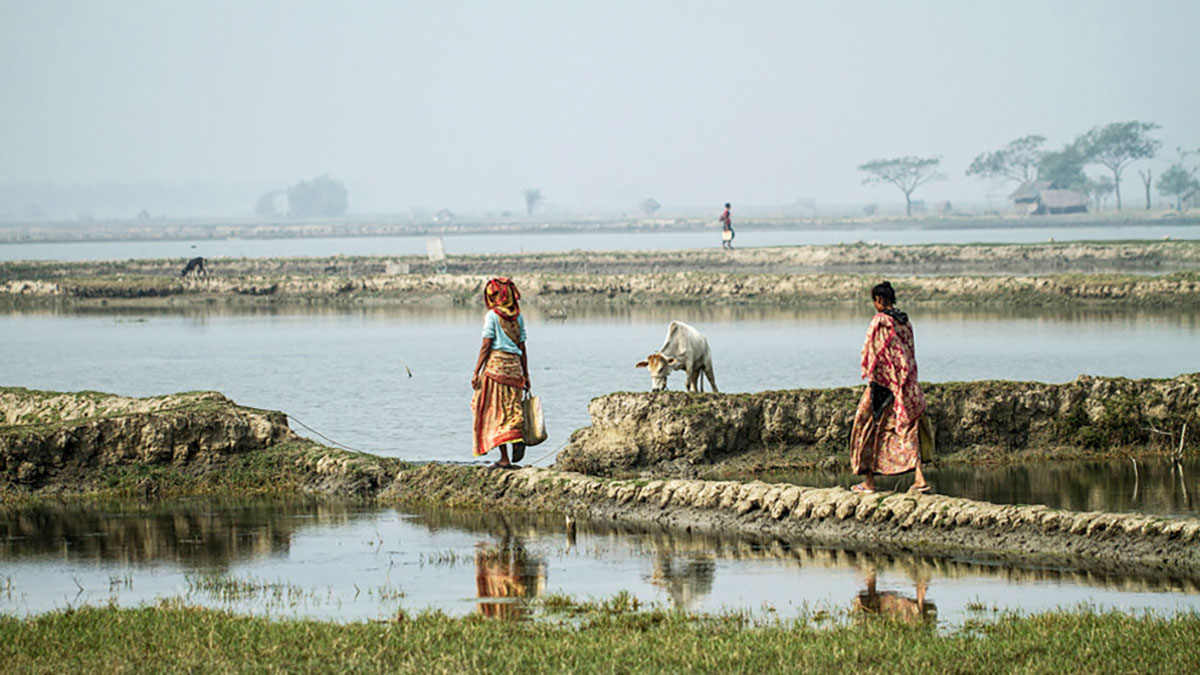
Challenge
Frequent floods, storms, drought, and salinity intrusion threaten rural livelihoods in Bangladesh, with female-headed households facing heightened vulnerability.
Solution
Communities implement locally led flood, storm, and salinity measures, with strong participation of female-headed households in risk reduction.
Overview
Rural Bangladesh is experiencing escalating climate-induced disasters, including frequent floods, tropical storms, and slow-onset events such as drought, water salinity, and river erosion. Agriculture remains a primary source of income, so climate shocks and gradual environmental change are directly affecting livelihoods and household stability.
Data from the United Nations Development Programme Climate Expenditure Survey across 10 rural districts shows that 42.7% of households are exposed to floods, 40.7% to storms, and 82.6% to at least one slow-onset disaster (Eskander et al., 2022). These exposure levels reflect the breadth of climate pressure facing rural communities.
In response, communities are developing locally driven disaster risk reduction strategies. Actions focus on three main areas: protecting homes from physical damage, safeguarding agricultural land that sustains income, and securing livestock and household materials that support daily life. These efforts are rooted in collective action and local knowledge.
Storm and flood risk reduction
Floods and storms remain among the most common and devastating hazards. One widely adopted measure is raising the floors of homes to reduce damage from floodwaters and storm surges. Among flood-affected households, 31.1% are elevating floors, while 11.3% of storm-affected households are doing the same. In flood-prone areas alone, 1,320 households have raised their homes to keep living spaces habitable during and after extreme events (Eskander et al., 2022).
Protection of agricultural land forms another pillar of risk reduction. To reduce crop losses, 2.5% of flood-affected households and 6.03% of storm-affected households are building embankments or planting flood-resistant crops (Eskander et al., 2022). These measures aim to stabilize agricultural production under increasingly unpredictable weather conditions.
Households are also securing movable assets and livestock. Among flood-affected households, 7.35% are protecting essential household materials and 22.9% are safeguarding livestock. Among storm-affected households, 6.11% are protecting materials and 16% are protecting livestock (Eskander et al., 2022). Livestock protection is particularly significant because animals serve as sources of food and income.
Responding to slow-onset hazards
Drought, salinity intrusion, and river erosion require sustained adjustments rather than short-term defensive actions. In areas affected by these gradual hazards, 3.36% of households are protecting agricultural land through measures tailored to local conditions (Eskander et al., 2022). Actions include shifting to salt-resistant crop varieties in saline areas and applying soil conservation techniques in drought-affected zones.
Material and livestock protection continues under slow-onset stress. Overall, 1.52% of households are securing materials against moisture or salinity-related damage, and 7.58% are protecting livestock, including ensuring access to clean water during droughts or providing shelter during extreme weather events (Eskander et al., 2022).
Communities are also improving local water management systems in areas prone to waterlogging or river erosion. Measures include maintaining irrigation channels and water storage facilities to manage changing hydrological conditions.
Gender-specific engagement in risk reduction
Female-headed households account for 22% of the surveyed sample and show higher engagement in protective measures (Eskander et al., 2022). Compared with male-headed households, female-headed households are raising floors by 19.32 percentage points more and protecting household materials by 5.50 percentage points more.
Despite lower overall income levels, female-headed households are allocating a larger share of income to disaster preparedness (Eskander et al., 2022). Their level of engagement stands out given financial constraints and reflects sustained effort to protect families and assets. Women are often taking central roles in organizing and implementing community disaster risk reduction strategies.
Community-based disaster risk reduction efforts in rural Bangladesh demonstrate resilience in the face of intensifying climate risks. Traditional practices and locally adapted innovations are operating side by side to protect homes, land, and livelihoods.
Female-headed households’ active participation reinforces the relevance of gender-sensitive climate adaptation policy. As climate pressures continue to evolve, these community experiences provide insight for disaster risk reduction efforts in other regions confronting similar hazards.
Acknowledgements
This report draws from work by Shaikh Eskander, Paul Steele, Mamunur Rashid, Nuzhat Imam, and Sirazoom Munira, detailed in “Still bearing the burden: how poor rural women in Bangladesh are paying most for climate risks” (Eskander et al., 2022). Acknowledgement is given to the original authors. Reported by IGES, edited and updated by AP-PLAT.
Related Information
Shaikh Eskander, Paul Steele, Mamunur Rashid, Nuzhat Imam and Sirazoom Munira (2022) Still bearing the burden: how poor rural women in Bangladesh are paying most for climate risks. IIED Working Paper, IIED, London.
https://www.iied.org/20851iied
 DISCOVER MORE

