 Asia - Japan
| Date of interview | November 25, 2024 |
|---|---|
| Interviewee | Hiroshi Takahashi, Professor, Graduate School of Fisheries Science (also affiliated with the Department of Applied Aquabiology), National Fisheries University |
Climate-Driven Interspecific Hybridization in Pufferfish
Could you tell us about your research first?
Since graduate school, my research has focused on how interspecific genetic exchange via hybridization shapes biodiversity. Currently, I am studying how hybridization amang species in the genus Takifugu contributes to the evolution of biodiversity. I previously analyzed the genes of hybrid pufferfish only rarely found in fish market catches. Around 2013, however, large numbers of hybrids began to appear along the eastern coast of Japan. At first, I found this hard to believe, but genetic analyses clearly showed that hybridization was occurring on an unprecedented scale. The increase in hybrids appeared to be linked to distribution shifts in one parental species associated with ocean warming, which led me to investigate this phenomenon in the context of climate change.

It refers to hybridization between different species within the genus Takifugu.
That’s right. The genus Takifugu comprises many genetically similar species and is considered a complex of closely related species. Because of this close relationship, these species can readily hybridize when their habitats change or their breeding areas overlap.
Hybridization occurs between different species. In interspecific hybridization, the female and male parent species can be identified; this is known as the direction of hybridization.
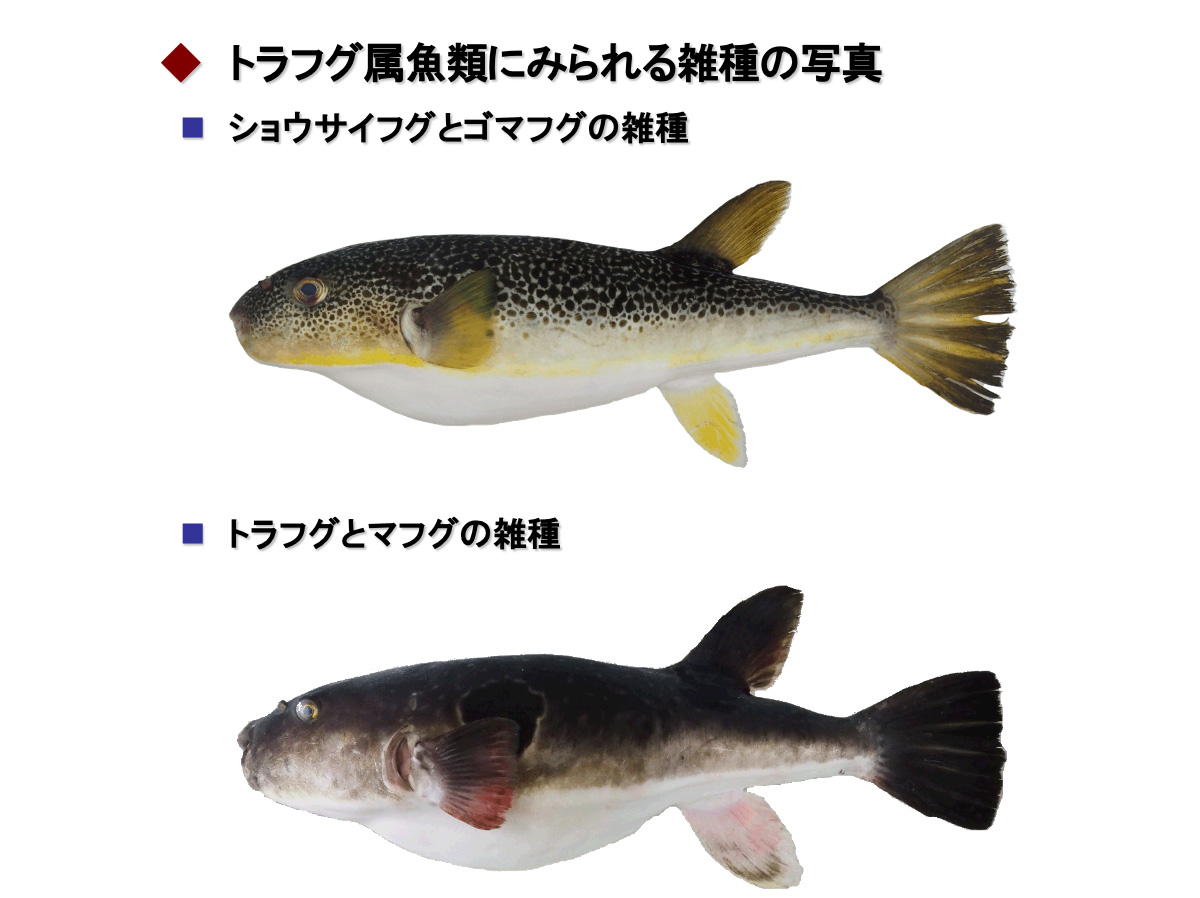
In pufferfish, hybrids between Takifugu snyderi and T. stictonotus began appearing in large numbers around 2012 and 2013. In this combination, the male parent is predominantlyT. snyderi and the female parent T. stictonotus. More recently, in Tokyo Bay, hybridization between T. rubripes and T. porphyreus has shown a similar pattern, with the male parentT. rubripes and the female parentT. porphyreus. In areas where many hybrids occur, a consistent pattern is observed: the more abundant species in the breeding grounds tends to be the male parent, whereas the less abundant species tends to be the female.

How do you determine the direction of hybridization in practice?
Fish genetic information consists of the nuclear genome and the mitochondrial genome located in the cytoplasm. Both genomes are transmitted from parents to offspring: the nuclear genome is inherited as one copy from each parent, whereas the mitochondrial genome is inherited only from the female parent. Because the mitochondrial genome is passed on through the egg cytoplasm, the maternal species can be determined by examining the mitochondrial DNA type.
Risks Associated with Pufferfish Hybridization under Rising Water Temperatures
You mentioned earlier that the more abundant species serves as the male parent, while the less abundant species serves as the female parent. Do you think this imbalance, in which one species is more common than the other in breeding grounds, is related to rising water temperatures, or is there another reason?
There may be several reasons, but it seems natural to interpret this as being related to climate change.
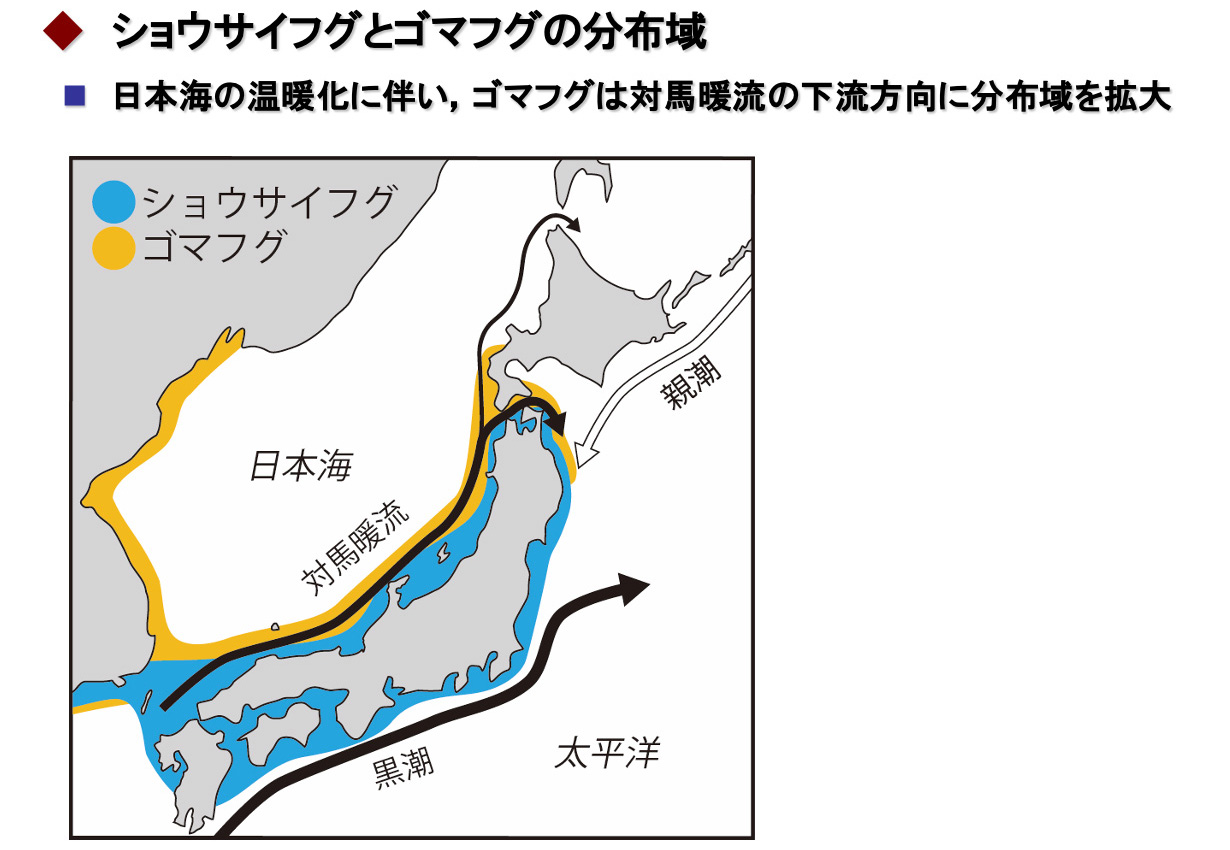
In the past, Takifugu stictonotus spawned in regions of the Sea of Japan influenced by the Tsushima Warm Current, whereas T. snyderi spawned in Pacific regions influenced by the Kuroshio Current. However, as warming in the Sea of Japan has progressed, the distribution of T. stictonotus is thought to have shifted northward and extended downstream along the Tsushima Warm Current, passing through the Tsugaru Strait and shifting clockwise around the Tohoku region until reaching the Pacific Ocean. As a result, small numbers of T. stictonotus began to enter the spawning grounds of T. snyderi on the Pacific side, which likely led to hybridization.
What negative impacts does pufferfish hybridization have?
Pufferfish differ markedly from most other fish in that they are toxic. The edible parts for each species are determined by Japanese regulations. For example, the skin of Takifugu rubripes is edible, whereas the skin of T. porphyreus is toxic and cannot be consumed. Because edible parts are determined through quantitative toxicity assessments of many individuals in each species, such quantitative evaluations have not yet been possible for hybrids due to their limited numbers. As a result, hybrids must currently be discarded. However, if the number of hybrids continues to increase, fisheries will face the additional challenge of having to identify and discard all hybrid individuals caught as bycatch.
Depending on the parental species combination, it may be difficult to identify hybrids among caught fish. If such hybrids are accidentally consumed, there is a risk of food poisoning.
Hybridization may also pose a risk to biodiversity, potentially leading to adverse genetic effects through gene flow between species or, in extreme cases, genetic merging of species.
Is there an established method to identify the toxic parts of hybrids?
Yes, the toxic parts can be identified scientifically. We are currently conducting a thorough investigation as part of a research project supported by the Ministry of Health, Labour and Welfare.
Is it possible that hybrid pufferfish could be marketed as food in the future?
In principle, this may become possible in the future. However, because the toxicity of hybrids remains largely unknown at present, all hybrids should, for the time being, be excluded from the market.
As I explained earlier, the skin of Takifugu porphyreus is toxic, whereas that of T. rubripes is not. We have recently found that hybrids, including those produced through backcrossing with T. rubripes, possess toxic skin similar to that of T. porphyreus.
However, if large numbers of hybrids begin to be caught continuously over a long period as a result of climate change, it may become possible to establish new rules based on thorough evaluations of their toxicity, with specific handling determined for each parental species combination.
The specific details of the rules will be required.
Yes. Because genetic analysis cannot be performed at distribution sites, the parental species of hybrids would need to be identified based on their external appearance. If reliable visual criteria can be established—for example, criteria that allow hybrids between Takifugu snyderi and T. stictonotus to be distinguished without involvement of other species—then it should be possible to establish appropriate rules.
Consider how the edible parts of each species are determined. Toxicity analyses are conducted on many individuals of each species over a long period of time.
Toxicity in pufferfish varies among individuals; even in Takifugu rubripes, only about two out of fifty individuals have highly toxic livers or ovaries. In addition, the organs exhibiting strong toxicity can change seasonally within the same species. Therefore, even if the proportion of highly toxic individuals is very small, consumption of a single toxic individual could cause poisoning, and safety standards must be based on the worst-case scenario.
The same applies to hybrids. Establishing appropriate countermeasures will require quantitative analyses of many individuals collected across different seasons.
The Importance of Quantitative Toxicity Assessment and of Training for Pufferfish Processors
If climate change progresses, how long do you think it would take before hybrids could be marketed relatively safely, after the quantitative analyses you mentioned have been completed?
For combinations of species that are caught in large quantities, quantitative toxicity analyses could be completed relatively quickly. Hybrids between Takifugu snyderi and Takifugu stictonotus are currently under analysis. There is already sufficient data, equal to or greater than the amount used when edible parts were previously determined for some species. As a result, safety levels are understood to some extent. On the other hand, as mentioned earlier, there are currently no visual identification criteria for these species combinations. It is also unclear how long it will take to incorporate scientific data into new rules.

The current highest priority is to prevent food poisoning caused by the misidentification of hybrids. In 2019, prefectural variations in the difficulty of certification for pufferfish processors were standardized following a notification issued by the Ministry of Health, Labour and Welfare. Because the pufferfish species captured vary by region, the content of the examination differs among regions. However, questions on basic knowledge and processing techniques have been standardized.
The notification stipulates that pufferfish processors are required to monitor the nationwide occurrence of hybrid pufferfish. This means that they are explicitly required to understand in which regions an increase in hybrids has been observed and the extent of their occurrence.
It also clearly states that periodic nationwide surveys of the occurrence of pufferfish hybridization shall be conducted, and that the results shall be provided to pufferfish processors through their respective prefectures. Amid the establishment of such a framework to address the increase in hybrid pufferfish, the Ministry of Health, Labour and Welfare added a new item entitled “Occurrence of Unidentifiable Pufferfish Nationwide, Including Hybrids” to the Risk Profile of Natural Toxins page on its website. The countermeasures have only just begun.
We hear that tropical pufferfish, as well as hybrids, have started to be caught in Kyushu.
I have received requests from Miyazaki and Kumamoto prefectures to identify whether pufferfish caught in their waters are Lagocephalus lunaris, a species of the genus Lagocephalus that is primarily distributed in Southeast Asia, including Vietnam. This species closely resembles the edible Lagocephalus spadiceus; however, its muscle tissue is highly toxic. In many cases in Japan, L. lunaris is not recognized until it causes food poisoning, which makes it particularly difficult to manage.
The reason Lagocephalus lunaris is difficult to identify is that its bycatch rate is very low. Over the past few years, I have conducted thorough checks but have not yet obtained any fresh specimens. Nonetheless, this species has caused food poisoning cases in recent years, which is quite problematic.
If ocean temperatures continue to rise at this rate, increases may occur not only in hybrid pufferfish but also in Lagocephalus lunaris. Therefore, I will continue to monitor the situation with heightened caution.

This article was written based on an interview conducted on November 25, 2024.
(Posted on May 20, 2025)
 DISCOVER MORE

